Category Archives: Countries

Rift Valley Institute Courses


2012 Rift Valley Institute Field courses: applications open

The Institute’s annual field courses offer an intensive, graduate-level approach to the history, culture and political economy of three subregions: Sudan and South Sudan; the Horn of Africa; and the Great Lakes. The courses consist of a six-day dawn-to-dusk programme of lectures, seminars and panel discussions, led by international specialists and scholars and activists from the region. Dates and locations are as follows:

– Sudan and South Sudan Course, Rumbek, S. Sudan, 26 May-1 June

– Horn of Africa Course, near Mombasa, Kenya, 16-22 June

– Great Lakes Course, Bujumbura, Burundi, 7-13 July

Download the prospectus at the site and/or apply online here. For further information (or to request the application form as a Microsoft Word document), email courses@riftvalley.net. Applications will be considered in order of receipt.

Voting in Yemen


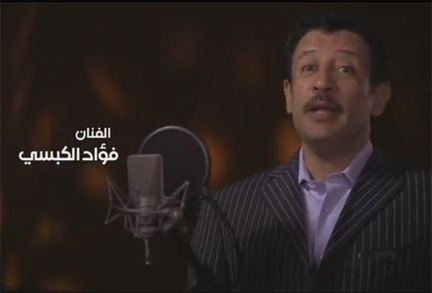
Fouad al-Kibsi and a new video on the Yemeni election

IRIN Middle East, SANA’A, 10 February 2012 – A presidential election to be held on 21 February in Yemen will open the door for a new chapter in the poorest and arguably most fragile country in the Arab world, says new Prime Minister Mohammed Salim Ba-Sindwa.

A successful election will pave the way for comprehensive reforms, said Ba-Sindwa, who was chosen to lead a national reconciliation government – part of a deal signed in November ending months of political turmoil.

Once elected directly by people, the new president will be constitutionally empowered to re-unite the divided army and replace corrupt officials in the various government institutions, Ba-Sindwa told IRIN in an interview.

“Our plan for the post-election period is to make the rule of law prevail nationwide. This is key to purifying the country from corruption and corrupt officials,” he said. “We will apply the law on the senior [official] before the junior; on the strong before the weak and on the rich before the poor.”

The prime minister’s words echo the optimism among some in the country, who see the election as the cornerstone of political transition. It is one of a string of steps stipulated in a power-transfer deal brokered by the Gulf Cooperation Council (GCC), after year-long nationwide protests against President Ali Abdullah Saleh’s 33-year rule dragged the country to the brink of civil war.

“The upcoming presidential election is the first step in this challenging journey,” Gustavo Gonzalez, senior country director for the UN Development Programme (UNDP) in Yemen, told IRIN. “Any positive transformation of Yemen in terms of stability, security and development will have a strong geopolitical impact on the region,” he said.

But the election faces massive challenges in feasibility and credibility, with the only candidate starting his campaign just two weeks before the election, various groups boycotting the election and violence continuing to affect parts of the country.

The sole candidate, current Vice-President Abdu Rabu Mansour Hadi, has the backing of the main opposition grouping and former Saleh supporters, but the electorate had no input in his selection and will not have a choice on election day beyond whether or not to vote. As Jane Novak, a US-based analyst and expert on Yemeni affairs, put it, “there isn’t a `no’ vote option on the ballot”.

Hadi was nominated by a parliament that deemed the country too fragile for possibly divisive competitive elections. But Hafez al-Bukari, president of Yemeni Polling Center (YPC), a local think-tank, worries the lack of competition will lead Yemenis to believe that democratic and competitive elections are not the ideal tool for change. Continue reading Voting in Yemen

World Press Photo of the Year 2011


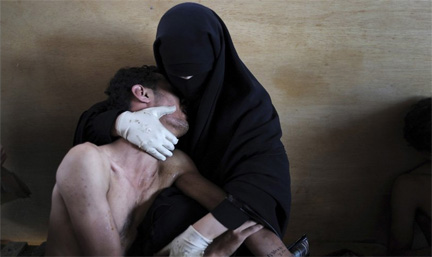
The international jury of the 55th annual World Press Photo Contest has selected a picture by Samuel Aranda from Spain as the World Press Photo of the Year 2011. The picture shows a woman holding a wounded relative in her arms, inside a mosque used as a field hospital by demonstrators against the rule of President Ali Abdullah Saleh, during clashes in Sanaa, Yemen on 15 October 2011. Samuel Aranda was working in Yemen on assignment for The New York Times. He is represented by Corbis Images.

Comments on the winning photo by the jury
Koyo Kouoh: “It is a photo that speaks for the entire region. It stands for Yemen, Egypt, Tunisia, Libya, Syria, for all that happened in the Arab Spring. But it shows a private, intimate side of what went on. And it shows the role that women played, not only as care-givers, but as active people in the movement.”

Nina Berman: “In the Western media, we seldom see veiled women in this way, at such an intimate moment. It is as if all of the events of the Arab Spring resulted in this single moment – in moments like this.”

Aidan Sullivan: “The winning photo shows a poignant, compassionate moment, the human consequence of an enormous event, an event that is still going on. We might never know who this woman is, cradling an injured relative, but together they become a living image of the courage of ordinary people that helped create an important chapter in the history of the Middle East.”

Manoocher Deghati: “The photo is the result of a very human moment, but it also reminds us of something important, that women played a crucial part in this revolution. It is easy to portray the aggressiveness of situations like these. This image shows the tenderness that can exist within all the aggression. The violence is still there, but it shows another side.” Continue reading World Press Photo of the Year 2011

The Druze, a “singular people”


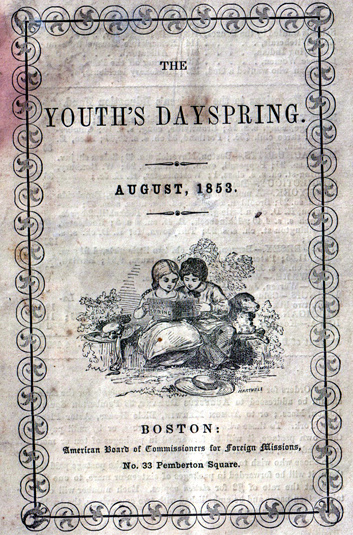
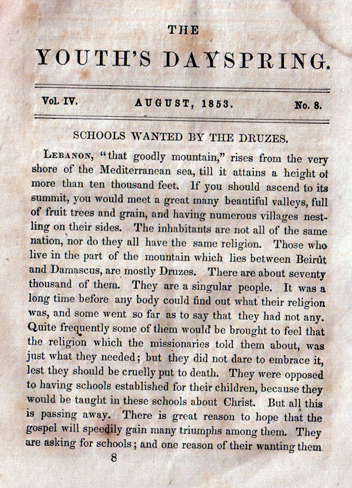
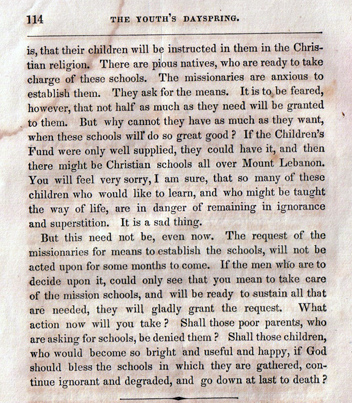
The current Islamophobia that sees states trying to adopt anti-sharia laws and painting Islam in the monocolored rhetoric of violent jihadism has a long history. So has the interest in converting those people in the Middle East who did not follow the kind of Christianity of the American and European missionaries. The Ottomans, who controlled much of the region up until the end of World War I, were rather tolerant in allowing Christian missionaries to operate in the Holy Land. I recently came across a little pamphlet published in 1853 by the American Board of Commissioners for Foreign Missions, based in Boston. This was a series that targeted young people. The first part of the issue I have is about the Druze, characterized as a “singular people” who may or may not actually have a religion. I attach the brief item here.


Behold the Huthis


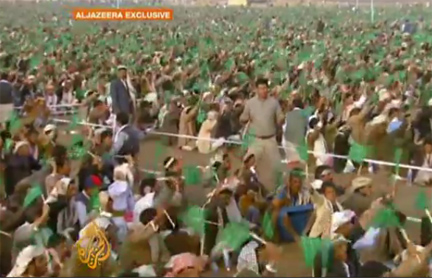
Huthi political rally near Sa’da this week

The ongoing political turmoil in Yemen has been overshadowed, and understandably so, by the increasing bloodshed in Syria, soccer riots in Egypt and lingering resistance by a few Qaddafi supporters in Libya. The past year of protests and revolution, unprophecied by political pundits, reminds me of a giant tire with so many holes that it is impossible to stop the air from escaping, even when one hole seems to be plugged. Meanwhile the road gets bumpier and bumpier in Yemen. Now for the latest recap… about-to-be-former President Ali Abdullah Salih is still in New York receiving medical treatment. He is in principle immune from prosecution, but certainly not immune from the continuing opposition to the excesses of his long rule in Yemen. A recently infused political form of Islam, known as Ansar al-Shari’a (with its own Facebook page) has all but replaced the infamous name Al-Qaida, in the south. The upcoming election, with one emerging compromise candidate for President, hardly seems headed for a democratic exercise apart from name only. Several aid workers were captured earlier this week and then released. And, behold the Huthis…

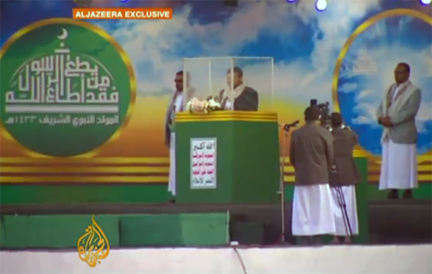
Al-Jazeera posts a video of a celebration of the Prophet Muhammad’s birthday in a remote area outside of the northern city of Sa’da. There on a platform etched against a barren landscape, a region less vibrant after almost eight years of conflict with the government that has left the ancient town of Sa’da in tatters, stood Abd al-Malik al-Huthi, the leader of the rebellion. Reports of his death at the hands of a government raid in 2009 are, as Mark Twain once noted about a premature obituary for himself, greatly exaggerated. While I do not doubt the sincerity of those present who celebrated the birth of the Prophet, the political flavor of the event certainly dominated the scenes shown on al-Jazeera.


Abd al-Malik al-Huthi speaking near Sa’da this week

Continue reading Behold the Huthis

Top Five U.S. misconceptions on Iran


By Hooman Majd, Politico, January 17, 2012

Top five, 10 or 100 lists are standard at the end of the year. Though the Iranian year doesn’t end for roughly two months, given the escalating tensions between Washington and Tehran, with threats and counter threats over the Strait of Hormuz — to say nothing of most GOP presidential candidates’ views on what to do about Iran — it might be useful to compile one on the growing Iran crisis, early 2012 here and late 1390 there:

1) More severe sanctions will eventually cause the regime to blink.

Um, no. Thirty-plus years of sanctions have had no effect on Tehran. None. The regime can’t blink — even if it wanted to. Not after it has spent energy, money and every tool it has convincing its people that the nuclear program is a matter of national pride, that the West wants to prevent Iranians from enjoying the fruits of technological advancement and that their suffering under the sanctions is for the country’s greater good.

The regime’s credibility has already suffered because of the opposition protests in 2009 and 2010. So what would it have left if it caved to foreign demands that even the opposition describes as unreasonable?

2) Increasing sanctions will cause the Iranian people to hate the regime even more, leading to an uprising against the ayatollahs.

No. The Iranian people may blame their government for economic mismanagement, as well as human-rights abuses — but most won’t blame it for U.S. actions. Similarly, Iranians may blame President Mahmoud Ahmadinejad for exacerbating domestic problems or creating problems with the West because of his rhetoric. But they don’t blame him for, say, sanctions that prevent Tehran from buying parts for its aging airplanes, which fall out of the sky with alarming frequency.

Think about it: When a nation is attacked, or under severe external pressure, it usually blames the external enemies, not its own leaders. If you factor in the assassinations of scientists on the streets of Tehran and mysterious factory explosions, sanctions and threats may make life miserable for Iranians but are unlikely to cause them to overthrow their rulers. Continue reading Top Five U.S. misconceptions on Iran