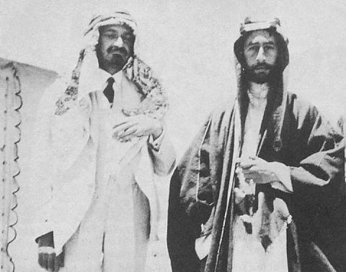
In 1918 the future king of Iraq, Faysal, met the Zionist leader Chaim Weizmann in Syria
by Anouar Majid
Â
As Arabs continue to agitate for freedom in their nations, no leading Arab or Muslim intellectual has been able to articulate a well thought-out program for the future of his or her country, let alone for the amorphous entities known as the Arab and Muslims worlds. Plenty of euphoria is being generated by getting rid of despots, but the expectations generated by the uprisings in Tunisia, Egypt, and Libya, as well as structural reforms in other places, have been limited to the language of morality, whose champions, as is amply evident by now, are Muslims wearing various garbs of moderation to reassure secularists in their midst and assuage the rest of the world’s apprehensions.
Â
Many Muslim citizens seem to trust pious politicians to establish a culture of accountability and transparency, fight corruption, institute democratic reforms, guarantee impartial justice, rebuild their nations’ abysmal infrastructure, reduce unemployment, and lead their countries to a new age of prosperity. In their view, the miracle of development would happen magically, through no more than the strict adherence to Islamic ethics. No manifestos or declarations are needed to chart a clear path; faith, and faith alone, would be enough to cleanse Arab societies of decades of decadence. Constitutions are being written or rewritten, to be sure, but such documents don’t convey the power of vision embodied in other forms of narrative, like the American Declaration of Independence (1776) or, better still, Theodor Herzl’s The Jewish State (1896) and his not-so-utopian novel Old New Land (1902).
Â
Theodor Herzl may strike Arabs and Muslims as an odd choice to invoke in these heady days of freedom and hope. He is, after all the leading figure of modern Zionism and the architect of the State of Israel. He is also blamed for uprooting Palestinians from their native land and condemning them to a tragic fate. Continue reading Looking for an Arab Herzl →