Category Archives: Palestine

Following Seward’s Folly: #4 The Dome of the Rock


Illustration of Cairo from Seward’s Travels (1873)

William H. Seward, the American Secretary of State who is forever linked with the “folly” of acquiring Alaska from the Russians, spent a year traveling around the world near the end of his life. In three previous posts I posted the comments he and his daughter made about India and Aden, and Egypt. The journey continued to Palestine and the city of Jerusalem:

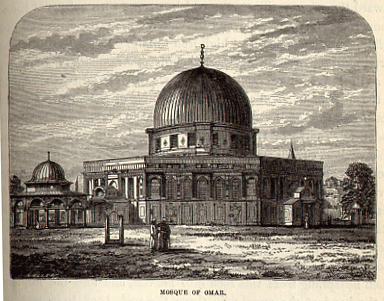
Yussef Effendi, with the brother and secretary of the pacha, attended us to the Mosque of Omar. It is only within the last five years that this mosque, scarcely less sacred in the eyes of Mussulmans than the Church of the Holy Sepulchre is in ours, has been opened to Christian travelers. Even now a careful, though somewhat disguised surveillance, is practiced over them. The mosque stands in an area enclosed with a high, parapeted wall, overlooking the vally of Jehoshaphat, and confronting the Mount of Olives. This occupies one-sixth of the land of the entire city. On the eastern side of this wall is a gate-way, built of marble, called by the Mussulmans the “Golden Gate,” which they are fond of representing as the “gate of the temple called Beautiful,” but its modern architecture does not support that claim. It is only interesting from the tradition that it was closed with the Roman conquest, and has never been reopened. The so-called Mosque of Omar is not single. It consists of two distinct mosques, placed at some distance from each other – the one here named Kubbet-es-Sukhrah, or “the Dome of the Rock,” commonly called the Mosque of Omar, and the Mosque-el-Aqsa. Though differing entirely from the Church of the Holy Sepulchre, the Mosque of Omar is not less unique and peculiar in its sacred antiquities. Twelve hundred years ago, on the surrender of the Greek Patriach, the Caliph Omar demanded to be shownt he site of the Jewish temple. He was taken to the sacred rock, he knelt and prayed over it, and he built over it a mosque, which, with subsequent repairs, is the present “Dome of the Rock,” or Mosque of Omar. In architectural design and execution it rivals the finest in Cairo and Constantinople. Continue reading Following Seward’s Folly: #4 The Dome of the Rock
Burn those Scofield Bibles, baby


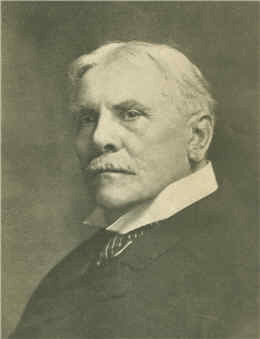
Cyrus Ingerson Scofield, 1843-1921

[Webshaykh’s Note: As someone who grew up on the Scofield Bible, I offer this critique from the peanut gallery.]

Zionism’s un-Christian Bible
Scofield Bible made uncompromising Zionists out of tens of millions of Americans.

By Maidhc O. Cathail, Middle East Online, November 25, 2009

The Boycott, Divestment, Sanctions for Palestine campaign should widen its scope to target non-Israeli companies who contribute significantly to the oppression of Palestinians. As part of this broader strategy, priority should be given to one of the most egregious offenders, the prestigious British publisher, Oxford University Press. As unlikely as it may seem, the world’s largest university press is responsible for one of the greatest obstacles to justice for Palestinians – The Scofield Bible.

Since it was first published in 1909, the Scofield Reference Bible has made uncompromising Zionists out of tens of millions of Americans. When John Hagee, the founder of Christians United for Israel, said that “50 million evangelical bible-believing Christians unite with five million American Jews standing together on behalf of Israel,” it was the Scofield Bible that he was talking about.

Although the Scofield Reference Bible contains the text of the King James Authorized Version, it is not the traditional Protestant bible but Cyrus I. Scofield’s annotated commentary that is the problem. More than any other factor, it is Scofield’s notes that induced generations of American evangelicals to believe that God demands their uncritical support for the modern State of Israel. Continue reading Burn those Scofield Bibles, baby

The Land and the Book #5: Dead Sea Reflections


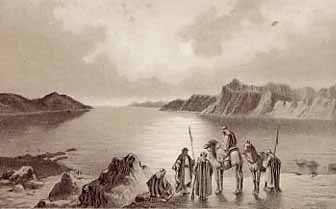
The Dead Sea from Thomson’s “The Land and the Book”, opp. p. 614

Almost 150 years ago one of the most popular travel accounts of the Holy Land was penned by an American missionary named William M. Thomson. Born in Ohio, my own home state, the 28-year old Thomson and his young bride arrived in Lebanon in 1834 as Protestant missionaries. This was a mere 15 or so years after the first American missionaries had made the Holy Land a mission field. At once an entertaining travel account and Sunday School commentary on the places and people of the Bible, this may have been one the most widely read books ever written by a Protestant missionary.


Reading Thomson is like reading one of the early English novels. The language is less familiar, although still thoroughly Yankee and the devotional tone has long since disappeared for a readership buying out The Da Vinci Code as soon as it hit the bookstores. The biblical exegesis, literalist yet frankly pragmatic at times, is intertwined with astute and at times humorous accounts of the people Thomson met along the way. But the style is not at all dry or discouragingly didactic. From the start Thomson engages in a dialogue with the reader, making the text (which stretches over 700 pages in the 1901 version) a rhetorical trip in itself.

Among the wonders described by Thomson is the Dead Sea, which as a devout literalist he interpreted through the biblical tale of the brimstone destruction of Sodom and Gomorrah. Yet, he is quite interested in the geologic and chemical character, as he notes: Continue reading The Land and the Book #5: Dead Sea Reflections

The Land and the Book #4: Bringing in the Sheaves


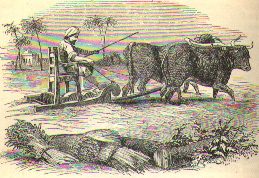
Threshing Sledge or Mowrej from Thomson’s “The Land and the Book”, p. 540

Almost 150 years ago one of the most popular travel accounts of the Holy Land was penned by an American missionary named William M. Thomson. Born in Ohio, my own home state, the 28-year old Thomson and his young bride arrived in Lebanon in 1834 as Protestant missionaries. This was a mere 15 or so years after the first American missionaries had made the Holy Land a mission field. At once an entertaining travel account and Sunday School commentary on the places and people of the Bible, this may have been one the most widely read books ever written by a Protestant missionary.


Reading Thomson is like reading one of the early English novels. The language is less familiar, although still thoroughly Yankee and the devotional tone has long since disappeared for a readership buying out The Da Vinci Code as soon as it hit the bookstores. The biblical exegesis, literalist yet frankly pragmatic at times, is intertwined with astute and at times humorous accounts of the people Thomson met along the way. But the style is not at all dry or discouragingly didactic. From the start Thomson engages in a dialogue with the reader, making the text (which stretches over 700 pages in the 1901 version) a rhetorical trip in itself.

While hardly free from Yankee hubris and missionary zeal, Thomson’s observations are often useful as well as colorful, especially when accompanied by illustrations. Consider, for example, this description of threshing on a visit to Yebna, about three and a half hours from Haifa through Wadi Hanayn in Palestine: Continue reading The Land and the Book #4: Bringing in the Sheaves

Transhumance in Tarkumia

Transhumance in Tarkumia: An Exploration of Aspects of Palestinian Summer Identity This Week in Palestine

“Exploration is not so much a covering of surface distance as a study in depth: a fleeting episode, a fragment of landscape or a remark overheard may provide the only means of understanding and interpreting areas which would otherwise remain barren of meaning.” Claude Levi-Strauss, Tristes Tropiques (1955)

The three-month summer vacation from schools liberates Palestinian families from the constraint of the temporal rhythm of school and from the constriction of space. The students are free, but the parents are equally liberated. This temporal space provides ample opportunities for exploration of self, of other, of place, and of time by means of travel. Travel is usually thought of as a displacement in space. This is an inadequate conception. A journey occurs simultaneously in space, in time, and in the social hierarchy. Each impression can be defined only by being jointly related to these three axes, and since space is itself three-dimensional, five axes are necessary if we are to have an adequate representation of any journey.

Travel is a form of exploration, a spark to the imagination, a quest, commerce, escape, and a means of self-discovery. Continue reading Transhumance in Tarkumia

Gender and Justice in Palestine


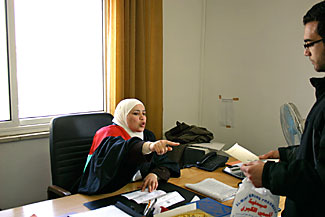
Khouloud el-Faqeeh argues a legal point in her West Bank office. In March, she became one of the two first female Islamic judges in the Middle East.

New female judge transforms Islamic court

Khouloud el-Faqeeh is part Judge Judy, part Sunday School teacher.
By Ilene R. Prusher,The Christian Science Monitor, May 10, 2009

Ramallah, West Bank:

Khouloud el-Faqeeh has shattered the glass ceiling of Islamic jurisprudence.

After years of pushing to break into the all-male ranks of sharia judges in the Palestinian territories, she finally secured a post after scoring among the best – along with another woman – in a recent test for new jurists. They are widely considered to be the first female sharia judges in the Middle East.

Now, Ms. Faqeeh is setting a new tone in her Ramallah courtroom, where defendants are often shocked to see a woman on the bench. With a style that’s part Judge Judy, part Sunday School teacher, she’s on a mission to change her society, case by case. But sometimes, even the most progressive intentions won’t overcome powerful social forces, such as those driving Miryam Abed-Nabi, a newlywed who came to court recently to finalize a divorce. Her husband – Fahmi Awadullah, a man twice her age – took her as a second wife just a few months ago. But the marriage infuriated his adult sons, who worried about their portion of his inheritance. Continue reading Gender and Justice in Palestine

In Pursuit of the Exotic

Museum Exhibits

January 29 to March 29, 2009: Napoleon on the Nile: Soldiers, Artists and the Rediscovery of Egypt

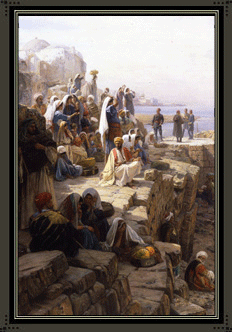
March 24 through April 30, 2009: In Pursuit of the Exotic: Artists Abroad in 19th Century Egypt and the Holy Land

New York, New York – The Dahesh Museum of Art and Syracuse University Art Galleries today announced the formation of a partnership, which will include the Museum’s organizing several exhibitions annually from its own collection of 19th-century art in the academic tradition, complemented by works in the University’s rich collection, for presentation at the SU Art Galleries in Syracuse, as well as The Palitz Gallery/ Lubin House, located on 11 East 61st Street, off Fifth Avenue. The Palitz Gallery has recently attracted artworld attention with the exhibition Michelangelo: the Man and the Myth on view through January 4th 2009. Continue reading In Pursuit of the Exotic

Reflections on Gaza


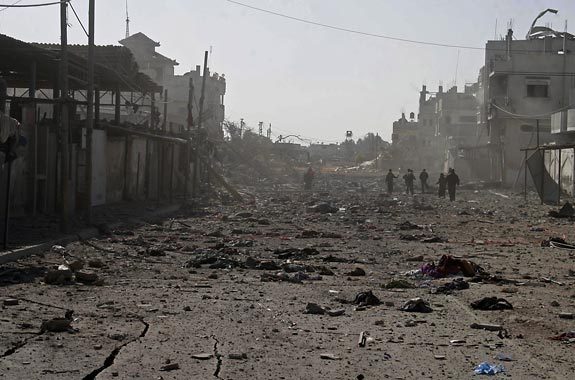
Palestinians walk in the rubble following an Israeli airstrike Wednesday in Rafah refugee camp in the southern Gaza Strip. Photo by Khaled Omar, The Associated Press.

Why did Israel start this War?
by Amr al-Azm, Brigham Young University

There are several answers to this question depending on which angle you look at it from.

The facts on the ground (Time Line) run as follows:

June 19 – An Egyptian brokered truce begins between Hamas and Israel. It calls for Hamas to stop cross-border rocket fire and for Israel to gradually ease its embargo on Gaza.

July 27: Israel kills Shihab al-Natsheh, a senior Hamas fighter, in his house in the West Bank city of Al-Khalil. Hamas protests action and Israel claims that the West Bank is not covered by the ceasefire.

November 5: Israel raids supposed smuggling tunnels in the Hamas-controlled region. Six Palestinians killed in the attack. Hamas responds by firing several dozen rockets and mortar shells at western Negev in Israel in retaliation. No casualties or property damage is caused, but three women are treated for shock. Continue reading Reflections on Gaza