Category Archives: Art

Inscribing The Body


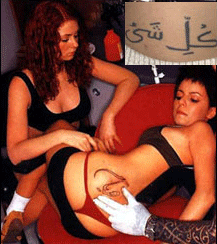
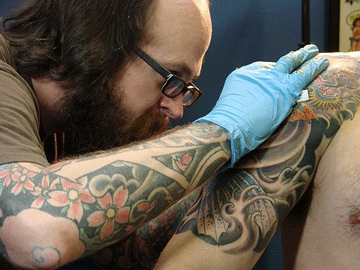
1. John MacIntyre Tattooing in Los Angeles

Inscribing The Body: Tattoos in Traditional and Modern Cultures

by el-Sayed el-Aswad
University of Bahrain

From ancient Egyptian culture, whence comes early evidence of tattooing, to contemporary art, the body has been employed as a living canvas for inscriptions and designs such as those of tattoos embodying symbols, icons, archetypes and mythological or folkloric themes. Tattoos, especially those consisting of lines and dots, have been found on preserved mummies, including that of Amunet, a priestess of the goddess Hathor at Thebes dating back to the XI Dynasty, 2000 B.C.E. Although amulets are widely used for protective, magical and ascetic purposes (and were predominantly used in ancient Egypt), they are replaceable or not permanent. Notions related to authenticity, ethnicity, gender, identity, sanctity, fertility, femininity, masculinity, class, and aestheticism, to mention a few, are inscribed permanently in various forms on the body.

Though tattooing is prohibited in Islam, because it is viewed as a factor in mutilating, maiming or altering the body’s physical features, local or traditional practices are still existent among the folk in various Muslim societies. Continue reading Inscribing The Body
The Kaaba’s New Kiswah


[Note: For a Youtube documentary on the Saudi Kiswah Factory, click here.]

By Manal Homeidan, Asharq Alawsat, December 17, 2007

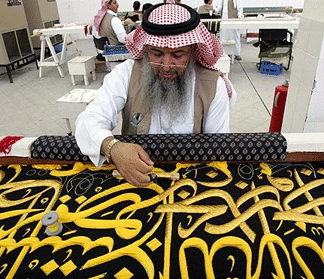
Jeddah, Asharq Al-Awsat – Following their departure from Mecca, millions of pilgrims have started to make their way to Mount Arafat. Coinciding with this unchanged ritual is the tradition of changing of the Kaaba’s ‘kiswah’, the cloth that adorns the Kaaba made of black silk and embroidered with gold calligraphy.

This event is customarily attended by the gate-keepers of the Kaaba and technicians from the Kiswah Factory, which has been manufacturing the fabric that adorns the Kaaba for the past six decades. These technicians employ a special mobile escalator so as to remove the old cloth and cover it with the new kiswah, one day before the first day of Eid ul-Adha. Continue reading The Kaaba’s New Kiswah

Baghdad in the 80’s

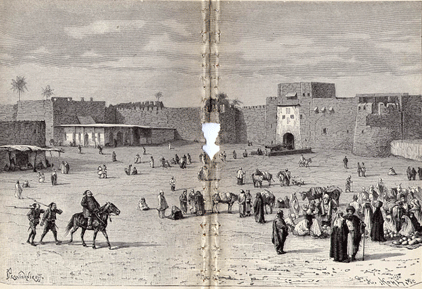
Baghdad in the 1880’s, in case you are curious.

As university libraries desperately look for space to hold old and rarely used volumes, many books fall by the wayside. My university holds an annual sale in which most of the books being discarded deserve to be. But then there are the occasional old and rare books that I cannot bear knowing will end up in a dumpster or landfill. One of these that I recently picked up for a dollar was Geographische Charakterbilder aus Asien. Aus den Originalberichten der Reisenden gesammelt von Dr. Berthold Volz mit 87 Illustrationen (Leipzig, Fues’s Verlag, 1887, 384 pages). The discursive Althochdeutsch aside, this text is a bit of print paradise for the lover of 19th century lithographs, all 87 of them. Continue reading Baghdad in the 80’s

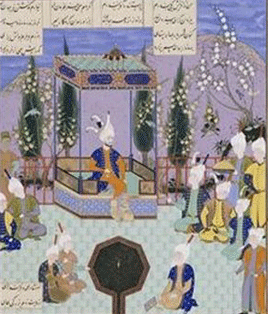
A Royal Ransom for the Book of Kings

Looking for the perfect Christmas or Eid present? Well, if you have little spare cash but love rare books, why not mortgage the farm and go for one of the most beautiful illustrated manuscripts of all time, The Shahnameh of Shah Tahmasb Safavi in its Houghton manuscript form. This facsimile set of two volumes was edited by Martin Bernard Dickson and Stuart Cary Welch in 1981 and published by the Fogg Art Museum of Harvard University. And it is available for only $1495.00 plus shipping. Here are the details and it can be ordered by clicking here:
Continue reading A Royal Ransom for the Book of Kings

The Calligraphic Tattoo

Tattoo artists are often skilled calligraphers, but what do you do if you want a tattoo in Arabic script? If you can’t make it to Patterson, New Jersey or some hippy stranded in Casablanca, there is always the Internet. Google to the rescue:

If you are considering having Arabic writing tattooed, then you need the correct translation for the lettering as well as the outline to give to the tattoo artist. We can provide you with this service. We translate using either Syrian Arabic, Israeli Arabic, or Druze Arabic.

Ordering a translation from us is simple:

1. Go to the translation-page and make payment.

2. Include the word or phrase that you want translated

3. Within a few hours-days, we will email the translated phrase or word back to you. Your translation comes in the form of a picture (jpeg, jpg) which you can print out on your printer and take to your tattoo artist.

For Arabic you have to double your pain: the needle and pulling out your credit card to have an expert spell out “Ummi” or “Qalbi.” Just don’t let them sell you any “khara.”

By the way, when I tried the “contact” click, I found the following message:

This website is for sale.
Please send your purchase offer to:
mail at jandrewsmedia.com

The law of supply and demand strikes again. Ma’a laysh.

The Letters of Badr Shakir al-Sayyab: #5


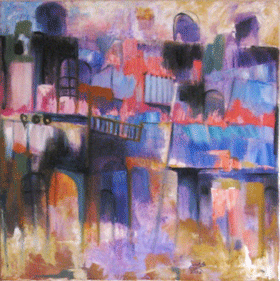
Mohammed Jafaar, Baghdad Things, Oil on Canvas, 2006

[Note: This is the fifth in a series of translations of selected letters of the noted Iraqi poet Badr Shakir al-Sayyab. For more information on the poet, click here.]

Letter #5 (6//19/1947)

Baghdad

My Kind and Respected Brother, Dr. Suheil Idris,

My sincere best wishes and scented greetings to you.

Your kind letter has overwhelmed me with joy. I am very appreciative of your good opinion of me, and I hope to remain worthy.

In your letter, you inquire as to what our brother, Kathem (Jawad), and I meant when we said in our commentary on your splendid novella, “A letter to My Mother,” that it appeared at the most opportune time. Explaining this could be very lengthy, but trust me that we intended to speak to you about this even if you had not asked. This is a topic that concerns every man of letters and every man who is faithful to his people and nation and who is concerned with their future and the future of Arabic literature. Continue reading The Letters of Badr Shakir al-Sayyab: #5

Creative Reckoning Today

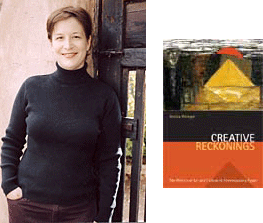
[Note: If you are in the New York Metropolitan area, you may be interested in a lecture by Jessica Winegar at Alwan for the Arts this evening.]

Creative Reckoning: The Politics of Art and Culture in Contemporary Egypt Creative Reckoning

Book Reading by Jessica Winegar

Tuesday, September 25, 2007 7 PM

Free and open to the public

Refreshments will be served

Creative Reckonings: The Politics of Art and Culture in Contemporary Egypt (Stanford University Press, 2006) is an ethnographic study of the intense debates over cultural authenticity and artistic value that occur in a postcolonial society undergoing market liberalization. Based on 33 months of fieldwork in Egypt, the book examines the creation, circulation, and commodification of art in the context of a globalizing cultural economy. Continue reading Creative Reckoning Today