Category Archives: Art

With Ratzel in North Africa

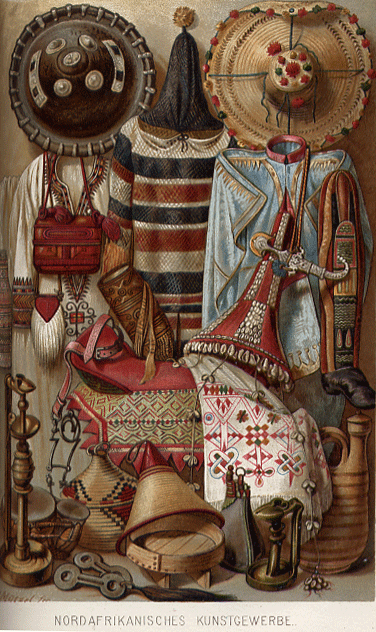
One of the most important German geographers of the late 19th century was Friedrich Ratzel (1844-1904), whose three-volume Völkerkunde (Leipzig and Vienna, Bibliographisches Institut, 1890) is one of those encyclopedia cultural accounts that circulated just as the discipline of anthropology was getting off (in this case literally “on”) the ground. While now a text for curiosity rather than critical scholarship on peoples and cultures, Ratzel’s work is still a fascinating portrayal of cultures being colonized for both revealing the biases of the day and the then-contemporary illustrations of people and material culture. My university library recently divested itself of uncirculated books in storage and one of these was an 1890 edition of the third volume on “Die Kulturvölker der Alten und Neuen Welt.” Whether it was the eye-watering althochdeutsch script of the volume or the mere fact it was written in German, no student or professor at Hofstra ever checked this volume out.

In salvaging a third of Ratzel’s opus for a mere dollar, I could not help but be drawn to the illustrations, mostly lithographs but with a few beautiful color plates. Continue reading With Ratzel in North Africa
Strolling Through Tarlabasi


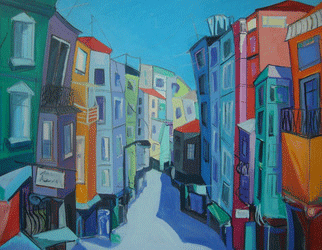
Tarlabasi, 2004, by Gamze Olgun, Oil Painting.

by Jenny White
Kamil Pasha Blog
Posted on January 24th, 2008

Tarlabasi is a district on the backside of the Beyoglu hill falling from the crest at Pera – where all the foreign embassies were in Ottoman times, now demoted to consulates – down in the direction of the Golden Horn. In The Abyssinian Proof, Kamil chases a wily criminal to his lair in Tarlabasi. The district is picturesque in the way of crumbling majesty on its last legs (a large part of Tarlabasi will be razed in 6 months, probably replaced by hotels). The steep, narrow lanes are strung with laundry, bustling with locals shopping at an outdoor market crammed into one of the lower streets. At the top of the hill near Istiklal Bouelvard are some lovely stone houses, now ruined or so shabby as to be nearly uninhabitable. A large stone house cracked down the side like an egg is posted for sale. As you walk down the hill, the houses become smaller, shabbier, sometimes outright ruins, less stone and more wood. In Ottoman times, Catholics and Greek Christians (Rum) lived near the top — shop owners, employees of the embassies — and poorer families near the bottom. Taylor Pepo’s apprentice lived in Tarlabasi with his family (The Abyssinian Proof). Today Tarlabasi is inhabited by Roma (gypsy), Kurds, the very poor, and social outcasts of various kinds. Continue reading Strolling Through Tarlabasi

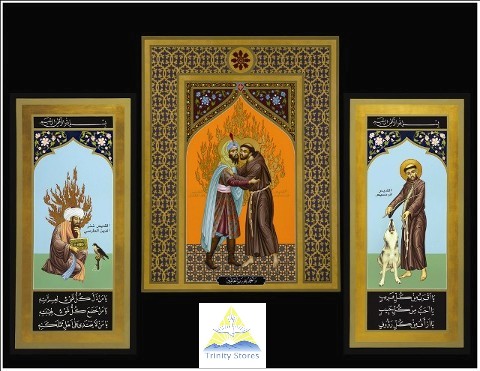
Brothers of the Book

by Robert Lentz

In 1219 St. Francis and Brother Illuminato accompanied the armies of western Europe to Damietta, Egypt, during the Fifth Crusade. His desire was to speak peacefully with Muslim people about Christianity, even if it mean dying as a martyr. He tried to stop the Crusaders from attacking the Muslims at the Battle of Damietta, but failed. After the defeat of the western armies, he crossed the battle line with Brother Illuminato, was arrested and beaten by Arab soldiers, and eventually was taken to the sultan, Malek al-Kamil.

Al-Kamil was known as a kind, generous, fair ruler. He was nephew to the great Salah al-Din. At Damietta alone he offered peace to the Crusaders five times, and, according to western accounts, treated defeated Crusaders humanely. His goal was to establish a peaceful coexistence with Christians.

After an initial attempt by Francis and the sultan to convert the other, both quickly realized that the other already knew and loved God. Francis and Illuminato remained with al-Kamil and his Sufi teacher Fakhr ad-din al-Farisi for as many as twenty days, discussing prayer and the mystical life. When Francis left, al-Kamil gave him an ivory trumpet, which is still preserved in the crypt of the Basilica of San Francesco in Assisi.

This encounter, which occurred between September 1 and 26, is a paradigm for interfaith dialog in our time. Despite differences in religion, people of prayer can find common ground in their experiences of God. Dialog demands that we truly listen to the other; but, before we can listen, we must see the other as a precious human being, loved by God. There is no other path to peace in this bloody 21st century. Continue reading Brothers of the Book

Art, Religion and History: The Case of Bahrain


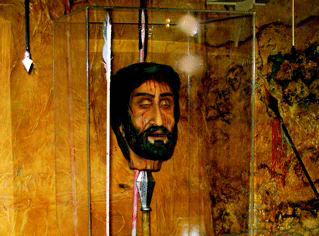
Figure 1. A Replica of the head of Imam Husayn

by El-Sayed el-Aswad
University of Bahrain

Art, in its broad meaning encompassing performance and non-performance forms of expression, plays a significant part in Bahraini imagination and folk culture. The focus here, however, will be on the innovative aspects of Shi‘a vernacular art. Among the Shi‘ti people of Bahrain there has been a shift from traditional or old-fashioned styles of mourning and commemorating the tragic events of ‘Ashura, or the tenth of Muharram (the first month of Islamic calendar in which Imam Husayn, grandson of the prophet Muhammad, was martyred) to a modern way of expression reflected mostly in the art.


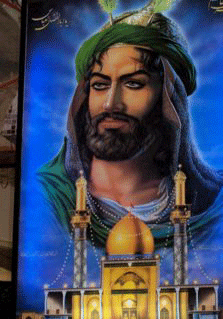
Figure 2. Imaginary of al-‘Abbas, the sibling of Imam Husain

During the first ten days of Muharram, colorful forms of calligraphy, iconography, replicas (tashihat), ritual and visual representations are presented and meticulously enacted in exhibitions and in the streets of Manama, the capital city of Bahrain, as well as in most of the villages with Shi‘a majorities. Continue reading Art, Religion and History: The Case of Bahrain

A 16th Century Caravan

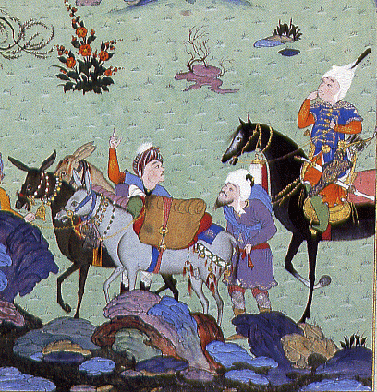
The title of this watercolor painting by ‘Abdol-‘Aziz is “Zal is sighted by a Caravan” and is part of a scene from the Shahname in which the hero Rostam’s father, known as Zal, was born an albino and exiled by his superstitous father to the top of a mountain, where he was rescued by the legendary bird known as a simurgh. The caravan, shown here, saw Zal and reported this to his royal father, who was glad his son was alive and would be the ehir to the throne. The painting was done in Tabriz around 1525 CE.

Illustration from Abdolala Soudavar, Art of the Persian Courts (New York: Rizzoli, 1992), p.370.

Woman by a Fountain

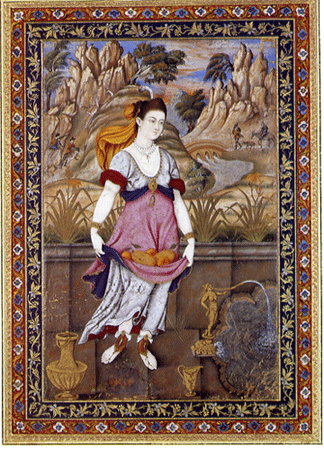
We are accustomed to Persian miniatures which depict the “Oriental” face, but later Persian art at times draws on Italianate style. The example above is entitled “Woman by a Fountain” and was painted by ‘Ali-Qoli Beyg Jebadar, around 1660 ce, probably in Isfahan.

Illustration from Abdolala Soudavar, Art of the Persian Courts (New York: Rizzoli, 1992), p.370.