Category Archives: Poetry

Ottoman Music


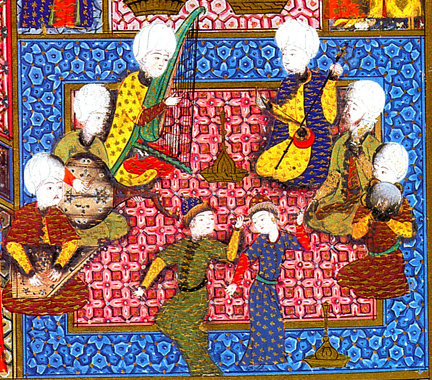
Ottoman ensemble in a Suleymaniye manuscript

For anyone interested in Ottoman music, or music as such, check out the nice webpage just uploaded in the Ottoman History Podcast.

Ottoman Classical Music: History and Transformations
with Mehmet UÄŸur Ekinci
74. Music of the Ottoman Court

While the Ottoman Empire was undoubtedly home to rich and diverse musical traditions, the subject of Ottoman music has often evaded historical analysis due to the scant nature of pre-nineteenth century sources on the subject. In this podcast, Mehmet Uğur Ekinci provides a general outline of the history of music during the Ottoman period along with its various waves of transformation and discusses his upcoming publication of Kevserî Mecmûası, an eighteenth century musical treatise that provides a rare glimpse of notation in Ottoman music before the nineteenth century. We also provide a number of recordings of Ottoman music composed during different periods.

The Barbarian Has to Keep It Real


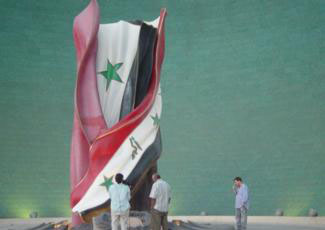
Sinan Antoon (far right) near the Symbolic Tomb at the Martyr’s Monument in Baghdad (2003). Image from Encounter Productions.

The Barbarian Has to Keep It Real: Interview with Jadaliyya Co-Editor Sinan Antoon

Interview with Nahrain Al-Musawi, al-Jadaliya, May 03 2012

[The following interview with Jadaliyya Co-Editor Sinan Antoon was conducted by Nahrain Al-Musawi and originally published in Al-Akhbar English on 2 May 2012.]

Sinan Antoon is an Iraqi-born novelist, poet, translator, filmmaker, and professor. His 2003 widely translated novel I’jaam is a fictional prison memoir. The book is ironic and haunting as it reflects the absurdities of Saddam Hussein’s Baathist regime, futile attempts to escape censorship, and prisoners going mad as a final act of revolt.

Antoon returned to Baghdad in 2003 and filmed About Baghdad, documenting the exhilaration and despair of Iraqis experiencing the fall of the Baathist regime and then the US occupation. He produced two collections of Arabic poetry, which have also been translated into English.

His most recent project is a translation of Mahmoud Darwish’s In the Presence of Absence (2011). Antoon has been at home in the US for decades, so when once asked about the distinction of being an Arab-American writer, he replied, “It’s not easy being a barbarian in Rome. The Romans rarely listen, but the barbarian has to keep it real.”

In this interview, Antoon discusses the distinction of being a barbarian, “an outsider, a stranger,” in the US, as well as the trope of closure that frames the recent US withdrawal from Iraq, sectarianism discourse, and the unique quality of spatial fragmentation and division that now characterizes Baghdad – once Antoon’s home.

Nahrain al-Mousawi (NM): When and how did you leave Iraq? Can you talk about that experience a little bit?

Sinan Antoon (SA): I was supposed to leave Iraq in August 1990 to continue my studies abroad, but Saddam invaded Kuwait on August 2 and there was a travel ban. I survived the war and left in April 1991 after the war was over and the travel ban was lifted. I had always wanted to leave. Living under an authoritarian regime isn’t fun, especially for an aspiring writer who wasn’t willing to write in praise of the leader and his wars. (Some of those who made their names praising Saddam and his wars are running around now posing as patriotic anti-imperialists).

So I took the bus from Baghdad to Amman like thousands of Iraqis did and would do throughout the 1990s and later. I was happy to escape, but I shed a few tears as the bus drove away. I knew that I was leaving some irretrievable parts of my self and my life behind. I stayed in Amman for a few months and then was able to come to the US to do my graduate studies. I worked and did an MA in Arab Studies at Georgetown, then went on to get a doctorate in Arabic literature at Harvard. Continue reading The Barbarian Has to Keep It Real

A Poem for Mother’s Day


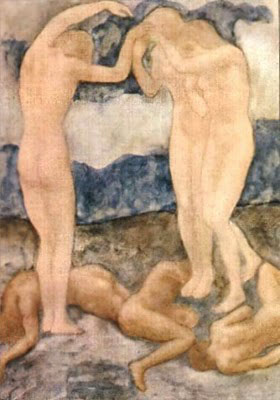
Art by Kahlil Gibran

by George N. El-Hage, May 13, 212

You are mother to the universe and to the stars.
The trees and the flowers are your children.
You are a symbol of eternity, for you are immortal
Like the oceans, the lakes and the rivers.
The sun and the seasons are your children.

You give all and take nothing.
You are nature in its diversity and bounty.
You are fire, the eternal flame.
You are the lava and the volcano.

You are Mary, the Blessed One, mother of the Crucified,
Yet mother to no one, for she remained a virgin.
You are mother to all humanity,
And all creations are your children. Continue reading A Poem for Mother’s Day

Tabsir Redux: A Rose for the Last Days

by Rana al-Tonsi [Translated from Arabic by Sinan Antoon]

On one foot
like a humiliated beggar I limp
past all the swinging doors
and the flags that are taken down from their masts . . .
The sidewalk was never my friend
but it embraced me those times
when the crying was tough and bitter

In my country
soldiers go to a war
where they never fight
In every coffeehouse or square
under the feet of the sick, the sad and insane
you can glimpse the trace of a rose
thrown into the arms of nurses
in lonely rooms inhabited by wailing,
a rose drawn in blood. Continue reading Tabsir Redux: A Rose for the Last Days

Prologue to Ozymandias


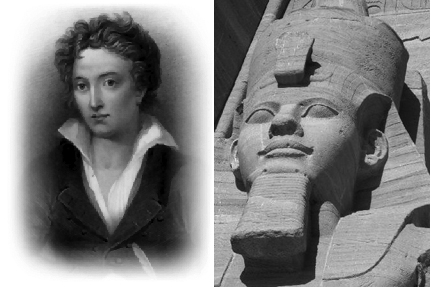
The fall of the dictators still echoes across North Africa and the Arabian Peninsula, with Syria’s Asad teetering at the brink. Mubarak, Qaddafi and Ali Abdullah Salih join the legion of past icons of unchecked power. Pharaohs and kings, caliphs and sultans, whether the divine myth of rule or the blatant Machiavellian Leviathan: oh how the mighty have fallen. No poem seems more poignant to capture the moment that Shelley’s timeless take on Ozymandias:

I met a traveller from an antique land
Who said: “Two vast and trunkless legs of stone
Stand in the desert. Near them on the sand,
Half sunk, a shattered visage lies, whose frown
And wrinkled lip and sneer of cold command
Tell that its sculptor well those passions read
Which yet survive, stamped on these lifeless things,
The hand that mocked them and the heart that fed.
And on the pedestal these words appear:
`My name is Ozymandias, King of Kings:
Look on my works, ye mighty, and despair!’
Nothing beside remains. Round the decay
Of that colossal wreck, boundless and bare,
The lone and level sands stretch far away”.

But the fantasized Ozymandias has a prologue, in Arabic graffiti and belles lettres. The entertaining text, today as ever before, known as The Book of Strangers and attributed to Abu al-Faraj al-Isfahani, reports the handwriting on the wall when the walls come tumbling down. An anecdote related by an old secretary tells of an inscription on the wall of a palace built by the Abbasid caliph al-Mutawakkil:

Money was spent and used up
and buildings were erected for fate to destroy.
When they arrived at the peak of their kingship,
a caravan leader cried out that it was time for the grave,
and he emptied the palaces, giving no respite to either the powerful or the oppressed.

Continue reading Prologue to Ozymandias

New Work on Mahri Poetry

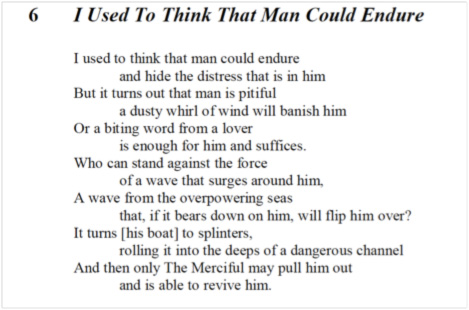
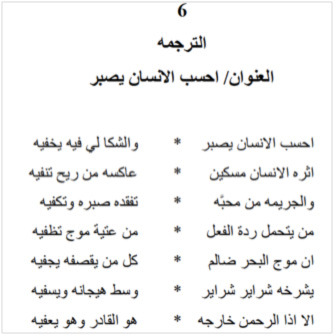
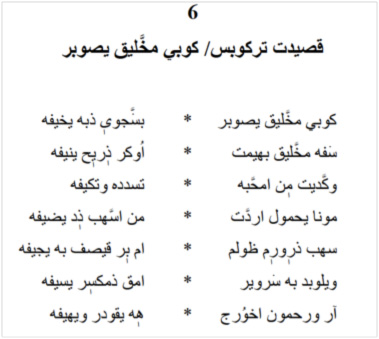
The Dīwān of Ḥājj Dākōn, published by the American Institute for Yemeni Studies in 2011, is a collection of eighteen poems in the endangered Mahri language of Yemen and Oman, one of the last, non-Arabic indigenous languages of the Arabian Peninsula. This publication marks an important step in the history of the Mahri language since it contains its first literary texts meant for a local readership. Ḥājj Dākōn, a pioneer of modern Mahri sung-poetry, has included an Arabic translation for each Mahri poem, which is supplemented by an English translation and transliteration into Latin characters provided by Samuel Liebhaber. The Dīwān is introduced by commentary that places the innovations of Ḥājj Dākōn’s lyric qaṣīdas in their cultural and linguistic context. A facsimile of Ḥājj’s original handwritten manuscript is included in the Dīwān. Starting in June 2012, audio and visual recordings of each poem in recitation will be accessible online on the site: http://blogs.middlebury.edu/mahripoetry/.

Sample poem, #6 from The Dīwān of Ḥājj Dākōn


English translation


Arabic translation


Mahri

Continue reading New Work on Mahri Poetry

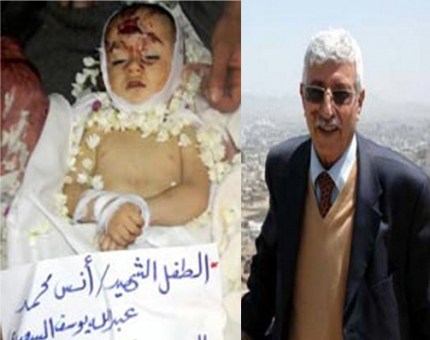
يا قاتل الأطفال يا مهدم الحياة والديار


عبدالعزيز المقالح: ذهبت مثلما أتيت ملعون المساء والنهار .. يا قاتل الأطفال يا مهدم الحياة والديار

Yemen Press, Saturday, 24 September, 2011

ذهبت مثلما أتيت ملعون المساء والنهار…
أيامك الطوال عار..
وعهدك القصير عار..
أكبر منك نملة..
أشهر منك ريشة على جدار..
يا أمسنا الذبيح..
يا فأرنا القبيح..
يا قاتل الأطفال يا مهدم الحياة والديار..
ظننت أنك الإله .. أننا العبيد..
تفعل ما تريد..
تعبث في مصائر العباد..
فخانك الظن وخانك الرشاد..
أصبحت كومة من الرماد..
تنام في انفراد..
تصحو على انفراد..
تسألك الريح ، يسألك الجماد..
ماذا صنعت قل ..
ماذا صنعت للبلاد؟,,
ماذا تركت من ذكرى على ضميرها ومن أمجاد؟..
لا شيء يا صغير..
لا شيء غير لعبة المزاد..
رفاقك القرًاد والقوًاد..
وعاصف الفساد..
ماذا تركت للذين يقرأون؟..
ماذا سيكتب الأطفال عنك حين يكبرون؟..
سيكتبون .. مر من هنا منتفخا..
فأر صغير يرتدي ثوب مغامر جلاد..

Digitalizing Yemeni Manuscripts


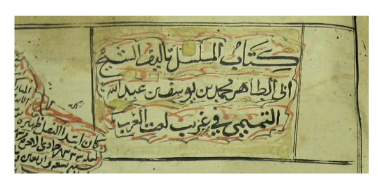
Detail from the title page of MS Glaser 20, Staatsbibliothek zu Berlin

Given the current unrest and economic turmoil in Yemen, little thought is being given to Yemen’s vast cultural heritage. But there is hope, at least for preservation of manuscripts. The German Archaeological Institute in Sanaa has recently released a report in English and Arabic entitled Preserving Yemens’ Cultural Heritage: The Yemen Manuscript Digitization Project and written by Sabine Schmidtke and Jan Thiele. This is available for reading online or as a pdf download.