Category Archives: Poetry

The Sultan of the East


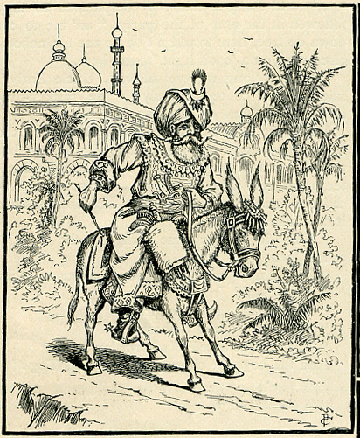
Illustration of his poem by Palmer Cox, 1882


The Sultan of the East

by Palmer Cox

There was a sultan of the East
Who used to ride a stubborn beast;
A marvel of the donkey-kind,
That much perplexed his owner’s mind.
By turns he moved a rod ahead.
Then backed a rod or so instead.
And thus the day would pass around,
The Sultan gaining little ground.
The servants on before would stray
And pitch their tents beside the way,
And pass the time as best they might
Until their master hove in sight. Continue reading The Sultan of the East

Rizpah and the Politics of Vengeance


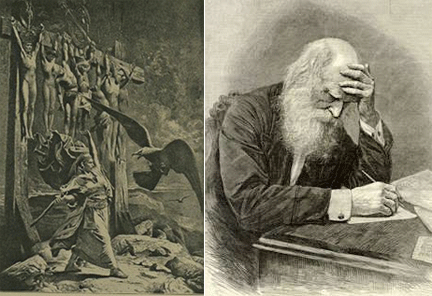
Rizpah protecting the bodies of her sons, by George Becker, left; William Cullen Bryant, right

With Gaza ablaze, the political woes of contemporary Palestinians continue to echo past tragedies on the same blood-drenched ground. Consider the vengeance of the Gibeonites, both a purge and a scourge in the early days of Israel’s King David. Setting aside who is who for the moment, the biblical account recorded in the book of II Samuel describes a weak David with a struggling economy (called a famine in those days). The Gibeonites, who sought vengeance for their slaughter by the former King Saul, demanded seven of his sons, and David agreed. The princes were soon hanged in eye-for-an-eye justice. Yet the queen mother of two of the sons spent five months protecting the bodies from being devoured by beasts not shaped like humans. Her name was Rizpah and she can be seen as a maternal heroine or a distraught widow.

Like so many of these seemingly sacred stories, almost any moral can be teased out of the narrative. Should the lesson be “Do not make deals with the enemy, even when you are weak”? I can see both supporters of Hamas and Israeli hardliners applauding the message. Or might it be possible to read the story in a more sane hindsight as a referendum on the futility of vengeance? Were the matter simply an eye for an eye, it could theoretically stop after the first act of vengeance, but this region has seen an infinity of eye-gouging that no blessed peacemakers have yet been able to stop. My own preference is for Rizpah fighting off the vultures of violence, less an act of protecting only one’s own than defiance of the perpetual killing that makes martyrdom a virtue on both sides.

Once again, I prefer to tune out the talking heads and let a poet of the past speak: Continue reading Rizpah and the Politics of Vengeance

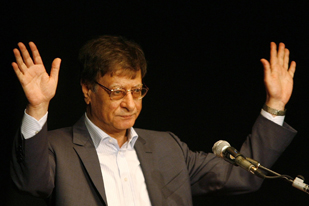
Mahmoud Darwish Dies

Al-Jazeera, August 9, 2008
Mahmoud Darwish, the renowned Palestinian poet, has died after open heart surgery at the Memorial Hermann medical centre in Texas.

Ann Brimberry, Memorial Hermann’s spokeswoman, confirmed to Al Jazeera that Darwish died at 1.35pm (1835GMT).

Siham Daoud, a fellow poet and friend of Darwish, 67, had asked not to be resuscitated if the surgery did not succeed.

She said Darwish departed for the US ten days ago for the surgery, and he had undergone two operations for heart problems before Saturday’s surgery.

Best known for his work describing the Palestinian struggle for independence, the experience of exile and factional infighting, Darwish was a vocal critic of Israeli policy and the occupation of Palestinian lands. Continue reading Mahmoud Darwish Dies

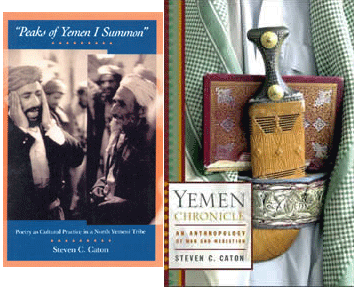
Peaks of Yemeni poetry he summons


[The following is Najwa Adra’s review of two books by anthropologist Steven C. Caton, who conducted ethnographic fieldwork in Yemen in 1979-1981. It was first published in
Yemen Update, #48 (2006):46-50.]


“Peaks of Yemen I Summon”: Poetry as Cultural Practice in a North Yemeni Tribe
, by Steven C. Caton
Berkeley, University of California Press, 1990
ISBN # 0-520-06766-5
351 pp., illus., maps, hardcover

Yemen Chronicle: An Anthropology of War and Mediation
, by Steven C. Caton
New York, Hill and Wang, 2005
ISBN-13: 978-0-8090
341 pp., maps, no illus., hardcover (also available in paper)

Reviewed by Najwa Adra

“Peaks of Yemen I Summon”: Poetry as Cultural Practice in a North Yemeni Tribe and Yemen Chronicle: An Anthropology of War and Mediation, published 15 years apart, should be read as two complementary parts of a whole. They document Steven Caton’s field research on tribal poetry in Khawlan at-Tiyal in 1979-81. Together, these books are important contributions to theory in anthropology, the ethnography of Yemen, and perhaps literary theory and political science as well. The first book is a technical discussion of tribal poetry as cultural practice; the second is a personal, reflexive description of the author’s experiences in the field. It provides rich contextual data that shed light on, and help support, the author’s argument in the first book. Continue reading Peaks of Yemeni poetry he summons

Poems from Guantánamo

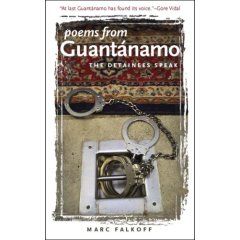
Poems from Guantánamo: The Detainees Speak is a short but provocative book of poems from several of the detainees held at Guantánamo Bay. Much has been written about the legal issues and violations of human rights, but here we can hear the silenced voices of those dehumanized in detention without access to justice. Here is one of the poems:

Death Poem
by Jumah Al Dossari

Take my blood.
Take my death shroud and
The remnants of my body.
Take photographs of my corpse at the grave, lonely.

Send them to the world,
To the judges and
To the people of conscience.
Send them to the principled men and the fair-minded.

And let them bear the guilty burden, before the world,
Of this innocent soul.
Let them bear the burden, before their children and before history,
Of this wasted, sinless soul.
Of this soul which has suffered at the hands of the “protectors of peace.”

Jumah al Dossari, a thirty-three-year-old Bahraini national, is the father of a young daughter. He has been held at Guantánamo Bay for more than five years. In addition to being detained without charge or trial, Dossari has been subjected to a range of physical and psychological abuses, some of which are detailed in Inside the Wire, an account of the Guantánamo prison by former military intelligence soldier Erik Saar. He has been held in solitary confinement since the end of 2003 and, according to the U.S. military, has tried to kill himself twelve times while in the prison. On one occasion, he was found by his lawyer, hanging by his neck nd bleeding from a gash to his arm.
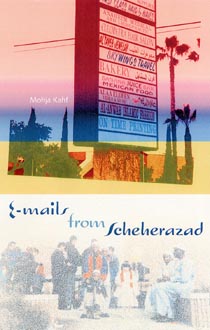
Hijab Scene #7

by Mohja Kahf

No, I’m not bald under the scarf
No, I’m not from that country
where women can’t drive cars
No, I would not like to defect
I’m already American
But thank you for offering
What else do you need to know
relevant to my buying insurance,
opening a bank account,
reserving a seat on a flight?
Yes, I speak English
Yes, I carry explosives
They’re called words
And if you don’t get up
Off your assumptions
They’re going to blow you away.

From Mohja Kahf, E-Mails from Scheherazad (Gainesville: University Press of Florida, 2003), p. 39.

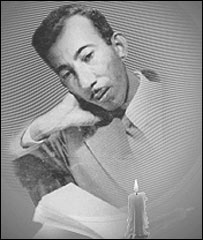
The Letters of Badr Shakir al-Sayyab: #21


The Iraqi Poet Badr Shakir al-Sayyab

[Note: This is the 21st in a series of translations of selected letters of the noted Iraqi poet Badr Shakir al-Sayyab. For more information on the poet, click here.]

Letter #21

Al-Ma’qil, 9/17/1964

My Brother, Adunis. Dearest Beloved (along with Muhyi al-Din Muhammad). May I be lucky enough to find Muhammad.

O Dearest Friend,

How are you? Correspondence between us has stopped for about nine months now. The two reasons for this are bad luck and my incurable disease. My general health is not bad, but my two paralyzed legs are still the same. My soul is overflowing with poetry, but it is poetry that flows from the fountain of deep pain and dejection, not of delight. Just yesterday, I wrote a poem void of sadness, despair, and pain because our brother, ‘Ali al-Sabti, met with my loved ones in Lebanon and carried joyful news about them to me with a promise that they will send me a letter. Continue reading The Letters of Badr Shakir al-Sayyab: #21

The Letters of Badr Shakir al-Sayyab: #20


The Iraqi Poet Badr Shakir al-Sayyab

[Note: This is the 20th in a series of translations of selected letters of the noted Iraqi poet Badr Shakir al-Sayyab. For more information on the poet, click here.]

Letter #20

al-Ma’qil 10/15/1963

My Dear Brother Jabra (Ibrahim Jabra),

Welcome to Iraq. I hope you enjoyed your summer in Lebanon. I am certain that you continued your literary activities while there. Besides Taoufiq Sayigh and Yusuf al-Khal, with whom did you meet? Did you see Salma al-Khadra’ al-Jayusi and Laila ba’albaki? Can you write me the details of the different phases of literary activities in Lebanon?

I heard, actually, I read, that you are going to deliver a series of literary lectures on Baghdad Radio. This is a good thing. Something like rust has begun to cling to literary life here, and it is the duty of great writers to remove this now when the field is wide open for those who are creative and innovative. Continue reading The Letters of Badr Shakir al-Sayyab: #20