Category Archives: Anthropology/Sociology

Tuareg Blues


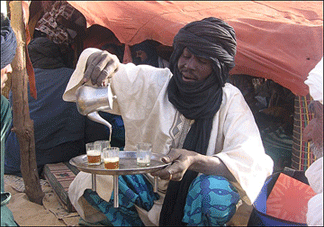
[Tuareg man serving tea; photo by Jane Greenhalgh for NPR.]

“Climate Connections” on today’s NPR website has a slideshow and brief article on recent changes in Tuareg lifestyle in southern Mali. Known as the “Blue Men” of the desert (for their indigo clothing) and serving as a prime ethnographic example of a society where the men (rather than the women) veil, life for the Tuareg is undergoing rapid change. In this case it is prolonged drought that has served as the main impetus for change. The slide feature is well worth a look.

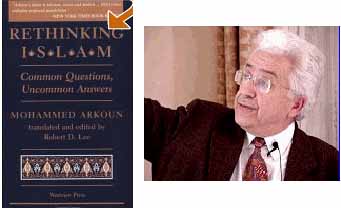
Reading the Qur’an: Mohammed Arkoun

By Jane Dammen McAuliffe
Dean of Arts and Sciences, Georgetown University
Professor, Department of Arabic and History

Mohammed Arkoun is the most honored French Islamicist alive today and continues to receive lecture invitations from around the world. His first language was Berber, and he learned Arabic and studied Islamic sources in French-speaking schools, first in Algeria and then in Paris (Gunther:127-131). Arkoun’s life-long project has been the sustained analysis of Islamic reason from the perspective of the contemporary epistemologies, both philosophical and social scientific. He is well-schooled in the successive forms of critical theory that have occupied humanistic scholarship for the last generation, particularly structural linguistics and semiotics. Continue reading Reading the Qur’an: Mohammed Arkoun

A Dialogue With Allah


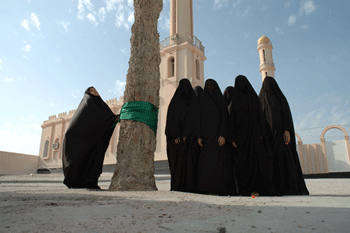
Figure 1: Mosque, women and palm tree.

By el-Sayed el-Aswad

Folk culture provides members of the society with living models in the form of iconic images, key symbols, and root metaphors that enable them to express themselves, and the other as well. Sanctity or religious meaning is bestowed on an object or place for the reason that a religiously significant event (a miracle, wonder or blessing) is associated with it.

At an art exhibition at the College of Art, Bahrain University last year, 2006, I was surprised to see very beautiful and stunning pictures in which a group of women were climbing palm trees (figure 2-5). Recognizing the cultural significance of the palm tree in Arab societies, I decided to interview Waheeda Malullah (figure 6), the artist whose photos show that the climbing of palm trees is not just aimed at the collection of dates commonly consumed in the Arab Gulf countries, but rather at the engagement in spiritual communication with invisible spheres of the cosmos and the achievement of blessing or grace (baraka), among other objectives. Continue reading A Dialogue With Allah

Reflections on Fieldwork in Yemen


Reflections on Fieldwork in Yemen: The Genealogy of a Diary in Response to Rabinow’s Reflections on Fieldwork in Morocco
by Daniel Martin Varisco


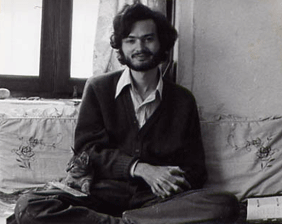
[Anthropologist at rest with cat, al-Ahjur, Yemen, 1978]

[The following excerpt is from an article recently published in Anthropology of the Middle East (Volume 1(2):35-62, 2006).]

Abstract: In preparation for writing an ethnographic monograph on fieldwork in Yemen, I compare and contrast my field diary, written in 1978–9, with Paul Rabinow’s ‘Reflections on Fieldwork in Morocco’ (1977). The underlying question is what post-fieldwork reflections reflect meaningfully about the immediacy of ethnographic fieldwork. I criticize the reflexivist trope of privileging ‘writing culture’ over the significance of ‘being there’ in the field. Point by point, I examine the implications of graduate training in anthropology, culture shock, health problems, language skills, the unreflective male voice, visual ethnography and the rhetoric of narrative writing.

Keywords: culture shock, ethnography, fieldwork, reflexivity, Visual Anthropology

Continue reading Reflections on Fieldwork in Yemen

Yemen Bashing Needs a Reality Check

Most Americans know little about the country of Yemen, located beneath (geographically and metaphorically for many foreign policy makers) America’s oil-friendly ally Saudi Arabia. I have been going to Yemen since 1978, when I lived for over a year as an ethnographer in a highland tribal village northwest of the capital Sanaa. Since that time my academic career has focused largely on the history and culture of Yemen. I edited a bulletin (Yemen Update) devoted to all aspects of Yemeni Studies for a decade, and I have returned frequently as researcher and development consultant. Over the years there have been very few news articles about Yemen by American correspondents. The few that have appeared are generally so full of stereotypes and misinformation that I often turn the paper aside in disgust. The major 3-part article begun last weekend (Dec. 18, 19, 20) by David Finkel on a democracy development project in Yemen for the Washington Post is sadly yet another ignorant and dangerous posting that needs a reality check. Continue reading Yemen Bashing Needs a Reality Check