Category Archives: Anthropology/Sociology

Congress is about to pour lighter fluid on Iran

Congress is about to pour lighter fluid on Iran

By WILLIAM O. BEEMAN, Star Tribune, Minneapolis/St. Paul, September 3, 2008

The U.S. Congress may inadvertently lay the foundations for war against Iran when it reconvenes in Washington this month.

Two essentially identical nonbinding resolutions call upon President Bush to “immediately and dramatically increase the economic, political and diplomatic pressure on Iran to verifiably suspend its nuclear enrichment activities.”

The House resolution has more than 200 cosponsors, including Minnesota Reps. Michele Bachmann, John Kline and Jim Ramstad. The Senate resolution has more than 30 cosponsors, including both Minnesota senators, Norm Coleman and Amy Klobuchar.

The methods for increased pressure differ slightly in the two resolutions. The House resolution calls for “stringent inspection requirements” of all goods entering or leaving Iran. The Senate resolution does not call for the inspection of all goods but joins the House resolution in calling for an embargo of refined petroleum products to Iran, which lacks the refining capacity to meet its need for gasoline. Achieving either goal would require a naval blockade — a de facto act of war on the part of the United States, though paradoxically both resolutions explicitly exclude authorization for military action. Continue reading Congress is about to pour lighter fluid on Iran
Chickens Come Home to Roost in Georgia

William O. Beeman, New America Media, Aug 12, 2008

Editor’s Note: The Bush Administration’s push for access to oil from the Caspian Sea and it’s desire to isolate Iran precipitated the Russian invasion of Georgia. William O. Beeman is professor and chair of the department of anthropology at the University of Minnesota. He has lived and worked in the Middle East region for more than 30 years.

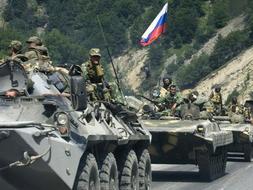
No one should be surprised that U.S. interference in the Caucasus has led to the Russian invasion of South Ossetia. By mixing into the volatile politics of the Caucasus, and trying to recruit the governments there to become American “plumbers” for a variety of purposes, the United States has only drawn Russian fire.

The Caucasus was one of the last territories added to the Russian Empire in the 19th century. It was captured from the Qajar Empire of Iran. The Caucasians never were fully incorporated into Greater Russia, and maintained a fierce cultural separatism. Georgia in particular was proudly nationalistic, with a distinctive language, cuisine, literary tradition and writing system. Continue reading Chickens Come Home to Roost in Georgia

Peaks of Yemeni poetry he summons


[The following is Najwa Adra’s review of two books by anthropologist Steven C. Caton, who conducted ethnographic fieldwork in Yemen in 1979-1981. It was first published in
Yemen Update, #48 (2006):46-50.]


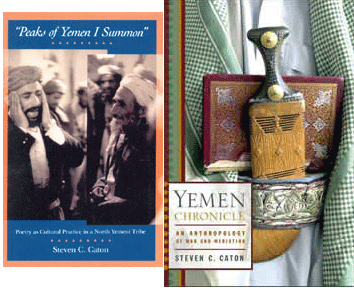
“Peaks of Yemen I Summon”: Poetry as Cultural Practice in a North Yemeni Tribe
, by Steven C. Caton
Berkeley, University of California Press, 1990
ISBN # 0-520-06766-5
351 pp., illus., maps, hardcover

Yemen Chronicle: An Anthropology of War and Mediation
, by Steven C. Caton
New York, Hill and Wang, 2005
ISBN-13: 978-0-8090
341 pp., maps, no illus., hardcover (also available in paper)

Reviewed by Najwa Adra

“Peaks of Yemen I Summon”: Poetry as Cultural Practice in a North Yemeni Tribe and Yemen Chronicle: An Anthropology of War and Mediation, published 15 years apart, should be read as two complementary parts of a whole. They document Steven Caton’s field research on tribal poetry in Khawlan at-Tiyal in 1979-81. Together, these books are important contributions to theory in anthropology, the ethnography of Yemen, and perhaps literary theory and political science as well. The first book is a technical discussion of tribal poetry as cultural practice; the second is a personal, reflexive description of the author’s experiences in the field. It provides rich contextual data that shed light on, and help support, the author’s argument in the first book. Continue reading Peaks of Yemeni poetry he summons

Playing Games with Iran


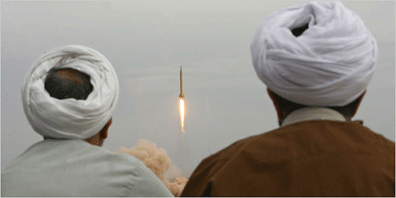
Clergymen watched a missile during war games Thursday near Qum, Iran. The exercise was conducted by Iran’s Revolutionary Guards. Fars News Agency, via Agence France-Presse

by William O. Beeman, Foreign Policy In Focus, July 21, 2008

By now the structure of the U.S. game with Iran is clear. In the first move, the United States and Iran make some small progress toward improved relations. In the counter move, hardliners in the United States and Israel launch attacks against Iran in order to sabotage these improving relations.

In the latest iteration of this game, the U.S. State Department has made an interesting gambit. It announced that Undersecretary of State William Burns would sit at the table on July 20 as members of the European Union entered into talks with Iran over its nuclear program. At the same time, the United States has been reported to be considering opening a formal American Interests Section in Tehran. These two actions will be the first serious public diplomatic activities between the two nations in nearly three decades. (Three earlier meetings in Baghdad between U.S. Iraqi Envoy Ryan Crocker and Iranian Ambassador to Iraq Hassan Kazemi-Qomi focused on security in Iraq). Continue reading Playing Games with Iran

From Failed Resolution 1696 to Real Diplomacy


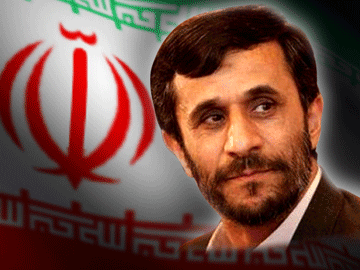
Iranian President Mahmoud Ahmadinejad

by William O. Beeman

The United Nations Security Council Resolution 1696 calling for Iran to suspend nuclear enrichment was passed on July 31, 2006 — nearly two years ago. Every sanction and demand placed on Iran since that time has been based on this Resolution (and its strengthened re-iteration, Resolution 1737 on December 23 of the same year).

Clearly after two years the Resolution and its follow-ups have not worked. Iran has not suspended its uranium enrichment activities, and indications this week are that it is not likely to do so in the future. The United States and its reluctant European allies obviously can not put enough pressure on Iran to cause it to abandon what the Nuclear Non-Proliferation Treaty — to which Iran (but not Israel, Pakistan or India) is signatory – provides as is its “inalienable right”: peaceful nuclear development. As long as it does not violate Provision One of the NPT, namely the agreement not to develop nuclear weaponry. Continue reading From Failed Resolution 1696 to Real Diplomacy

Tribute to Professor Syed Hussein Alatas (1928-2007)

[The following tribute by Alvin Tay is more than a year old, but for those who were unaware of the passing of Prof. Alatas, it is a reminder of the value of his scholarly work, which remains unappreciated in many university settings. Webshaykh.]

23rd January 2007 was a sad day for sociology, Singapore sociology in particular, with the sudden passing of Professor Syed Hussein Alatas, former Professor in Malay Studies at University of Singapore and a pioneer of the kind of sociological theorizing that Singapore, and indeed the region of Southeast Asia, could truly call our own. I did not have the opportunity of the many sociologists before me who had passed through the doors of the department and were taught by him in the university, and so I speak only from the position of one who regrets deeply the loss of a formidable sociologist, and yet feels greatly blessed by the corpus of sociological knowledge which he has left behind. It is the imprint of his many works on me, ranging from religion to race to colonialism, amongst other substantive issues, which impels me to proceed with this modest tribute, albeit with a heavy heart and a prayer for love and peace. Continue reading Tribute to Professor Syed Hussein Alatas (1928-2007)

Keith Ellison’s Iran Forum

Keith Ellison’s Iran Forum and the June 10 Call-In to Congress

By Lydia Howell, Engage Minnesota, June 6, 2008

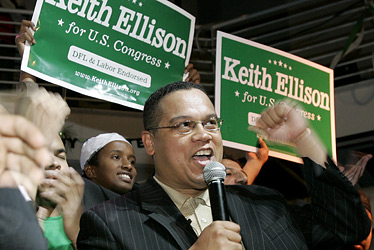
On May 28, U.S. Rep. Keith Ellison, D-Minn., hosted Iran scholars for a community forum in a packed hall at the First Unitarian Society church in Minneapolis. The focus was on the U.S.-Iran relationship, estranged for over 30 years, which many fear may become the next chapter in the Bush administration’s “war on terrorism.”

“Nary a day goes by that someone isn’t saying something abut Iran in the media. Part of my responsibility as a U.S. congressman is to be a forum to discuss the critical issues we face and to promote dialog about the most pressing issues,” said Ellison. “To quote [African-American writer] James Baldwin: Anything that cannot be faced cannot be fixed.”

In the first half of 2008, newspaper front pages and television news have begun repeating a message about a Middle Eastern country that has not attacked the United States but which allegedly “poses a grave threat,” “may build nuclear weapons” and “must be prevented from making war on its neighbors.” In 2002-3, such stories were about Iraq; now, Iran is being described in similar ways. No actual evidence is given for the frightening allegations about Iran—which are too often made by unnamed “Pentagon officials” or the same members of right-wing think tanks that previously pushed the disastrous attack on Iraq. Continue reading Keith Ellison’s Iran Forum

Another Arabesque: Arabs in Brazil

North American to release book about Arabs in Brazil

John Tofik Karam, a grandson of Lebanese born in the United States, should release up to the end of the year, in Brazil, book ‘Another Arabesque’. The work is on the valuation of the Arab tradesman in the country in the late 20th century. To write the book, initially a master’s degree thesis, he was in Brazil for over a year.

Isaura Daniel, ANBA, Brazil-Arab News Agency, 3/26/2008

São Paulo – The North American John Tofik Karam, of Lebanese origin, is going to release in Brazil his book “Another Arabesque” through Martins Editora publishing house. The work is the result of a doctoral thesis that Karam worked on about the Arab community in Brazil and shows the valuation of the Arabs in the late 20th century.

“It shows the greater visibility that the Arabs got during the neoliberal phase,” explained Karam in a telephone interview to ANBA. According to the Lebanese descendant, up to the middle of the 20th century, Arabs were marginalized due to the stereotype of good businessman, always wanting the greatest possible gain in trade. “This idea suddenly became an advantage in the neoliberal phase,” he said. Continue reading Another Arabesque: Arabs in Brazil