Category Archives: Anthropology/Sociology

2011 RIFT VALLEY INSTITUTE FIELD COURSES


Dhow near Lamu at sunset

2011 RIFT VALLEY INSTITUTE FIELD COURSES:
SUDAN, HORN OF AFRICA AND GREAT LAKES

SUMMARY

This year’s Rift Valley Institute field courses stress the historical background to political developments in the region: the two-state future in Sudan, the effect of recent and upcoming elections in the Great Lakes, and the continuing challenges to political evolution in the countries of the Horn of Africa. The courses are seminar-based, one-week, high-intensity events to be held between May and July. Faculty includes internationally-known regional specialists, researchers and civil society activists from Sudan, Ethiopia, Somalia, Rwanda, Burundi, and the DRC.

The application deadline for all courses is Monday 28 February. You can apply online here.

Summaries of each course are included below. Prospectuses containing further details are attached to this message and can be downloaded from www.riftvalley.net/courses. (Or write to courses@riftvalley.net.)

DATES AND GENERAL INFORMATION

Dates for this year’s courses are as follows:

The Sudan Course, Wednesday 25 May to Tuesday 31 May, in Rumbek, Southern Sudan.

The Horn of Africa Course, Saturday 4 to Friday 10 June in Lamu, Kenya.

The Great Lakes Course, Saturday 9 July to Friday 15 July in Bujumbura, Burundi.

The courses are intensive, graduate-level, residential programmes. They are designed for local and expatriate peacekeepers, aid workers, diplomats, researchers, campaigners, business people and journalists.Taught by leading regional and international specialists, the courses provide a fast-track introduction to the history, political economy and culture of a country or region, challenging assumptions and offering new perspectives on politics, development and other current issues. Continue reading 2011 RIFT VALLEY INSTITUTE FIELD COURSES
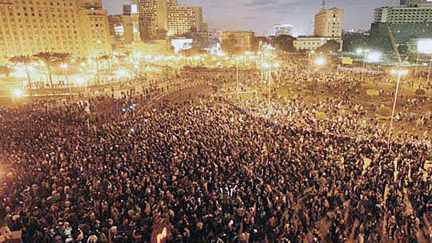
Dawn

by Sherifa Zuhur, Sociology of Islam and Muslim Societies, February 1, 2011

I find it very difficult to assemble emotions, memories and impressions to respond to the events in Tunisia and Egypt. I have been responding sharply to others who seized the moment to offer their analysis. Certain characterizations of Egyptians did not sit well with me. I also fear that specific arguments are easily manipulated — that the centers of power who have so deftly dominated the media, huge sums of money and many segments of national elites will thwart the resurgence of popular resistance and demonstration of public will. But since those consulted by Barry and Joe and their “teams” are hard at work, spreading fear of a future Egypt non-compliant with the terms of Camp David, conjuring up the Islamist bogeyman, and (one fears) holding Hosni’s hand, we too should speak.

A group of Tunisian friends joined my Facebook page and share their jubilation and updates with me. Their example has inspired Egypt, however, to attribute events in Egypt to Tunisia, or social media and the impact of al-Jazeera would be wrong. Underlying events are Egyptians’ own lengthy struggles and perceptions that transformation is possible. To some degree, fear of counter-revolution is what froze civil expression in Egypt when the communists, the workers and the Muslim Brotherhood were each treated as intolerable threats to the Nasser government. Student activism became possible again in Sadat’s era, but firm rules were established about the “forbidden topics” (the infitah, peace with Israel, corruption, Saudi Arabia etc.) People complied, or they suffered professional defeat, exile, or worse. Then, for many years, violent attacks – against government officials, against judges, policemen, continued up to the crescendo of the firebombing of buses in Tahrir square and the massacre of tourists at Luxor. When the truce with the Gama’at Islamiyya and then Gihad Islami (Islamic Jihad) were achieved, the detentions, torture, and suspension of civilian liberties could have been lifted, but they were not. This year, I spent some time studying instances of extrajudicial actions versus what is acknowledged as state terror. Perhaps they differ in volume, but not in effect. We are speaking of drowning in cold water, the use of dogs, hanging, beatings, electrocution, and threats to family members. These were the weapons of government and are responsible, at least to some degree for the emergence of figures like Ayman al-Zawahiri. In the 2000’s as new “terror” threats emerged, the Minister of the Interior and his employees arrested thousands in the Sinai and elsewhere, and these tactics continued as well as public beatings and confrontations with demonstrators. The emergency laws were extended again, and again. Continue reading Dawn

Yemen is Not Tunisia, not Egypt

Yesterday I published a commentary on CNN Opinion about the recent protests in Yemen. I attach the start of this here, but the full account can be read at CNN.com.

(CNN) — “Yemen is not Tunisia.” These were the words that President Ali Abdullah Saleh spoke to his people on television last Sunday.

As street protests erupt in Yemen’s capital, it is not surprising that an Arab leader who has held power since a bloodless coup in 1978 would dismiss calls for his ouster.

But he was correct.

Although his regime has been accused of corruption, Saleh is no Zine El Abidine Ben Ali of Tunisia, nor even Hosni Mubarak of Egypt. Instead of using an iron fist, he has maintained power by cleverly playing off rivalries among tribal, religious and political divisions.

When he became president of North Yemen, he allied himself with Sheikh Abdullah al-Ahmar, who headed the most powerful tribal alliance in the North. After negotiating the unification of Yemen’s North with the socialist South in 1990, Saleh fostered a climate of grass-roots democratization before outmaneuvering the socialists for total control of the country.

Power is shared in Yemen largely because of the continuing local importance of tribal affiliation. This is not always understood. A major conflict near Yemen’s border with Saudi Arabia, for example, has been wrongly characterized as an Islamist rebellion. Like most political conflict in the region, the battle has religious overtones, but it is mainly over tribal autonomy…

I was interviewed this morning for the program Worldview of WBEZ in
Chicago and this interview aired today but is archived on the website.

Daniel Martin Varisco

A Geography Lesson from 1879: #2: An Enlightened National View of the Others


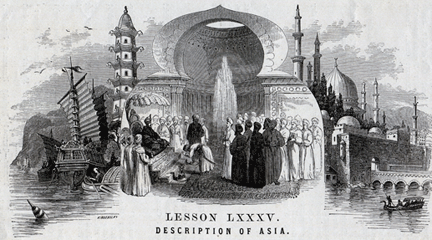
I recently started a thread on a school geography book from 1879. At that time the idea of “civilization” was fixed in a hierarchy. According to Lesson XXI (States of Civilization), there were degrees for separating out the inhabitants of the earth. Here is the sequence, with the student no doubt informed in the classroom that the United States was the most enlightened:

1. Nations, with regard to the degree of their civilization, are divided into five general classes: Savage, Barbarous, Half-civilized, Civilized, and Enlightened Nations.
2. Savages
dwell in tribes; they live in caves, dens, or huts, and are chiefly occupied in hunting, fishing, or war.
3. Barbarous Nations live in larger communities than savages, practice some rude arts, attend to the rearing of flocks and herds, and in some cases, till the soil.
4. Half-civilized Nations
have organized governments and dwell in cities, occupy themselves in agriculture and mechanic arts, but are without education, refinement, or morality.
5. Civilized Nations are such as have made considerable progress in knowledge and morality, have good governments and generally wise laws.
6. Enlightened Nations
are such as hold the highest rank in intelligence, scientific progress, and moral, religious, and social culture.

Excerpt from: Colton’s Common School Geography (New York: Sheldon and Company, 1879), 17.

to be continued

Tuning into Tunisia

The recent revolution in Tunisia has exploded across the blogosphere, with pundits talking about a popular tsunami that may promote democracy out of the ashes of a lifelong dictatorship. In yesterday’s New York Times, Roger Cohen provided an optimistic view from his journalistic perch in Tunis: “These are heady days in the Arab world’s fragile democratic bridgehead.” Cohen, and others, are wondering aloud if Tunisia can become the new Turkey, a more or less secular democracy in which the “Islamists” are moderate members of a political mosaic. If so, then he warns that the “tired refrain of all the Arab despots that they are the only bulwark against the jihadists will be seen for the self-serving lie it has become.”

Perhaps, but one does not have to go far back into the regime of Saddam Hussein to realize that his Ba’athi party did not tolerate religiously motivated sectarian violence. Brutal as it was, his regime was a bulwark (if such a metaphor really makes sense politically) against the continual round in “liberated” Iraq of sunni killing shi’a and vice versa. But then Saddam was not brought down by a popular street uprising. Continue reading Tuning into Tunisia

A Geography Lesson from 1879: #1: The Earth is not a Plain


Once upon a time Geography went right along with the three r’s in the school curriculum. I have a copy of the geography text my great, great Aunt Ida used. This was Colton’s Common School Geography illustrated by numerous engravings and twenty-two study maps, drawn expressly for this work, and specially adapted to the wants of the class-room, to which are added two full-paged railroad maps, showing the chief routes of travel, and a complete series of twelve commercial and reference maps of the United States. It was published by Sheldon and Company, located at the time on 8 Murray Street in New York, in 1879.

In 1879, when my discipline of Anthropology was still in academic diapers, Geography was defined as “that branch of science which describes the surface of the earth, the divisions and inhabitants” (p. 3). Apparently back then it was still important to show why we knew the earth was not flat. As the text explains:

We know that the earth is not a plain, because 1. Navigators have sailed around it; 2. The upper portions of objects at a distance, as a ship at sea, are seen before any other part; 3. The shadow of the earth, as seen at the time of an eclipse of the moon, has always the form of a circle or a segment of a circle. (p. 3)

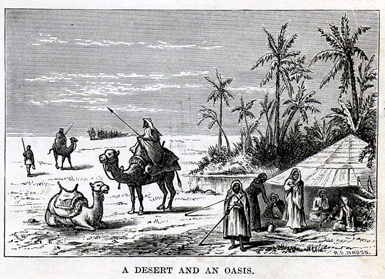
In discussing land divisions some 20 different kinds are listed, including a desert (“a tract of land nearly or quite barren”) and an oasis (“a fertile spot in the desert”) with both of these rating an illustration as shown above.

to be continued

El-Aswad on Bahraini Shi’a


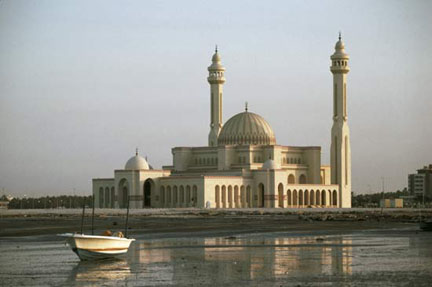
Grand Mosque in Bahrain

Tabsir contributor El-Sayed el-Aswad recently published an article entitled “The Perceptibility of the Invisible Cosmology: Religious Rituals and Embodied Spirituality among the Bahraini Shi’a” in Anthropology of the Middle East, Volume 5, Number 2, Winter 2010 , pp. 59-76. The article is available to subscribers of the journal or for purchase. The abstract is cited here:

This article analyses the relationship between the seen and the unseen in the cosmology and practices of Bahraini Shi’a. Rather than contrasting the visible and the invisible, the study delineates the hierarchical relations between them, within a whole or cosmology, as reflected in various discursive and non-discursive actions that are supported by the religious beliefs of Bahraini Shi’a. Issues of the Hidden Imam, concealment, dissimulation and other unseen dimensions of the cosmos are discussed. The article finds that the Shi’a construct the invisible in their social world by using visible ways of creatively enacting their hidden thoughts and beliefs, as represented in their religious discourses, rituals and body symbolism. Their belief in a divine higher power provides a source of emotional, spiritual and socio-political empowerment.

Grease-Monkeys and Bedouin Girls


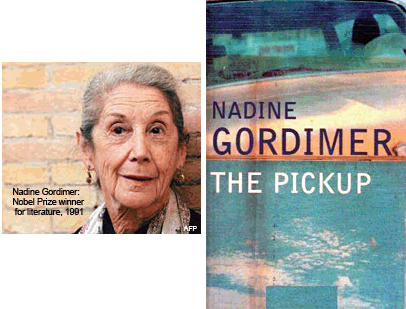
Grease-Monkeys and Bedouin Girls: The Rhetorical Fate of Arabs and Muslims in Nadine Gordimer’s The Pickup.
By Daniel Martin Varisco, Tingis Redux, December 11, 2010

Novels tell Stories, allowing readers to fantasize about reality but with no obligation to represent that reality as anything other than fantasy. Good novels, at least the kind that garner a Nobel prize for their author, capture the imagination through creative engagement and style. The South African author Nadine Gordimer has been writing about the shame of apartheid in her native land for more than half a century. Her focus on the moral and psychological tensions of racial inequality provides a welcome political stamp to her fiction. Yet, sometimes in telling one kind of story, especially teasing out the relationships of lovers across cultural boundaries, another story can be read between the lines. The Pickup, Gordimer’s acclaimed novel which pairs a privileged South African white girl named Julie with an Arab Muslim and illegal alien named Abdu, traces an unlikely love story but leaves the identity of Abdu literarily in the dust, the dust of a stereotyped Orientalist denigration of his homeland and his religion. One need not follow Edward Said’s controversial contrapuntal reading to find in this novel a generic image of Arab and Muslim that serves the plot only in its unrelenting negative portrayal. The Pickup, whatever its merits as a close study of personal dislocation, succeeds by picking on distorted images of Arab and Muslim.

For the rest of this essay, read it on Tingis Redux.