Category Archives: Anthropology/Sociology

Varisco on WBEZ


I was interviewed yesterday on the “Worldview” Program of WBEZ, Chicago. To listen to the broadcast, click here.

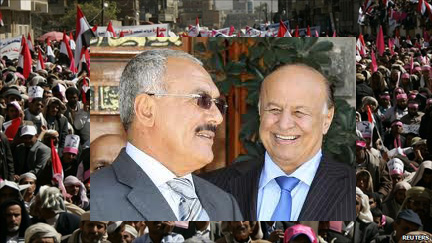
Yemen’s new president, Abdu Rabbu Mansour Hadi, has been in power nearly a month. He’s facing trouble in the southern province of Abyan. According to the United Nations High Commissioner for Refugees (UNHCR), the fighting has displaced more than 150,000 people since militants seized several cities in the province last May. Worldview will discuss the humanitarian crisis with Daniel Varisco, professor of anthropology at Hofstra University.

Sharing our values…


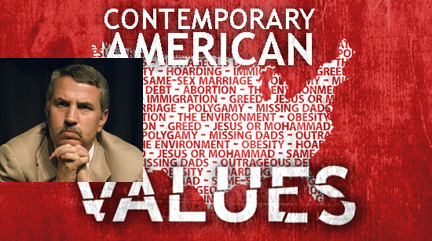
This post is not about the value of journalism, but about the blind prejudice that infiltrates much journalistic writing about values. I am not talking about the caricature newscasting of a Fox News Geraldo Rivera, who thinks wearing a hoodie is a problem (just like some maintain that a woman wearing a miniskirt is asking for “it”). Rather it is the prize-touting expert-of-all-trades mentality of Thomas Friedman, whose talking-head status is, in journalistic terms, astronomical. Yesterday, Friedman posted a commentary in The New York Times entitled “A Festival of Lies.”

Friedman begins with a quote from the historian Victor Davis Hanson in The National Review:

“Military assistance or punitive intervention without follow-up mostly failed. The verdict on far more costly nation-building is still out. Trying to help popular insurgents topple unpopular dictators does not guarantee anything better. Propping up dictators with military aid is both odious and counterproductive. Keeping clear of maniacal regimes leads to either nuclear acquisition or genocide — or 16 acres of rubble in Manhattan. What have we learned? Tribalism, oil, and Islamic fundamentalism are a bad mix that leaves Americans sick and tired of the Middle East — both when they get in it and when they try to stay out of it.”

I certainly agree with Friedman’s gut reaction that “And that is why it’s time to rethink everything we’re doing out there. What the Middle East needs most from America today are modern schools and hard truths, and we haven’t found a way to offer either.” Bravo. Bombs make enemies and schools build friendships: this hardly seems like a new revelation, but it is the kind of truth spoken to power that needs to be voiced time and time again.

But it is what underlies the rationale where I find an all-too-familiar ritual of truths that carry along the heavy baggage of assumptions that belie the argument being made. Continue reading Sharing our values…

Happy Birthday Sir Richard Francis Burton


Burton in Aden

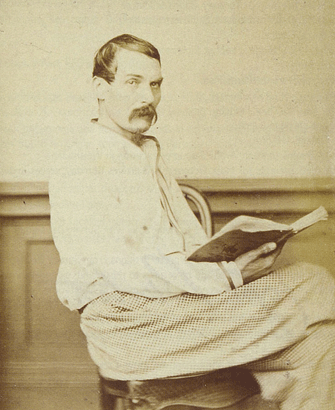
Today is March 19. Exactly 191 years ago, at 9:30 in the evening in the British town of Torquay in Devon the future Sir Richard Francis Burton was born. Like his 2oth century acting namesake, Burton was a character for the ages. He reveled in adventure and eroticism, for which he was much reviled in public and no doubt admired in private. If any one word can be used to described the persona that Burton pursued it would be “swashbuckling” in life as in spirit. My point today is neither to praise this flamboyant quasi-Victorian Caesar nor bury him (his grave is indeed a monumental site to behold). May his dry bones rest in the kind of peace he never seems to have found in life.

Burton’s biographers are numerous, as befits someone who is remembered as larger than life. His prolific corpus is now almost entirely online in various formats, but the place to start is burtoniana.org. There is much to question and quibble about in Burton’s exploits. Was his surreptitious entry into Mecca, disguised as a pilgrim, a travesty of Islamic values? Did his fascination with erotica in an age of gentlemananged taboos overstep ethical bounds? Was he the bad kind of “Orientalist,” a discourse cum intercourse voyeur that warrants calling him “Dirty Dick”, as Edward Said does in Orientalism (p. 190)? Was he, perhaps, a bit mad in that ubiquitous England manner?

Whatever you might think of the man, it is probably because of what you have read about him rather than what he actually wrote. Regardless of what he is saying, it must be noted that he had an extraordinary capacity for learning languages. Below is a list of the languages and dialects he is said to have mastered to some extent:

English, French, Italian, Latin, Greek, Jataki dialect (he wrote a grammar), Hindustani, Marathi, Urdu, Arabic, Persian, Pushtu, Sanskrit, Portuguese, Spanish, German, Icelandic, Swahili, Amharic, Fan, Egba, Ashanti, Hebrew, Aramaic, Many other West African & Indian dialects

I suspect he would get into Harvard, no matter what his SAT score.

Miniskirting the Issue


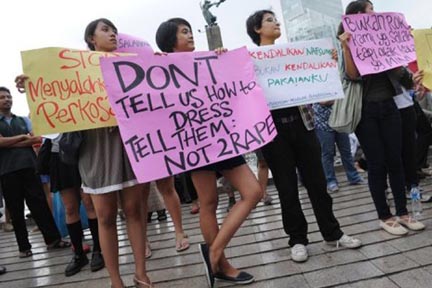
Indonesian women’s rights groups said they were outraged by the comments and called for a stop to the demonization of rape victims

Why is it that men blame women for their own failures? Whenever I hear a variant of the phrase, “Well, he couldn’t help himself,” I can’t but think that this excuse is in need of a lot of help. In Indonesia there is a bill being considered in parliament that would ban female lawmakers from wearing provocative clothing, such as miniskirts. Given that the number of Indonesian lawmakers wearing miniskirts must be a whopping minority, why is this needed? Here is the rationale:

“We know there have been a lot of rape cases and other immoral acts recently, and this is because women aren’t wearing appropriate clothes,” house of representatives speaker Marzuki Alie said.

“Women wearing inappropriate clothes arouse men, so it needs to be stopped. You know what men are like — provocative clothing will make them do things.”

So men rape women because women wear miniskirts. I have not seen the statistics, but I suspect the majority of women in Indonesia do not fall for the idea that all they have to do is dress conservatively and there will be no danger of a man raping them. This notion that the male rapist cannot really be blamed because “provocative clothing will make them do things” is not limited to any national or religious group. What is rather bizarre in this case is that the ban would only be to protect male lawmakers and not for the public at large. So either there is an epidemic of male lawmakers raping female lawmakers in Indonesia or these males are so easily aroused that the ban need only be to stop those provocative female lawmakers. I guess once outside the parliament building, male lawmakers can contain themselves. Continue reading Miniskirting the Issue

South Arabia and the Berber Imaginary


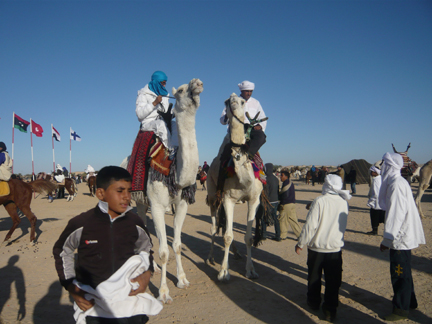
Mahri camels at the International Festival of the Sahara in Douz, Tunisia,
December 24, 2012. Photo by Sam Liebhaber.

by Sam Liebhaber

One of the long-standing myths of Berber ancestry places their origins in Yemen from whence they were dispatched to North Africa in the service of ancient Ḥimyarite kings. Although this chapter in the mythological prehistory of the Arab world can be refuted on the grounds that the Berber are indisputably indigenous to North Africa, the offhand dismissal of the South Arabian-Berber imaginary overlooks an important sociolinguistic kinship between the Berber of North Africa and one of the last indigenous linguistic communities of the Arabian Peninsula: the Mahra of Yemen and Oman.

A number of socio-cultural parallels distinguish the Berber and Mahra from the other minority language communities of the Middle East. For one, the Mahra and Berber are members of the Islamic ʾummah, unlike many of the other minority language communities of the Arab world where linguistic boundaries are frequently coterminous with religious divisions. Further, the Berber and the Mahra did not inherit a written tradition that includes religious and literary texts. As a consequence, the Mahri and Berber languages are frequently consigned to the category of “lahja,” an Arabic term that signifies any non-prestigious, vernacular idiom that lacks of historical or social value.

Without their own written history or affiliation to a prestigious, non-Arab civilization, the Mahra and Berber are more easily “willed” into historical narratives of “Arabness” (ʿurūba) than the other language minority communities of the Arab world. This motif is the mainstay of modern Arabic scholarship on Berber and Mahri genealogical and language origins. A sample of a few recent titles demonstrates this point: The Berber: Ancient Arabs (al-Barbar: ʿArab qudāmā, al-ʿArbāwī, Tunis: 2000), The Arabness of the Berber: The Hidden Truth (ʿUrūbat al-Barbar: al-Ḥaqīqa al-Maghmūra, Mādūn, Damascus: 1992), Comprehension of Arabic and the Secret of the Mahri Language (Fiqh al-ʿArabiyya wa-sirr al-lugha al-mahriyya, al-Ways, Sana’a: 2004) and Ancient Arabic and its Dialects (ie, Mahri, al-ʿArabiyya al-qadīma wa-lahajātuhā, Mārīkh, Abu Dhabi: 2000).

Even if contemporary scholarship on Mahri and Berber origins is problematic, it is conceivable that historical intersections between the Berber and the Mahra gave medieval Arab historians a justifiable basis to propose their common ancestry. Continue reading South Arabia and the Berber Imaginary

Anthropology, anthropologies; Islam, islams: Fields in Flux


The Middle East and Middle Eastern American Center (MEMEAC) presents

Anthropology, anthropologies; Islam, islams: Fields in Flux

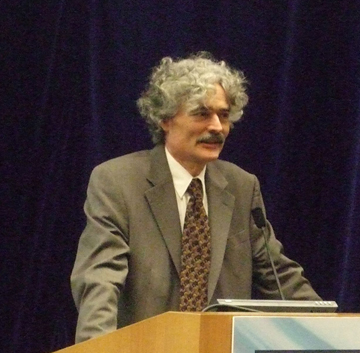
a talk by Daniel Varisco

Thursday, March 8, 2012 6:30-8:00pm Room 9206,
The Graduate Center, CUNY
365 Fifth Avenue, at 34th Street
New York, NY 10016
Directions

Can there be an anthropology of Islam when both the discipline of Anthropology and the idea of Islam appear to be suspended in a state of undisciplined flux? This talk places Abdel Hamid El-Zein’s suggestion that anthropologists study “islams” in dialogue with John Comaroff’s recent response to “Is anthropology about to die?” Professor Varisco explores the ways anthropologists have been rethinking the idea of Islam. He also offers suggestions on how anthropologists can contribute to the broader study of Islam as practiced in contemporary cultural and historical contexts.

Daniel Martin Varisco is Professor of Anthropology and Director of Middle Eastern and Central Asian Studies at Hofstra University. His latest book, Reading Orientalism: Said and the Unsaid (2007), is a study of the contested debate over Edward Said’s seminal Orientalism. His Islam Obscured (2005) is a critical assessment of the seminal texts of Clifford Geertz, Ernest Gellner, Fatima Mernissi and Akbar Ahmed on Islam.

Co-sponsored by the Committee for the Study of Religion and the Ph.D. Program in Anthropology

Political Cultures and the Revolution in the Cyrenaica of Libya


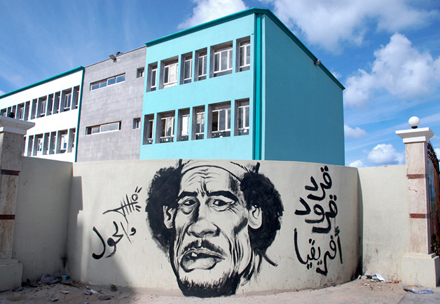
Spray painting the Libyan revolution

by Thomas Hüsken, Anthropology News, January, 2012

This commentary will explore some actors and patterns of the recent political culture in the Cyrenaica region of Libya with special regard to the revolutionary events. This political culture is shaped by the polymorphy of tribal, Islamic and civil urban forms of political organisation as well as varying notions of power and legitimacy.
Tribe and Revolution

In his early years Gaddafi abolished the tribe as a legal unit and reorganised local administrative structures, explicitly replacing tribal politicians with followers of the revolution. However this collided with the political, social and cultural realities in the country. In the past decades of Gaddafi’s regime tribal leaders had not only come to dominate and control a significant part of the state but also charged the political culture with tribal notions and practices. It is thus not surprising that tribal politicians have not been at the forefront of the revolution. Nevertheless they have actively shaped and organized a great deal of the transitional political order in the last months. They have come to dominate the local transitional councils in Cyrenaica due to their skills as producers of order and conflict mediators on the basis of the tribal customary law. They have gained significant influence in the National Transitional Council (NTC). The production of order is accompanied by a broad common sense on tribal culture among the population. Both build the legitimacy of these leaders. The political practice of these politicians is shaped by a consensus-oriented process of moderation and negotiation that is embedded in tribal traditions but is also informed by their education and by experiences in governance and business. Their political visions focus on the continuation of a regional and local intermediary rule between the central state and the people. The reintroduction of polygamy and Sharia by NTC Chairman Mustafa Abdul Jelil in November 2011 was an affirmative signal towards these leaders. In my understanding they will play an important role in the political future of post-Gaddafi Cyrenaica and in Libya as a whole. Continue reading Political Cultures and the Revolution in the Cyrenaica of Libya

A World to Fear or of Fear?


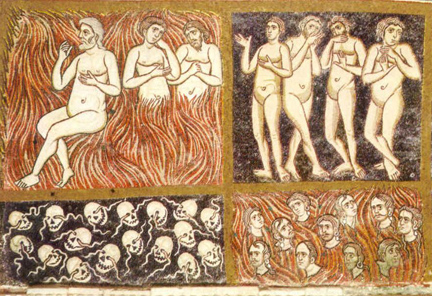
Unknown Artist. Sinners in Hell. Cattedrale di Santa Maria Assunta. Torcello (Italy). 12th century)

Yesterday I had the privilege of hearing a lecture by the anthropologist Talal Asad, who discussed the impact of the Arab Spring revolution in Egypt based on conversations he has held with Egyptians there and with a keen sense of historical insight. In the case of Egypt it is not just that it was sucked into strong-man rule for three decades under Mubarak, but that an entire generation has known nothing but cronyism and a firmly entrenched military elite still holds the reins, despite the street scenes on CNN. No one knows what exactly will happen next, least of all the media pundits who exude an expertise mentality that often borders on the ludicrous. One of the points that particularly struck me as poignant is the role of fear as a key aspect of all power politics. Mubarak, like Ali Abdullah Salih in Yemen and Ben Ali in Tunisia and even the Asad clan in Syria, have justified their self-serving iron grip as a quasi-secular bulwark against the specter of radical Muslims. They pretend to be the right kind of Muslims preventing the wrong kind of Muslims from taking over and returning the region to the 7th century. And Western nations, along with a number of Arab citizens, let fear dictate policy and overrule common sense.

Fear is on all sides, of course. Those who have dared to defy the power of the state have had good reason to fear, as the bloody security apparatus let loose in Syria amply demonstrates. Any trumped-up kind of “other” is an easy target for fear, especially when religious or ethnic identity is ascribed. In fact, as Talal noted, Mubarak went to great lengths to foster tension between Copts and Muslims in Egypt, creating fault lines for conflict where mutual cooperation had often been the norm. Religious sects do it to each other, dragging out the infidel charge and the heresy alibi whenever convenient. This is not at all unique to the Middle East or those who call themselves Muslims. When Rick Santorum states that President Obama does not base his policies on the Bible and Franklin Graham questions the president’s faith, religious passion is harnessed for political gain.

But what do we really mean by “fear”? Continue reading A World to Fear or of Fear?