Category Archives: Anthropology/Sociology

What do Ordinary Egyptians want?


[Editor’s Note: The following commentary is a post originally submitted to the Sociology of Islam listserv about the current debate over the proposed new Egyptian constitution. There has been an active discussion of the pros and cons of the constitution, both in Egypt and among academics abroad, as evidenced in Dr. Bamyeh’s comments.]

by Dr. Mohammed Bamyeh

I think we have been constantly losing track of, or at least are not sure about, the right question to ask. For me, the primary question has always been: what ordinary Egyptians wanted? I know that “ordinary” is a construct, but there are ways to either measure that when you can, or at least sense with reasonable evidence where the prevailing sentiments may be heading. The revolution was made by those “ordinary people,” not by professional “revolutionaries.” It would never have succeeded any other way. But within the revolution there has always been a hardcore self-identified “revolutionary camp” (which in fact was the minority) that had an inflated sense of self-importance, and thus a propensity to be easily and deeply frustrated when it did not get its way (beginning with the March 19, 2011 referendum). Out of that they developed a strong suspicion of ordinary Egyptians, but outwardly that suspicion appeared as a strong resentment of what to them appeared as a monolith called the Brotherhood. The fact that they did not afterwards hesitate to use the Supreme Constitutional Court, that bastion of the counter-revolution, as their main weapon against popular will, and do so precisely in the name of the revolution(!) is simply shameless.

The fact that they did not want to accept was that the Ikhwan won not because of any manipulation, nor because of a deal with the military, but simply because they deserved to win. I am certainly not an Islamist–in fact I would describe my political leanings as anarchist. However, the real question for me is not one of ideology, but of sociology. The force that will have most resonance after the fall of a dictatorship would naturally be one that is most organically embedded in the deep, deep fabric of society, that exists in every Egyptian village, that for more than 80 years has been doing what ordinary Egyptians have felt to be useful, practical, everyday, non-revolutionary work–mostly. In contrast, what have the leftists/secularist/liberals ever done other than issuing pamphlets and grand declarations? What have they ever done for anyone, so as to cultivate the conviction that they should be the natural leaders of a society in which they had little roots and to which they spoke as vanguardist strangers–and before the revolution, often with contempt? Continue reading What do Ordinary Egyptians want?
No Olive Branch in Gaza


by Daniel Martin Varisco
[Originally posted on Anthropology News.]

Civil unrest continues to grip the Middle East. Adding to the battle to remove Syria’s Russian-backed Assad and the political infighting following the ousting of dictators in Tunisia, Libya, Egypt and Yemen is a recent flare up in Gaza, leaving more than 160 Palestinians dead before a fragile ceasefire took hold just before Thanksgiving Day.

Politics can often mirror geography, especially in a land considered holy by three major religions. The lowest geographical point on earth is the Dead Sea, a critical juncture point of Israel, the Palestinian Authority and Jordan. But not far away sandwiched between Israel and Egypt is the narrow strip of Gaza, which is perhaps the lowest moral point in the current political strategy of the Israeli government and its vaunted IDF.

To say that the Gaza Strip is over populated and under resourced is an understatement. An estimated 1.7 million Palestinians live in a beleaguered area of 141 square miles, isolated and walled off like a Bantustan oasis. Before the 1948 creation of the state of Israel, this was a sparsely populated area with few resources to attract settlement, but some 200,000 Palestinians fled here at the time. Formal occupation of Israel, following the 1967 6-day war, officially ended in the mid-90s with the Oslo Accords. But there has been no peace in Gaza, whether under the control of the PLO or Hamas.

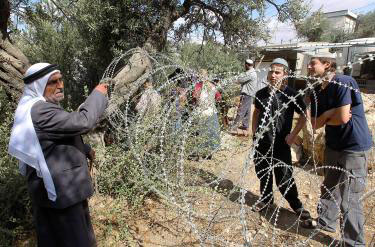
Pundits flood the airwaves with condemnation of Hamas, as though calling it a terrorist organization means open season on any Palestinian living in Gaza. So why does Hamas not sue for peace, given the obvious fact that a slew of puny missiles lobbed at Israel only brings more retaliation? A potent symbol of peace in the “Holy Land” is the olive branch. Students still read about this peace symbol in Virgil’s first century BCE Aeneid, so the need for such a symbol has certainly been around along the shores of the Mediterranean for a long time. Defenders of Israel’s continuing bombing strikes and assassinations in Gaza argue that Israel has a right to defend itself because Hamas is out to somehow destroy Israel. Hence Israel’s expensive prophylactic “Iron Dome” symbolically trumps an olive branch on the cable news. But it is hard to expect Palestinians to wave olive branches when there are so few olive trees left standing in Gaza. The recent “Pillar of Cloud” military campaign that rained down on Gaza occurred during the height of the olive harvest and processing season.

For the rest of this post, click here.

Being Normal and being Car Bombed


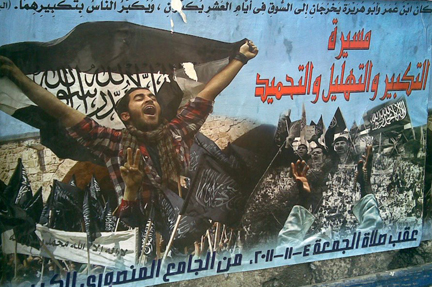
Poster in Tripoli, Lebanon; photography by Estella Carpi

Unearthing a misconceived “normalization” of violence in Beirut. The October car bomb in relation to generalized insecurity.

The 19th October 2012 car bomb in Beirut’s Ashrafiyye, within the Eastern district of the Lebanese capital, shed light on the re-articulation of the relations between the State, allegedly “inexistent” in the Lebanese context, and its society that lives in the constant effort to subjectively reformulate their citizenship, in the lack of a commonly shared nationhood.

New outbursts of violence seem to give a reason to the state to promote its technology of control, as Michel Foucault would put it. This complex re-articulation of relations has come to the fore with the October 26 White March from Martyrs Square (Beirut Downtown) to Sassine Square (Ashrafiyye, where the explosion was one week before). The “White March”, in which no political flag but the national Lebanese was waved, wanted to be considered as an act of social refusal of further violence and national solidarity, in addition to their political contestation of both the 14 and 8 March coalitions, which have politically and socially polarized the country into two sections after Hariri’s murder in February 2005. The White March mainly had the implicit aim of contesting the taken for granted watershed between what is “normal” and what is not in Lebanese parameters.

Social fear, as well as the perception of risk in Beirut, has specific historical explanations. Lebanese society seems to be doomed to live in a not-war-not-peace state, as Jeffrey Sluka used to define Northern Ireland during the clashes between Protestants and Catholics. Such an unstable state has engendered a social attitude towards violence that has been named by political scientists and journalists as “normalization”, which, in light of the Lebanese reaction to the last explosion, begs for a re-conceptualization. Continue reading Being Normal and being Car Bombed

Two documentary films on Islam in NYC

For those in the New York area and who have power (I still do not after Sandy hit last week), there are two films that will be of interest to those who read this blog. One is American Imam by Donya Ravasani. It is showing twice at the IFC Center: Saturday, Nov 10 at IFC 11:15am and Thursday, Nov 15 at IFC 1pm

It will be screened together with Building Babel, David Osit’s documentary about the developer of the so called Ground Zero Mosque.

For details on New York’s Documentary Festival, check out their website.

Yemen Conference at Harvard


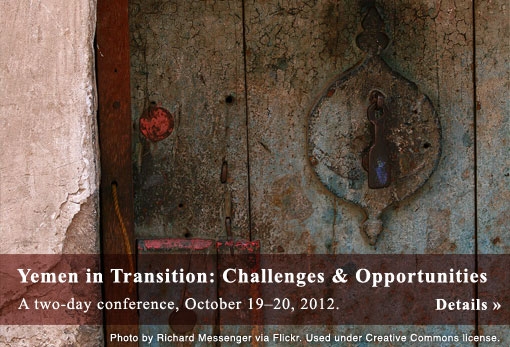
This past Friday and Saturday a conference was held on “Yemen in Transition.” While I was originally scheduled to give a presentation, I was not able to attend. But here is an overview of the conference, with complete details on the conference website.

Date: October 19, 2012 (All day) – October 20, 2012 (All day)
Speaker: various
Yemen in Transition: Challenges and Opportunities
Organized by Steven C. Caton, Harvard University, and the Yemen Working Group, this conference brings together Yemeni American professionals and academics along with some of their counterparts from Yemen, and academics from the U.S., Europe, and Yemen to discuss the future of Yemen and what might be done to help the country as it transitions into its new historical phase. It also brings together students from Harvard and the Boston area who are from Yemen. The main topics to be discussed are: women and youth, economic development, politics and political reform, and the water crisis. As an academic conference, the focus will be on theory and analysis, though concrete proposals and recommendations will also be presented.

The panels and the keynote address are open to the public. These presentations will be videotaped and made available on the website of the Harvard Center for Middle Eastern Studies but they will not be published as part of a conference proceedings. The use of recording devices by anyone other than the organizers is strictly prohibited.

On Drones


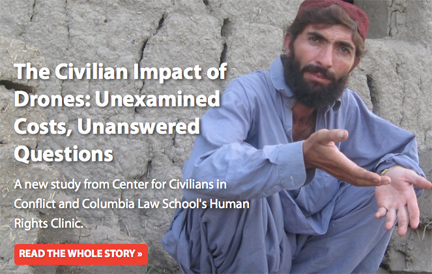
The Center for Civilians in Conflict and Columbia Law School’s Human rights Clinic have recently produced a report on the impact of drones on civilians. Below is the abstract; the full report can be found in pdf format here.

The Civilian Impact of Drones: Unexamined Costs, Unanswered Questions
Publication | 29 Sep 2012

This joint report from the Center for Civilians in Conflict and Columbia Law School’s Human Rights Clinic is an in-depth look at the US government’s covert drone program and its impact on civilian populations. Our objective is to critically assess US government procedures and standards for ensuring civilian protection and responding to civilian harm from drone strikes conducted both outside of full-scale military operations and with a degree of secrecy. The study is based on a review of publicly available materials, interviews with current and former government officials, responses to requests for information from agencies, and previous field interviews by Center for Civilians in Conflict.

Drones are touted as the most precise and humane weapons platform in the history of warfare. The technological advance is significant, but covert drone strikes carry costs for civilians and local communities even as they become a policy norm. Blinded by the promise of this technology and reports of short-term effectiveness in killing militants, policymakers are failing to ask hard questions of the drones program, including whether other tactics or strategies are more appropriate to counterterrorism strategy, and whether US expansion of strikes to new places and against new groups is truly justified.

Malala and malevolence

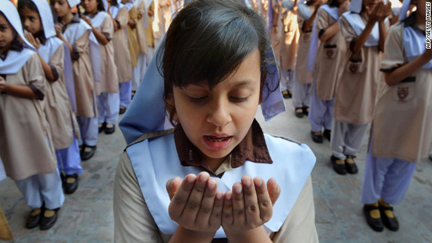
Pakistani school girls pray for the recovery of teen activist Malala Yousufzai at their school in Peshawar on Friday.

A fourteen-year old girl is shot in the head for wanting to be educated. It is hard to imagine a more sadistic premeditated attack on innocence. Her name is Malala and her attackers are Taliban extremists who have so perverted the teachings of Islam that they commit the ultimate modern-day shirk: assuming that their cowardly act has divine sanction. The assassination attempt on a school bus is now one of those shots heard across the world. To be sure, the gunshots that have ripped through bodies in Muslim countries number in the thousands these days. The attack on Malala does not override the horrific bloodshed taking place in Syria, the continuing violence in Afghanistan and Iraq and elsewhere. But it stands out as a symbol of what goes terribly wrong when partisan religious fervor enters the political arena.

Pakistan’s president, Asif Ali Zardari, recognizes this: “”The Taliban attack on the 14-year-old girl, who from the age of 11 was involved in the struggle for education for girls, is an attack on all girls in Pakistan, an attack on education, and on all civilised people.” He recognizes that such malevolence puts every young girl in Pakistan in danger and threatens to further divide debates in his country into violent conflict. But this is not only an attack on “all civilised people”; this is an assault on all people. And, as the photograph of a young Muslim girl praying above shows so well, an attack on the very idea of the merciful God she prays to.

I have never met Malala and probably never will. But Malala is my daughter, my wife and my mother. Shooting her is an attack on my family and yours. If the shooters dared to whisper bi-ism-Allah-al-rahman-al-rahim before they pulled the trigger against a child of God, may that same God have mercy on their souls, because they never learned the true meaning of the words they spoke. Continue reading Malala and malevolence

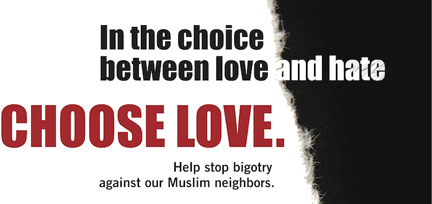
Poster War on the New York Subway


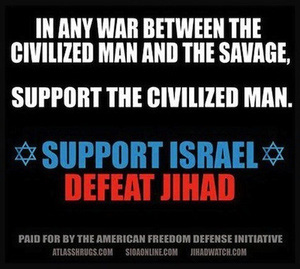
Poster from American Freedom Defense Initiative


Poster from Rabbis for Human Rights

[The following commentary has just appeared on Anthropology News in my blog there called “Middle East Muddle.: I provide the first paragraph, and the rest of the commentary can be read here.]

In the late 19th century there was little doubt about the gulf between “civilized man” and the “savage,” as anyone reading John Lubbock or Edward Tylor or Lewis Henry Morgan would readily note. Anthropology has come a long way since the cultural evolution scenarios that followed immediately upon the Darwinian revolution in biology. By the time Claude Lévi-Strauss penned Tristes Tropiques in 1955, the tables had turned, with so-called “civilized man” seen as acting the “savage.” Anyone reading Bartolemé de las Casas on the Spanish atrocities in the New World in the early 16th century could have come to the same conclusion. So it is quite un-anthropological today to encounter a poster in the New York subway system about the “war between the civilized man and the savage,” let alone to be urged to “support the civilized man.” Yet, this is the message paid for by the “American Freedom Defense Initiative.”

For the rest of this post, click here.

Since writing this, several groups are now running counter ads in the subways. For more on this, see the commentary by Omid Safi.