Category Archives: Orientalism

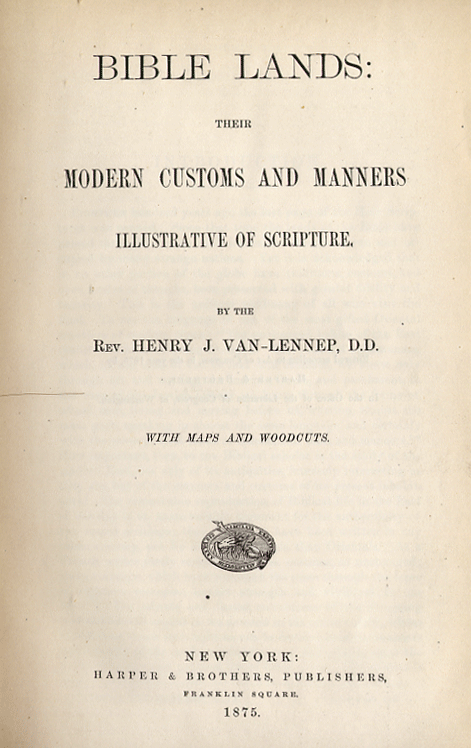
With Van-Lennep in Bible Lands: 3


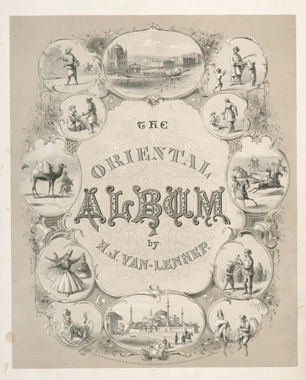
Van-Lennep’s album cover

In 1862 Henry J. Van-Lennep published twenty original chromolithographs of life in Ottoman Turkey. These include two scenes of Jewish life in the Ottoman Empire, “A Turkish Effendi,” “Armenian Lady (at home),” “Turkish and Armenian Ladies (abroad),” “Turkish Scribe,” “Turkish Lady of Rank (at home),” “Turkish Cavass (police officer),” “Turkish Lady (unveiled),” “Armenian Piper,” “Armenian Ladies (at home),” “Armenian Marriage Procession,” “Armenian Bride,” “Albanian Guard,” “Armenian Peasant Woman,” “Bagdad Merchant (travelling),” “Jewish Marriage,” “Jewish Merchant,” “Gypsy Fortune Telling,” “Bandit Chief,” “Circassian Warrior,” and “Druse Girl.” The lithographer for Van-Lennep’s paintings was Charles R. Parsons (1821-1910).
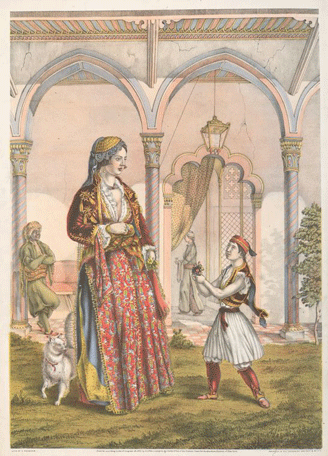

Van-Lennep’s illustration of a Turkish Lady of Rank (At Home)
Continue reading With Van-Lennep in Bible Lands: 3

With Van-Lennep in Bible Lands: 2


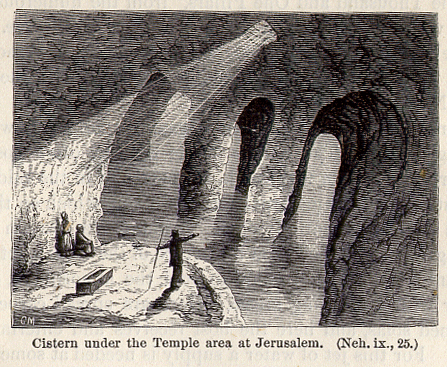
Van-Lennep’s illustration of a Easterner with outstretched arm in awe at the scenes under the Temple mount at Jerusalem

Heny J. Van-Lennep, missionary, author and artist of the Holy land, has no doubt that the “remarkable reproduction of Biblical life in the East of our day is an unanswerable argument for the authenticity of the sacred writings.” While the bias of this Christian writer is clear, it would appear to flow more from a sense of sectarian and cultural superiority rather than an innate desire to denigrate the people being studied. Because writers like Van-Lennep believed that current customs of the Arabs, in particular, had been preserved by God as a testimony to the truth of scripture, these customs were held in high regard. While I hesitate to label the efforts of these texts as “ethnography” in the contemporary sense, Van-Lennep (1875:6) is proud of the fact that he “enjoyed unrivaled opportunities of intercourse with all classes of people.”

Rather than using his text to criticize the “Orientals,” Van-Lennep (1875:7) is at pains to counter existing stereotypes of his day. Thus, he used “Mohammed” rather than “Mahomet”, “Bedawy” rather than “Bedouin.” Consider the rationale for recognizing how Muslims saw themselves: “On the other hand, we have not called the religion of Mohammed Mohammedanism, but Islam, its universal name in the East (not Islamism, nor the religion of Islam); and his followers not Mohammedans, but, as they call themselves, Muslims (not Mussulmans); Muslimin is the plural of Muslim.” To the extent that Van-Lennep believed that God had preserved these customs as a testimony, it was important to describe them as accurately as he could. Continue reading With Van-Lennep in Bible Lands: 2

With Van-Lennep in Bible Lands: 1

The nineteenth century Rev. Henry J. Van-Lennep provided one of the most exhaustive (832 pages) compilations of contemporary customs of “Holy Land” peoples said to be “illustrative of scripture.” In a sense the popularity of the “Bible customs” genre, which included many of the travel accounts of ministers, missionaries and lay Christians, served as an antidote to the Higher and Lower Criticism of the Bible. To the extent the Bible was treated as a literary text, the divine luster wore thin for conservative Christians. By the mid-nineteenth century archaeological discoveries in the Holy Land seemed to vindicate aspects of recorded biblical history. Van-Lennep, however, was less concerned about the spoils beneath the soil than the customs of contemporary Arabs and other indigenous people in what he thought of as Bible lands. Continue reading With Van-Lennep in Bible Lands: 1

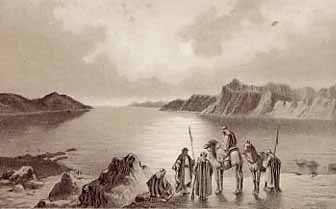
The Land and the Book #5: Dead Sea Reflections


The Dead Sea from Thomson’s “The Land and the Book”, opp. p. 614

Almost 150 years ago one of the most popular travel accounts of the Holy Land was penned by an American missionary named William M. Thomson. Born in Ohio, my own home state, the 28-year old Thomson and his young bride arrived in Lebanon in 1834 as Protestant missionaries. This was a mere 15 or so years after the first American missionaries had made the Holy Land a mission field. At once an entertaining travel account and Sunday School commentary on the places and people of the Bible, this may have been one the most widely read books ever written by a Protestant missionary.


Reading Thomson is like reading one of the early English novels. The language is less familiar, although still thoroughly Yankee and the devotional tone has long since disappeared for a readership buying out The Da Vinci Code as soon as it hit the bookstores. The biblical exegesis, literalist yet frankly pragmatic at times, is intertwined with astute and at times humorous accounts of the people Thomson met along the way. But the style is not at all dry or discouragingly didactic. From the start Thomson engages in a dialogue with the reader, making the text (which stretches over 700 pages in the 1901 version) a rhetorical trip in itself.

Among the wonders described by Thomson is the Dead Sea, which as a devout literalist he interpreted through the biblical tale of the brimstone destruction of Sodom and Gomorrah. Yet, he is quite interested in the geologic and chemical character, as he notes: Continue reading The Land and the Book #5: Dead Sea Reflections

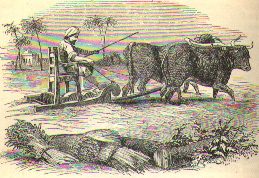
The Land and the Book #4: Bringing in the Sheaves


Threshing Sledge or Mowrej from Thomson’s “The Land and the Book”, p. 540

Almost 150 years ago one of the most popular travel accounts of the Holy Land was penned by an American missionary named William M. Thomson. Born in Ohio, my own home state, the 28-year old Thomson and his young bride arrived in Lebanon in 1834 as Protestant missionaries. This was a mere 15 or so years after the first American missionaries had made the Holy Land a mission field. At once an entertaining travel account and Sunday School commentary on the places and people of the Bible, this may have been one the most widely read books ever written by a Protestant missionary.


Reading Thomson is like reading one of the early English novels. The language is less familiar, although still thoroughly Yankee and the devotional tone has long since disappeared for a readership buying out The Da Vinci Code as soon as it hit the bookstores. The biblical exegesis, literalist yet frankly pragmatic at times, is intertwined with astute and at times humorous accounts of the people Thomson met along the way. But the style is not at all dry or discouragingly didactic. From the start Thomson engages in a dialogue with the reader, making the text (which stretches over 700 pages in the 1901 version) a rhetorical trip in itself.

While hardly free from Yankee hubris and missionary zeal, Thomson’s observations are often useful as well as colorful, especially when accompanied by illustrations. Consider, for example, this description of threshing on a visit to Yebna, about three and a half hours from Haifa through Wadi Hanayn in Palestine: Continue reading The Land and the Book #4: Bringing in the Sheaves

Reviewing the Review

In 2005 I published Islam Obscured, a critical assessment of four books widely read as “the” anthropology of Islam. The books I examined were by Clifford Geertz, Ernest Gellner, Fatima Mernissi and Akbar Ahmed. Having wielded an iconclastic hammer over the first four chapters, I concluded the book with a brief question-and-answer survey of the ways in which “Islam” has and should be studied by anthropologists who value the role of ethnographic fieldwork. At the time, the publisher failed to send the book out for review, although some review copies finally went out over a year ago. There are many, many books out there on “Islam,” but my text was, to not mire myself in humility, somewhat unique. It faulted these texts for not using ethnographic data but rather essentializing their own views of what Islam should be.

I recently received a lengthy review by Ken Lizzio, whose research was on Sufi texts, in The Journal of North African Studies (14:309-316, June, 2009). Having written my book in large part for non-anthropologists, I was quite interested in how a specialist in Near Eastern Studies would react to it. The thrust of the reviewer strikes me as quite positive, especially when he states: “As Varisco proceeds to fell some of the giants in the anthropological forest, he does so with an axe sharpened with impeccable logic and refreshing intellectual honesty” (p. 310). The reviewer agrees with me that both Geertz and Gellner both fail to apply data from fieldwork to their assertions. So far, so good. Continue reading Reviewing the Review

Conference on Said’s “Orientalism”

Today I am at the American University of Beirut for a one-day conference looking back on the impact of Edward Said’s seminal and polemical Orientalism, first published in 1978. The conference, “Orientalism and its Critics,” is sponsored by The Center for Arab and Middle Eastern Studies and the Department of Philosophy. Here is the line-up, for those who want to pseudo-twitter the event.

9:30 Basim Musallam (Cambridge University)
A First Reading of Orientalism

10:30 Daniel Varisco (Hofstra university)
Orientalism’s Wake: The Ongoing Politics of a Polemic

12:00 Ahmad Dallal (Georgetown University)
Cultural History and the Persistence of Orientalism: The Case of the 18th Century

1:00 Robert Irwin (University of London)
Pulp Orientalism

4:00 Robert Spencer (University of Manchester)
The War on Terror and the Backlash against Orientalism

5:00 Sadiq Jalal al-Azm (University of Damascus)
Political Said

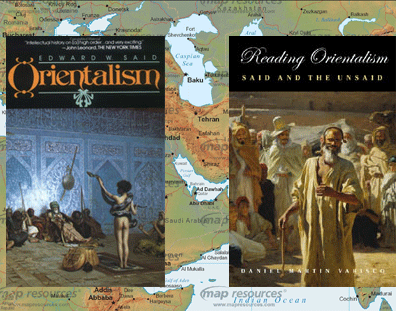
My talk will be published this fall in a special issue of Viewpoints, an online forum of the Middle East Institute. It is a follow-up to my 2007 book, Reading Orientalism: Said and the Unsaid, published by the University of Washington Press.