Category Archives: Orientalism

A Geography Lesson from 1879: #2: An Enlightened National View of the Others


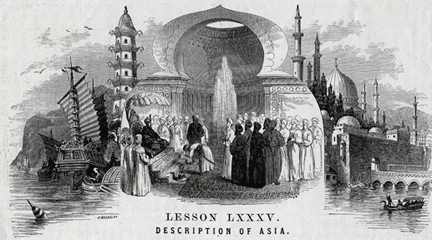
I recently started a thread on a school geography book from 1879. At that time the idea of “civilization” was fixed in a hierarchy. According to Lesson XXI (States of Civilization), there were degrees for separating out the inhabitants of the earth. Here is the sequence, with the student no doubt informed in the classroom that the United States was the most enlightened:

1. Nations, with regard to the degree of their civilization, are divided into five general classes: Savage, Barbarous, Half-civilized, Civilized, and Enlightened Nations.
2. Savages
dwell in tribes; they live in caves, dens, or huts, and are chiefly occupied in hunting, fishing, or war.
3. Barbarous Nations live in larger communities than savages, practice some rude arts, attend to the rearing of flocks and herds, and in some cases, till the soil.
4. Half-civilized Nations
have organized governments and dwell in cities, occupy themselves in agriculture and mechanic arts, but are without education, refinement, or morality.
5. Civilized Nations are such as have made considerable progress in knowledge and morality, have good governments and generally wise laws.
6. Enlightened Nations
are such as hold the highest rank in intelligence, scientific progress, and moral, religious, and social culture.

Excerpt from: Colton’s Common School Geography (New York: Sheldon and Company, 1879), 17.

to be continued
A Geography Lesson from 1879: #1: The Earth is not a Plain


Once upon a time Geography went right along with the three r’s in the school curriculum. I have a copy of the geography text my great, great Aunt Ida used. This was Colton’s Common School Geography illustrated by numerous engravings and twenty-two study maps, drawn expressly for this work, and specially adapted to the wants of the class-room, to which are added two full-paged railroad maps, showing the chief routes of travel, and a complete series of twelve commercial and reference maps of the United States. It was published by Sheldon and Company, located at the time on 8 Murray Street in New York, in 1879.

In 1879, when my discipline of Anthropology was still in academic diapers, Geography was defined as “that branch of science which describes the surface of the earth, the divisions and inhabitants” (p. 3). Apparently back then it was still important to show why we knew the earth was not flat. As the text explains:

We know that the earth is not a plain, because 1. Navigators have sailed around it; 2. The upper portions of objects at a distance, as a ship at sea, are seen before any other part; 3. The shadow of the earth, as seen at the time of an eclipse of the moon, has always the form of a circle or a segment of a circle. (p. 3)

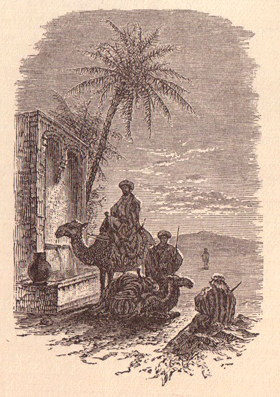
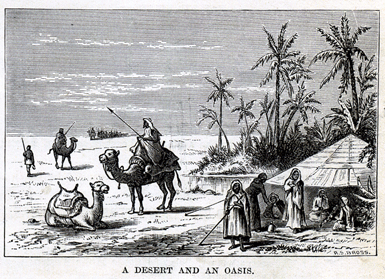
In discussing land divisions some 20 different kinds are listed, including a desert (“a tract of land nearly or quite barren”) and an oasis (“a fertile spot in the desert”) with both of these rating an illustration as shown above.

to be continued

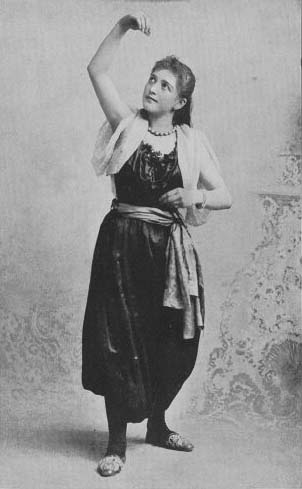
Belly Dance a century ago


Little Egypt

There are several fascinating videos uploaded on Youtube of belly dance more than a century ago. One is a very short clip of 14 seconds from 1895 of a dancer named “Princess Ali.” Another is an early Edison film of Ella Lola, made in 1898, combined on Youtube with a 1900 track of Turkish music. The video lasts over three minutes. Ella was in costume, but another early video from 1904 shows “Princess Rajah” in the dress of the day dancing away her hoochie koochie as a circus act complete with chair. The queen of the art, at least in hindsight, was “Little Egypt,” who is also to be found in a clip from a movie about striptease. Although not an original film video, there is an interesting Youtube video with vintage “Orientalist” commentary about Egyptian and other North African belly dance at the 1889 L’Exposition Universelle, especially along “La Rue du Caire.”

For an overview of belly dance, see the excellent article by Najwa Adra.

Grease-Monkeys and Bedouin Girls


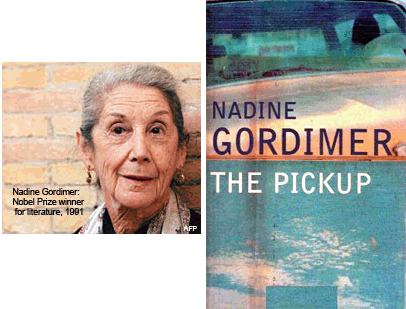
Grease-Monkeys and Bedouin Girls: The Rhetorical Fate of Arabs and Muslims in Nadine Gordimer’s The Pickup.
By Daniel Martin Varisco, Tingis Redux, December 11, 2010

Novels tell Stories, allowing readers to fantasize about reality but with no obligation to represent that reality as anything other than fantasy. Good novels, at least the kind that garner a Nobel prize for their author, capture the imagination through creative engagement and style. The South African author Nadine Gordimer has been writing about the shame of apartheid in her native land for more than half a century. Her focus on the moral and psychological tensions of racial inequality provides a welcome political stamp to her fiction. Yet, sometimes in telling one kind of story, especially teasing out the relationships of lovers across cultural boundaries, another story can be read between the lines. The Pickup, Gordimer’s acclaimed novel which pairs a privileged South African white girl named Julie with an Arab Muslim and illegal alien named Abdu, traces an unlikely love story but leaves the identity of Abdu literarily in the dust, the dust of a stereotyped Orientalist denigration of his homeland and his religion. One need not follow Edward Said’s controversial contrapuntal reading to find in this novel a generic image of Arab and Muslim that serves the plot only in its unrelenting negative portrayal. The Pickup, whatever its merits as a close study of personal dislocation, succeeds by picking on distorted images of Arab and Muslim.

For the rest of this essay, read it on Tingis Redux.

Still in a pretty pass …


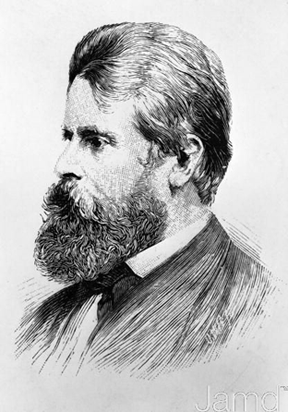
English poet and traveller Wilfrid Scawen Blunt (1840 – 1922), circa 1880.

Webshaykh’s Note: Given the ongoing crises in the Middle East, it is useful to return to earlier commentaries. In the excerpt below the voice of Wilfrid Scawen Blunt echoes with resonance for events currently in the news about Gaza, Iraq and Afghanistan. Let us all hope that the new year brings tolerance and peaceful intentions for us all.

Wealthy and well connected Wilfrid retired from the foreign service in 1869 and soon the traveling Blunts went east. As Wilfrid noted about his first visit to Egypt in 1879, he was still “a believer in the common English creed that England had a providential mission in the East.” After learning about Bedouin customs firsthand in Syria Lady Anne spoke for both travelers about their interest in no longer looking at the people “with the half contemptuous ignorance” of Europeans. Not only were the Blunts aware and appalled at Eurocentric attitudes, but Wilfrid wrote of Islam as a “true religion,” which certainly had far more to offer African converts than Christianity. In 1881 Blunt bought an estate in Cairo, where he became a neighbor and friend of the Islamic reformer Muhammad ‘Abduh. On a visit to England Blunt arranged a visit between ‘Abduh and the reigning social philosopher, Herbert Spencer; the Egyptian reportedly told Spencer that the East was learning the evil rather than the good from the West, but the best of both was the same.

Blunt was perhaps the most famous aristo-critic of British imperialism in Egypt. With the impunity his elite upbringing bequeathed at the time he admonished Lord Cromer, whose “wrong-headed administration” only served to Anglicize Egypt. He used his impeccable social connections to lobby British politicians, including Prime Minister Gladstone, whose “Oriental” policies he deplored. Blunt’s radical critique of the colonial transgressions committed by the burdensome white race is second to none, including Fanon and Césaire. Consider his prescient diary note at the close of the nineteenth century:

The old century is very nearly out, and leaves the world in a pretty pass, and the British Empire is playing the devil in it as never an empire before on so large a scale. Continue reading Still in a pretty pass …

Buried Texts Recovered: An American Consul goes to Bethlehem, 2

I continue a thread on one of the numerous 19th century Bible customs travel accounts by Christian enthusiasts able to travel to their “Holy Land.” The author, Frank S. DeHass, served as the United States Consul in Palestine in the mid 19th century. His text is aptly entitled Buried Cities Recovered, or, Explorations in Bible Lands, giving the results of recent researches in the Orient, and recovery of many places in sacred and profane history long considered lost. My copy, handed down from my grandmother, was published in 1886 in Philadelphia by Bradley & Company; the tenth edition no less! This is a wonderful read and it is worth reading the entire book online, thanks to Google Books.

An eastern inn, or khan, never was a house of entertainment in the sense that Americans understand a hotel to be. Such accommodations as provision, bed, and other comforts at an inn are unknown int he Orient, and belong exclusively to western civilization. In the East all travelers carry their own bedding and provision with them, and must dress their own food, kindle their own fire, and spread their own table. An Oriental inn is merely a place of shelter from the storm, or protection from robbers, where a man and his beast can safely lodge for the night free of charge. A portion of the khan was assigned to the beasts, generally one side, and travelers who came in late, if they found the khan full, would have to make their beds in the manger with the horses and camels, as Joseph and Mary were forced to do. These caravansaries, or inns, were sometimes very rude, simply a rough wall built around a house, or natural caves int he rocks, as appears to have been the case at Bethlehem. Many of these grottoes are used as stables in the neighborhood, and some of them as dwellings by the Arabs. Continue reading Buried Texts Recovered: An American Consul goes to Bethlehem, 2

New book on Lawrence


A new book has appeared by Michael Korda entitled
The Life and Legend of Lawrence of Arabia (Harper/HarperCollins Publishers, 762 pages). A review by Ben MacIntyre was published in yesterday’s New York Times, the beginning of which I attach here.

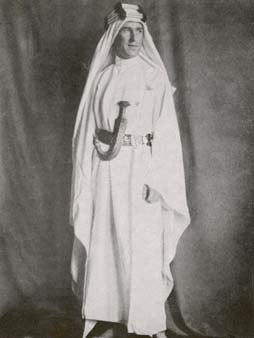
Lowell Thomas, the pioneering American journalist and filmmaker, was buying dates on a Jerusalem street soon after the holy city had been wrested from Turkish control by British forces in 1917, when he spotted a group of Arabs, led by a most remarkable figure. “A single Bedouin who stood out in sharp relief from his companions; . . . in his belt was fastened the short curved sword of a prince of Mecca, . . . marking him every inch a king. . . . This young man was blond as a Scandinavian. . . . His expression was serene, almost saintly, in its selflessness and repose.”

The robed figure was T. E. Lawrence, Lawrence of Arabia, Laurens Bey to his Arab comrades in arms, the “Uncrowned King of Arabia” according to his boosters. And if Thomas’s description seems sensationalist, that is hardly surprising, for the American did more than any other single person to turn Lawrence into a glittering multimedia global celebrity, a fable, a saint and a myth.

Lawrence was an ambiguous figure in his lifetime, and has remained so ever since, in part because the fog of fame made it virtually impossible to see him clearly, then and now. He was a scholar and warrior, an imperialist and supporter of Arab independence, a politician and rebel, a publicity seeker and recluse. Fighting alongside Arab irregulars in the revolt against Turkish Ottoman rule during World War I, he was fanatically brave and chillingly ruthless. He was fastidious, inconsistently vegetarian, sexually repressed, allergic to physical contact and addicted to danger, flagellation and roasting baths. He was fabulously weird. Continue reading New book on Lawrence