Category Archives: Terrorism Issue

Suharto’s Legacy

By Timothy Daniels

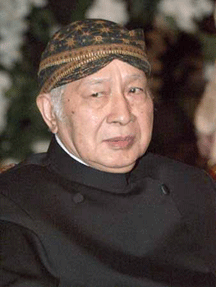
Former President Suharto, long-time dictator of Indonesia, has passed away on January 27, 2008. He came to power during a shadowy “coup” in 1965 which resulted in the charismatic first president, Bung Sukarno, being unseated and imprisoned and in the massacre of thousands of people in what came to be known as the “year of living dangerously.” Bung Sukarno was a leader of the non-aligned movement during the Cold War era and architect of an unifying ideology (nasakom) which sought to include nationalists, religious organizations, and communists—the three main streams of the anti-colonial movement—within national governing units. US political officials viewed Bung Sukarno as a threat to the “free” and “democratic” First World and Suharto, an opportunistic lower-ranked colonel, as the military strongman to keep Indonesia under western influence. Continue reading Suharto’s Legacy

Raw Footage


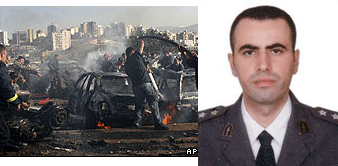
Blast site in Beirut, left; Wissam Eid, right

Another city, another bomb, more deaths. It could be anywhere in the Middle East these days, but I am referring to a bomb that went off in a Christian neighborhood of Beirut yesterday. If you lived in Beirut you would see the devastation without media cleansing. An Arabic report is viewable at http://www.liveleak.com/view?i=70b_1201323034 and needs no translation, but the BBC also has a video report at http://www.liveleak.com/view?i=fc6_1201258935. For the raw footage of the aftermath another video is also on the net at http://www.liveleak.com/view?i=010_1201257690.

According to the latest reports at least five people died, including Wissam Eid, a senior intelligence officer, as well as more than 40 wounded. It was shocking enough in a country that has witnessed so many bombings and bloodshed, most recently the loss of Major General Francois al-Hajj, who was killed on Wednesday by a car bomb. Prime Minister Fouad Siniora has declared today, Saturday, a national day of mourning in Lebanon.

Look at the picture of Wissam Eid, posted above. Look beyond this one face to the mutilated bodies of thousands that die each year from bombs and guns, not just in the Middle East. Are there any tears in your eyes today or is this just somebody else’s problem because it is somebody else’s face? Continue reading Raw Footage

Poems from Guantánamo: The Detainees Speak

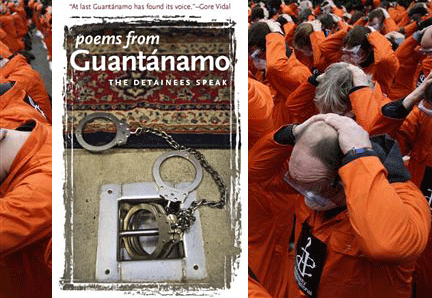
Since 2002, at least 775 men have been held in the U.S. detention center at Guantánamo Bay, Cuba. According to Department of Defense data, fewer than half of them are accused of committing any hostile act against the United States or its allies. In hundreds of cases, even the circumstances of their initial detainment are questionable. Poems from Guantánamo: The Detainees Speak (The University of Iowa Press, 2007) conveys the voices of men held at Guantánamo. Available only because of the tireless efforts of pro bono attorneys who submitted each line to Pentagon scrutiny, Poems from Guantánamo brings together twenty-two poems by seventeen detainees, most still at Guantánamo, in legal limbo. The collection is edited by Marc Falkoff, who has worked on behalf of many detainees from Yemen, and contains a preface by Flagg Miller, an anthropologist and professor of religious studies at the University of California, Davis. Miller’s essay combines an overview of Muslim prison poetry throughout history to an analysis of the poems in the collection, and is entitled “Forms of Suffering in Muslim Prison Poetry.” An afterward is written by Ariel Dorfman, a Chilean American poet, novelist, and human rights activist who teaches at Duke University. Continue reading Poems from Guantánamo: The Detainees Speak

Hillbilly Heaven and Muslim Paradise

There is an old Tex Ritter song where he imagines going to heaven and hearing the roll call of future Country Western singers. It goes like this:

I met all the stars in hillbilly heaven
Oh what a star-studded night

Then I asked him who else do you expect in the next, uh, say a hundred years? He handed me a large book covered with star dust. Will called it the Big Tally Book. In it were many names and each name was branded in pure gold. I began to read some of them as I turned the pages: Red Foley, Ernest Tubb, Gene Autry, Roy Acuff, Eddy Arnold, Tennessee Ernie, Jimmy Dean, Andy Griffith, Roy Rogers, Kareem Salama
Whaaaatttt???
Kareem Salama? Oh, well, that’s when I woke up, and I’m sorry I did, because
I dreamed I was there in hillbilly heaven
Oh what a beautiful sight…

OK, so the original lyrics did not include Kareem Salama, but if Dolly Parton can rearrange the song, why can’t I? So who is Kareem Salama, you ask? Continue reading Hillbilly Heaven and Muslim Paradise

Out-of-Print CCAS Occasional Papers now Available Online

By L. King-Irani, Georgetown Center for Contemporary Arab Studies, October 22, 2007

Dissemination of information and analyses within and beyond the scholarly community is a key priority for the Center for Contemporary Arab Studies. The Center’s Multimedia, Research and Publications office publishes a prestigious Occasional Paper series featuring works by scholars, journalists, policy makers and field experts three to four times each year. This series now includes nearly 100 works covering a wide variety of subjects and perspectives on the Arab world. In addition, the series also includes transcripts of discussions among key players in the U.S. and the Arab world, such as Uncovered: Arab Journalists Scrutinize Their Profession, which features prominent Arab journalists’ analyses of press freedom and responsibility across the region. Forty of the Center’s Occasional Papers are now online.

The following six Occasional Papers have just been added to the group available in PDF format, two of them, Talal Asad’s The Idea of an Anthropology of Islam, and the late Hanna Batatu’s The Egyptian, Syrian and Iraqi Revolutions: Some Observations on Their Underlying Causes and Social Character, have been among the most popular and requested Occasional Papers over the last two decades. Continue reading Out-of-Print CCAS Occasional Papers now Available Online

Research Fellowship on Muslim Modernities

2008 DPDF Research Field:
Muslim Modernities

Research Directors: Charles Kurzman and Bruce B. Lawrence

Islamic fundamentalists and Western Orientalists often emphasize pre-modern resonances in contemporary Muslim communities. Over the past generation, by contrast, an interdisciplinary set of scholars has come to emphasize the ways in which Islamic historical heritages are extruded, redefined, or invented through modern processes. We label this emerging field “Muslim Modernities.”

The idea of modernity was invented in Western Europe to distinguish the region from the rest of the world, including Muslim societies. Scholars disagreed about what modernity consisted of — capitalism, division of labor, rationalization, reflexivity, etc. — but broadly agreed that these were characteristics of the West and not of other societies. Increasingly, however, the study of Muslim communities has contributed to a re-thinking of the West’s monopolistic claims to modernity. Instead of measuring modernization as the adoption of Western institutions and norms, these studies have explored the development of alternative forms of modernity. These alternative forms are modern in three potentially distinct ways: their proponents claim that they are modern; they are recent, not found in “tradition,” though sometimes imposed retroactively on tradition; and they exhibit characteristics frequently associated with Western modernity, such as universalism, rationalization, and reflexivity. Continue reading Research Fellowship on Muslim Modernities

Truth, Troops, Tooth and Clausewitz


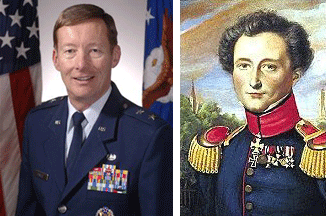
Maj. Gen. Charles J. Dunlap Jr., left; General Carl von Clausewitz, right

The surge to victory for John McCain in yesterday’s New Hampshire primary is attributed by Senator McCain to his telling the truth on a statewide bus tour. Truth and politics are seldom embedded fellows, so surely there is more at stake. It may be that the seeming success of the “surge” of U.S. troops combined with McCain’s last ditch, Chuck Norris tactic of shouting that he will get Osama on Day One in the White House was a factor in rousing New England independents to brave the snowbanks. Less American soldiers are reported dead in the daily papers, the suicide bombings in Baghdad are claiming less lives, and the economy looms larger in voter minds in the current trillion-dollar-deficit-spent free fall. The Democrats, on the other partisan hand, dismiss the Bush/McCain surge as the kind of military victory that can not win the diplomatic war in the end. Most of us would like to find some kind of truth in all the spin, but the super-media-charged primary machine surges on with truth as the main casualty.

So what do the generals say we should do? Today’s New York Times carries an op-ed commentary by Charles J. Dunlap Jr., an Air Force major general, who is about to publish a monograph called Shortchanging the Joint Fight?. In the general’s gung-ho “We Still Need the Big Guns,” he writes tooth and Clausewitz that effective counter insurgency in Iraq and future conflicts still needs to be measured in dead insurgent bodies. As he states:

Many analysts understandably attribute the success to our troops’ following the dictums of the Army’s lauded new counterinsurgency manual. While the manual is a vast improvement over its predecessors, it would be a huge mistake to take it as proof — as some in the press, academia and independent policy organizations have — that victory over insurgents is achievable by anything other than traditional military force.

Unfortunately, starry-eyed enthusiasts have misread the manual to say that defeating an insurgency is all about winning hearts and minds with teams of anthropologists, propagandists and civil-affairs officers armed with democracy-in-a-box kits and volleyball nets. They dismiss as passé killing or capturing insurgents. Continue reading Truth, Troops, Tooth and Clausewitz

Better Luck Next Year, Osama

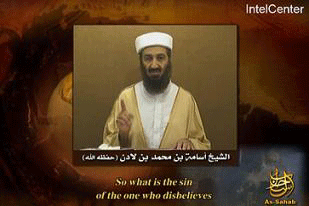
There was a time when Osama Bin Laden owned the audio and video- hungry airwaves. Each new tape brought out the usual talking heads and whetted the non-stop talking lips of the cable newstalker hosts. Could it be a fake? Does he look healthy? Where could he be? But these days the world’s number one bearded terrorist might as well be living in the Stone Age, cave or no cave for an address. Last year, may it rest in peace, Bin Laden released five new tapes, more than Beyonce and the Dixie Chicks combined (not that they would mix that well). The last message came in under the radar of the newswire at year’s end. As reported in yesterday’s The Guardian, this time the target is fellow Sunnis in Iraq who are working with the American forces. They join the Saudi regime, which Bin Laden has similarly damned as apostates headed for hell. Continue reading Better Luck Next Year, Osama