Category Archives: Terrorism Issue

Deoband first: A fatwa against terror

The Times of India, June 1, 2008

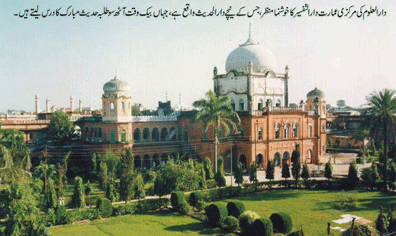
NEW DELHI: For the first time ever, Islamic seminary Darul-Uloom Deoband issued a fatwa against terrorism on Saturday, stating Islam had come to wipe out all kinds of terrorism and to spread the message of global peace. The Darul-Uloom had denounced terrorism for the first time in February, but had not issued a fatwa so far.

Saturday’s fatwa, signed by Darul-Uloom’s grand mufti Habibur Rehman, asserts that “Islam rejects all kinds of unjust violence, breach of peace, bloodshed, murder and plunder and does not allow it in any form”.

Citing the “sinister campaign” to malign “Islamic faith…by linking terrorism with Islam and distorting the meanings of Quranic Verses and Prophet traditions”, Mahmood Asad Madani, leader of Jamiat Ulema-e-Hind, had wanted Deoband to spell out the stand of Islam on world peace.

The fatwa, issued before a huge gathering of Muslims in Delhi’s Ramlila Ground for the Anti-Terrorism and Global Peace Conference, went on to say, “It is proved from clear guidelines provided in the Holy Quran that allegations of terrorism against a religion which preaches and guarantees world peace is nothing but a lie. The religion of Islam has come to wipe out all kinds of terrorism and to spread the message of global peace. Allah knows the best.” Continue reading Deoband first: A fatwa against terror
Poems from Guantánamo

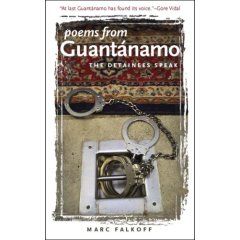
Poems from Guantánamo: The Detainees Speak is a short but provocative book of poems from several of the detainees held at Guantánamo Bay. Much has been written about the legal issues and violations of human rights, but here we can hear the silenced voices of those dehumanized in detention without access to justice. Here is one of the poems:

Death Poem
by Jumah Al Dossari

Take my blood.
Take my death shroud and
The remnants of my body.
Take photographs of my corpse at the grave, lonely.

Send them to the world,
To the judges and
To the people of conscience.
Send them to the principled men and the fair-minded.

And let them bear the guilty burden, before the world,
Of this innocent soul.
Let them bear the burden, before their children and before history,
Of this wasted, sinless soul.
Of this soul which has suffered at the hands of the “protectors of peace.”

Jumah al Dossari, a thirty-three-year-old Bahraini national, is the father of a young daughter. He has been held at Guantánamo Bay for more than five years. In addition to being detained without charge or trial, Dossari has been subjected to a range of physical and psychological abuses, some of which are detailed in Inside the Wire, an account of the Guantánamo prison by former military intelligence soldier Erik Saar. He has been held in solitary confinement since the end of 2003 and, according to the U.S. military, has tried to kill himself twelve times while in the prison. On one occasion, he was found by his lawyer, hanging by his neck nd bleeding from a gash to his arm.

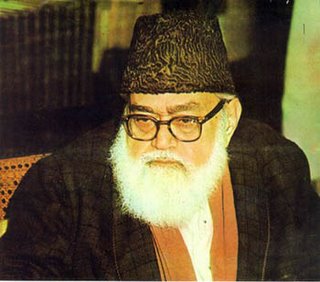
Nadwi on Maududi: a traditionalist maulvi’s critique of Islamism


Sayyid Abul A’la Maududi (1903-1979)

By Yoginder Sikand, TwoCircles.net, May 18, 2008

The late Sayyed Abul Hasan Ali Nadwi (or Ali Miyan as he was also known) was one of the leading Indian ulema of modern times. A noted writer, he headed the famous Nadwat ul-Ulema madrasa in Lucknow from 1961 till his death in 1999. He was associated with several other Indian as well as international Islamic organisations, a mark of the high respect that he was accorded among Muslims all over the world.

Maulana Nadwi’s wrote extensively on a vast range of subjects, including on Islam and politics. On this issue, his views underwent a gradual process of change and maturation, beginning with his early association with a leading Indian Islamist formation and later making a forceful critique of some crucial aspects of its understanding of Islam. His views in this regard point to the little-known yet rich internal debate among Indian Muslim scholars about the relationship between Islam and politics, particularly on the question of what Islamists describe as an ‘Islamic state’.

In 1940, Maulana Nadwi came under the influence of Sayyid Maududi, the founder of the principal Indian Islamist outfit, the Jamaat-i Islami. Maududi, along with the Egyptian Syed Qutb, may be said to be among the pioneers of contemporary Islamism. Soon after joining the Jamaat, Maulana Nadwi was put in-charge of its activities in Lucknow. This relationship proved short-lived, however, and he left the Jamaat in 1943. He later wrote that he was disillusioned by the perception that many members of the Jamaat were going to what he called ‘extremes’ in adoring and glorifying Maududi as almost infallible, this bordering on ‘personality worship’. At the same time, he felt that many Jamaat activists believed that they had nothing at all to learn from any other scholars of Islam. He was also concerned with what he saw as a lack of personal piety in Maududi and some leading Jamaat activists and with their criticism of other Muslim groups. Continue reading Nadwi on Maududi: a traditionalist maulvi’s critique of Islamism

Marranci on the Anthropology of Islam

Note: The following is an excerpt from Gabriele Marranci’s latest book, The Anthropology of Islam (Oxford: Berg, 2008), which is well worth reading for insights on previous ethnographic study of Islam and guidelines for current research.

Books and ‘how-to’ guides about anthropological fieldwork are increasing in number within publishers’ catalogues. Among this large production, it is unusual to find even even chapters addressing the experience of conducting fieldwork among Muslim societies and communities. In the few cases in which some examples have been provided, they describe and discuss what I call ‘exotic’ fieldwork. Even less available is material containing reflections on the impact and issues that an anthropologist may face in conducting fieldwork within Muslim communities, in the west and in Islamic countries, during this endless ‘war on terror’. In this chapter, I have tried to start a reflection and discussion on what it means to conduct fieldwork among Muslims today. In doing so, I have provided examples from the experience of some anthropologists as well as my own. I have suggested that at the centre of a contemporary anthropology of Islam should be the human being even before the Muslim. This is vital if we wish to overcome a certain Orientalism and suppression of self-represented identities, as we can observe in classic works, from Geertz to Rabinow and Gellner. Continue reading Marranci on the Anthropology of Islam

The State of Statements on the Islamic State

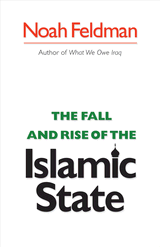
In the latest New York Review of Books, Malise Ruthven offers a cogent review of nine recent books about Islam and terrorism. Here is a brief excerpt about Noah Feldman’s The Fall and Rise of the Islamic State. Check out the online article for the full review.

Excerpt from Malise Ruthven, “The Rise of the Muslim Terrorists,” New York Review of Books, Volume 55, Number 9, May 29, 2008

Jihadis are not the only political activists seeking an Islamic state that will restore the Sharia—the holy law of Islam—to the position it held in pre-colonial times. In a short but masterful exposition, The Fall and Rise of the Islamic State, Noah Feldman seeks to answer a question that puzzles most Western observers: Why do so many Muslims demand the “restoration” of a legal system that most Occidentals associate with “medieval” punishments such as amputation for theft and stoning for sexual transgressions? What do they mean by, and expect from, an Islamic state?

Feldman’s analysis focuses on the crucial responsibility of the Ottoman state for the decline of the Sharia. Pre-modern Islamic societies were for the most part governed according to an informal division of authority between the military rulers (often outsiders such as the Mamelukes, recruited from warrior societies, which were far removed from Islam’s cultural centers) and the religiously trained class of legal scholars conversant with the law. The informal compact comparable to, but different from, the feudal arrangements in the West conferred legitimacy on the military men on condition that they upheld the authority of the scholars. The system of scholarly control over law encouraged “stability, executive restraint, and legitimacy.” Continue reading The State of Statements on the Islamic State

Neoconceit and the Iraq Debacle

By now all but the most ardent of Bush administration admirers must face the obvious: the mission in Iraq was never accomplished, only botched. Historians and pundits will devote tomes upon tomes in assessing one of the most egregious blunders in American foreign policy. But it is not that difficult to see how it happened. Take a horrific tragedy (9/11), a convenient scapegoat (Muslim extremists), a personal grudge (Saddam surviving the first Gulf War and bragging about it), ideological nitwits (Cheney, Rumsfeld, Wolfowitz, Feith, and the list goes on), a bottom line (oil supply), a fear factor (WMDs) and outright lies. Much of the evidence for the Iraq Debacle survives on videotape. Now Christopher Cerf and Victor S. Navasky have documented what the “experts” bungled in their recent Mission Accomplished or How We Won the War in Iraq: The Experts Speak (New York: Simon & Schuster, 2008).

Cerf and Navasky operate out of The Institute of Expertology, an outside the Beltway anti-think tank that reveals that most would-be intellectual emperors have no clothes, and many of these stand stark naked without shame, even after being exposed. The case for the prosecution is both cute (without having to change a word of the neocon experts) and acute, as the architects of the Bush Iraq Debacle walk the planks they themselves imagined out of hot air. Here is a sampling of the neoconceit anti-principles that got us into this mess: Continue reading Neoconceit and the Iraq Debacle

Yemen: Fighting in North Hampers Humanitarian Work


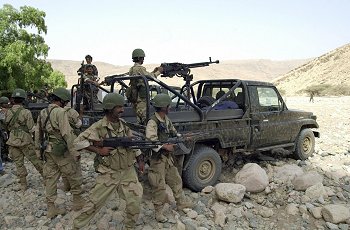
Yemeni soldiers patrolling in Saada, 150 miles north of the capital, Sana’a. A Yemeni Member of Parliament accused of being a leader of a deadly three-year uprising by the Zaidi minority in the northern mountains warned in remarks published on Feb. 25 that rebels might widen their campaign. (Photo: Khaled Fazaa / AFP-Getty Images)

Integrated Regional Information Networks, United Nations, May 6, 2007

The I.C.R.C. and Red Crescent came under attack in the Saada region of northern Yemen. (Photo: Afif Sarhan / IRIN)

A humanitarian aid convoy of the International Committee of the Red Cross (I.C.R.C.) and the Yemen Red Crescent Society came under heavy gunfire on May 2 in the governorate of Saada, north Yemen, the I.C.R.C. has reported.

The incident took place in al-Saifi area, 18 kilometers north of Saada city.

Fighting between government forces and followers of rebel leader Abdul-Malik al-Houthi in Saada governorate is still going on, causing thousands of people to leave their homes, said aid workers. Continue reading Yemen: Fighting in North Hampers Humanitarian Work

The Habib and Remy Show

Many things are not funny, but most things can be poked fun at. Certainly the ongoing violence, destruction and daily killing in Iraq is not funny. But when we stop belonging to Homo ludens as a species, we lose yet another part of our humanity. There is a lot of prejudice against Arabs, Iranians, and Muslims in general. This is no more funny to most Arabs, Iranians, and Muslims than Black Sambo is to African Americans or Chief Wahoo to Native Americans. But there are times when laughing at yourself is a way of dealing with tragedy. In the real world Arabs are not a bunch of bearded, hook-nosed, camel-smelling harem masters, so making fun of the stereotype can at times be like streaking naked in front of a boring commencement speaker. Such raw moments are provided by Habib, an Iraqi, and Remy, a Virginian, in a YouTube rap video called A-R-A-B: the Rap. Continue reading The Habib and Remy Show