Category Archives: Terrorism Issue

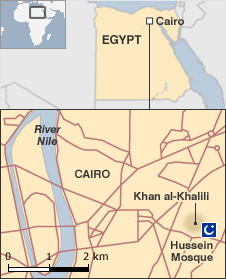
Suspects detained in Cairo blast

Suspects detained in Cairo blast
BBC News, February 23, 2009

Egyptian police are questioning three suspects over the bombing of a Cairo market that killed one person and injured 20 others, officials say.

They were detained near the market shortly after the blast, police said.

It happened at an open-air hotel cafe packed with tourists in the Khan al-Khalili area – a major attraction and home to a prominent mosque.

French President Nicolas Sarkozy has expressed “deep sorrow” at the death of a French teenager in the blast.

Police said they thought the device had been thrown from a balcony. It is not yet known who was responsible. Continue reading Suspects detained in Cairo blast
Security authorities launch massive sweep for al-Qaeda


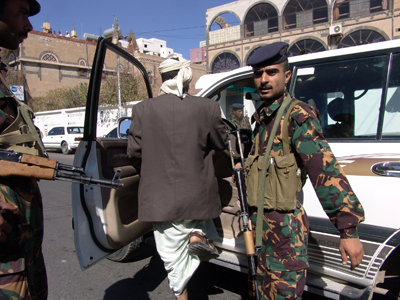
Yemeni security forces have apprehended thirty terrorist suspects over the course of ten days as part of a massive security sweep.

Security authorities launch massive sweep for al-Qaeda

Abdul-Aziz Oudah, Yemen Observer, Feb 3, 2009

The Ministry of Interior has announced a comprehensive campaign against all suspected al-Qaeda hideouts, following last week’s declaration of the appointment of Nasser al-Wahishi, who has been wanted by Yemeni security since 2006, as the new Amir for Arabia. His compatriots include the former Saudi Guantanamo detainees, Saeed al-Shihri and Mohammed al-Aofi, who escaped Saudi Arabia several months ago.

The manager of the security section at the Ministry of Interior, General Mohammed al-Qosi, said security authorities are observing sites where the organization is likely to be hiding, indicating that public cooperation has been helpful in locating these hideouts. Al-Qosi added that the al-Qaeda threat is not something new in Yemen, but rather has been present for many years. Continue reading Security authorities launch massive sweep for al-Qaeda

Murder in ‘Amran


Children of deceased Masha Nahari, playing in their front yard. Because of hostility against them and fear of harm they remain indoors as must as possible. (YT Photo by Amira Al-Sharif)

While Gaza crisis causes more hostility against Yemeni Jews,
murdered Jewish family demands transferring trail to Sana’a

by Mohammed bin Sallam, Yemen Times, January 4, 2009

SANA’A. During the second court session of the trial of Abdul Aziz Al-Abdi, who is accused of murdering Jewish citizen Masha Al-Nahari this past December 31, journalists and lawyers said that “the court session was full of chaos and quarrels. A soldier was attacked by one of the family members of the accused. In addition, the Jewish family received death threats from the murderer’s relatives.”

Advocates of Al-Nahari demanded to transfer the case and trial to Sana’a due to lack of proper security at the Amran Court and dominance of Al-Abdi’s relatives who �control the events of the session and create chaos inside the court hall,” said Abdul Rahman Barman, a lawyer from Allaw Law Foundation which volunteered to defend Al-Nahari’s case in the court. Continue reading Murder in ‘Amran

Excommunicating Dead Terrorists


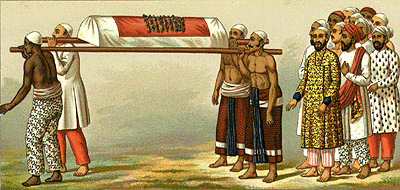
A lithographic painting depicting a Muslim funeral procession in India, circa 1888.

Excommunicating Dead Terrorists
by Leor Halevi, On Faith, Washington Post, December 29, 2008

Recently the Muslim Council of India sent an important message to the world’s Muslims. It asked one of the country’s largest Muslim graveyards, Marine Lines Bada Qabrastan, where unclaimed bodies are often interred, to deny burial rites to the nine men who died after terrorizing Mumbai. Refusal to bury the terrorists in a Muslim cemetery signifies not just that terrorist attacks are un-Islamic, a contention often heard, but that their perpetrators become, by carrying these acts, non-Muslim. “They cannot be Muslims or followers of Islam,” declared Muslim Council president Ibrahim Tai, “so they cannot have a final resting place anywhere
on sacred Mother India.”

The question then arises, what should India do with the dead bodies? Continue reading Excommunicating Dead Terrorists

Gaza: the cycle can be broken


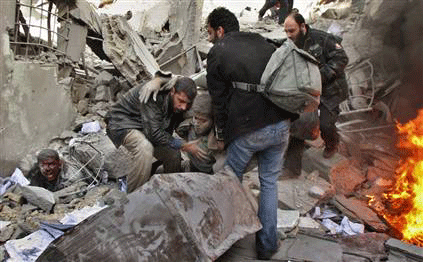
Palestinian rescue workers carry a wounded prisoner in the rubble of the Saraya prison after it was hit by a missile strike on Sunday. Photo by Majed Hamdan / AP.

Gaza: the cycle can be broken

The Independent/, Sunday, 28 December 2008

More than 30 years ago, the American political philosopher Michael Walzer wrote: “First oppression is made into an excuse for terrorism, and then terrorism is made into an excuse for oppression.” It was a good description of the Israel-Palestine problem then, and a good description of the dynamic that would make it worse over the following three decades.

It is a dynamic that operates in contravention of the simple, comforting and wrong principle that two democracies have never gone to war against each other.

The conflict between Israel and the people of Gaza is driven by democratic impulses. Hamas, the Islamic political party and paramilitary organisation, won control of the Gaza Strip in free and fair elections in January 2006. Its charter famously calls for the destruction of the state of Israel and, although that was hardly the issue on which those elections were fought, there can be little doubt about the depth and extent of hostility towards Israel felt by the majority of the population of Gaza. Continue reading Gaza: the cycle can be broken

Saving ISIM

If you are in any way involved in the academic study of Islam, the acronym ISIM is no stranger. This International Institute for the Study of Islam in the Modern World, based in The Netherlands, has served as a welcome resource for information on Islam, especially in contemporary contexts. The free journal (ISIM Review), available online and in print, has been one of the most diverse, interesting, informative and accessible forums on Islam. The institute itself has sponsored conferences, workshops and fellows. Yet, if you click on to the main website today, here is what you see:

ISIM to be closed as per 1 January 2009

The International Institute for the Study of Islam in the Modern World (ISIM) will be closed as per 1 January 2009, due to the lack of adequate funding. ISIM was set up ten years ago by the universities of Leiden, Amsterdam, Utrecht and Nijmegen, and the Netherlands Ministry of Education, Culture and Science. The objective of the institute has been to carry out innovative research into the social, political, cultural and intellectual trends and movements in present-day Muslim communities and societies worldwide. Continue reading Saving ISIM

The Mothers Of The Lashkar

The Mothers Of The Lashkar

by C.M. Naim, Outlook India, Dec 15, 2008

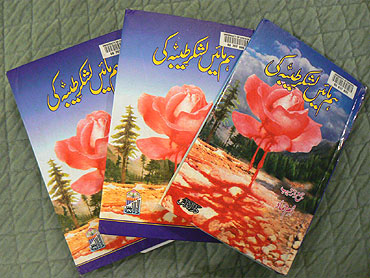
The book is titled Ham Ma’en Lashkar-e-Taiba Ki (‘We, the Mothers of Lashkar-e-Taiba’); its compiler styles herself Umm-e-Hammad; and it is published by Dar-al-Andulus, Lahore. Its three volumes have the same garish cover, showing a large pink rose, blood dripping from it, superimposed on a landscape of mountains and pine trees The first volume, running to 381 pages, originally came out in November 1998, and was reprinted in April 2001. The second and third volumes, with 377 and 262 pages, respectively, came out in October 2003. Each printing consisted of 1100 copies. Portions of the book—perhaps much of it—also appeared in the Lashkar’s journal, Mujalla Al-Da’wa.

Here is how the publisher, Muhammad Ramzan Asari, describes the book’s contents and purpose. Continue reading The Mothers Of The Lashkar

Tariq Ali, Pashtun Nationalism, and Taliban


By Naeem Wardag, Indus Asia Online Journal, December 3, 2008

Since the Afghan War, important power quarters in Pakistan have been propagating a particular interpretation of the security situation in Afghanistan through a variety of means ranging from the vociferous propaganda of the religious right to the more subtle works and ways of the allied experts strategically deployed here and there. Joined the campaign lately have also some ideologues of the liberal left-in particular from Punjab – whose paradigm of the class-struggle fully converge with the “cosmic struggle metaphysics” of the extreme religious right at this point of time as far as their analysis of the problem is concerned. Continue reading Tariq Ali, Pashtun Nationalism, and Taliban