Category Archives: Islamic Sects

Iranian Studies Directory Online


Putting the world’s scholars and organisations at your fingertips, the Iranian Studies Directory (ISD) is a pioneering initiative to develop a comprehensive reference and research facility that will open up the fields of Persian and Iranian studies to academics, teachers, students, curators, professionals and lay enthusiasts across the globe.

If you are in any way involved in the world of Iranian or Persian studies, get networked now! Register with this public resource and connect yourself to other professionals and institutions in your field throughout the world.

A Bulgarian in 19th century Yemen


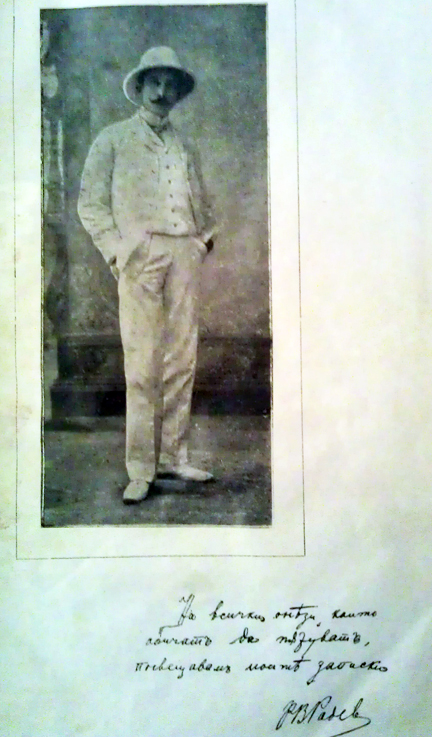
Photo of R. V. Radev with signature: “For these who love to travel, i devote my travel notes.”

The blogger Ruslan Trad has sent along an interesting piece regarding a Bulgarian traveler to Yemen, R. V. Radev, who published a book on his travels in 1906. If you can read Bulgarian, check out the original blog item. Otherwise, Ruslan has sent me a brief translated excerpt and some of the photographs, which I include here.

“Much like the Bedouin in the vast desert – one of those few unknown patches on the Earth’s surface, unexplored by Europeans – the Arab of the Happy Arabian coast today fights a legendary battle that turns fighters into heroes, invulnerable even to the slashes of the vengeful, merciless blade of Istanbul. A revolutionary network with its center in Syria is redoubling its efforts and preparing to sweep over all of Arabia, which has an estimated population of 12 million. Standing in the path of these millions is nothing more than one or two hundred thousand government clerks, looters, Turks and a few garrisons, spread around fortified checkpoints – a battle that would take no more than a couple of days to reach a favorable outcome, were it not for the proverbial scuffles between the various chiefs of the numerous tribes inhabiting Arabia, or for Turkey’s underhanded tactics in handing out bribes – gifts to some, privileges and unlimited power to others. Turkey sows the seeds of rivalry among the Sheikhs so they would fight and destroy each other. Neither the masses, nor the intellectual class, the rich Arabs, seem to understand that it would take no more than a couple of hours to resolve the issue of freedom and independence for Arabia, for which so much blood has, and continues to be shed…” Continue reading A Bulgarian in 19th century Yemen

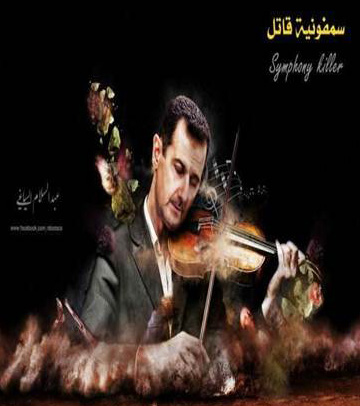
More of the Sham of al-Sham


Image source: alhadath.yemen

The demise of Bashar al-Assad continues its downward spiral with bodies strewn all over Syria in the process. What makes him hang on? Can he not see what just about every pundit outside of Syria and increasingly most Syrians see in blood red letters: mene mene tekel upharsin? Even vain Belzhazzar saw the gig was up in Babylon when those lines cracked his banquet hall. Or is he raving mad in the style of Nero, who plucked his lyre while Rome burned? Or is he just a chicken without a head, but who is still trying to bury his head in the sand?

He hangs on for a variety of reasons. First and foremost, because for the time being he can. Russia has not yet told him he has to go and the United States has basically given him leave to do whatever he wants to his own people except gas them. The military has not yet deserted him in sufficient numbers and they are, thanks to Russia, very well armed. Even the hint from the U.N. envoy Lakhdar Brahimi that Assad has been in power long enough is not likely to move the last of the pre-Arab-Spring dictators (not counting kings, sultans and emirs for life) into retirement.

The Syria of 2013 is not that conquered by Umar ibn al-Khattab, not that of Ayyubid Saladin, nor that run over by the Mongols, nor that ruled briefly at the end of World War I by Faisal of Arabia (patron of Lawrence of Arabia and vice versa), nor that which joined the ill-fated United Arab Republic initiated by Gamal Abd al-Nasser in the 1960s. But there are indeed historically-stretched fault lines. Continue reading More of the Sham of al-Sham

Self-inflicted wounds


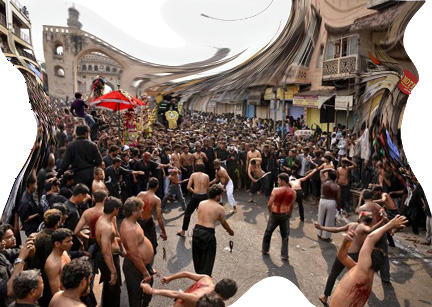
The most potent symbol of the history of the Middle East, indeed of much of human history, is the stuff of life itself: blood. In the sacred history of the three major monotheisms enough blood has been shed since their inception (by and against each one of them) to raise the sea level meters upon meters. Even in the Genesis origin story the first two natural births, Cain and Abel, became the first to introduce bloodshed as a norm. The God of Genesis got into the act, killing animals to make skins that would clothe the naked bodies he created of Adam and Eve and then preferring the animal sacrifice of Abel to the firstfruit figs raised by Cain. The same God went on to substitute a lamb for Abraham’s heir, although only when Abe’s knife was poised to slit his son’s throat, but then in Christian dogma the now-threefold deity shed a third of his essence on the cross. In that same dogma Jesus no longer needs that lost blood as he resurrected to make the trinity a divine threesome once more. But the bloodletting has never stopped.

By all accounts the prophet Muhammad was not fond of shedding blood. The forays and battles that took place while he and his followers were in exile in Medina are remarkable for how few deaths are said to have occurred. When he returned in triumph to Mecca it was not because of any great military victories, nor was their a bloodbath of the Meccans. At the start of Islam the Allah seen through the Quran is neither interested in literal blood sacrifices or a figurative eucharistic variety. Muslims purify themselves with water to make themselves ready for prayer. Calls for jihad have resonated throughout the Islamic era as countless thousands upon thousands have died for not being Muslim, being Muslim or being the wrong kind of Muslim: such is the political baggage common to most religions known to history and probably before recorded history. Continue reading Self-inflicted wounds

Being Normal and being Car Bombed


Poster in Tripoli, Lebanon; photography by Estella Carpi

Unearthing a misconceived “normalization” of violence in Beirut. The October car bomb in relation to generalized insecurity.

The 19th October 2012 car bomb in Beirut’s Ashrafiyye, within the Eastern district of the Lebanese capital, shed light on the re-articulation of the relations between the State, allegedly “inexistent” in the Lebanese context, and its society that lives in the constant effort to subjectively reformulate their citizenship, in the lack of a commonly shared nationhood.

New outbursts of violence seem to give a reason to the state to promote its technology of control, as Michel Foucault would put it. This complex re-articulation of relations has come to the fore with the October 26 White March from Martyrs Square (Beirut Downtown) to Sassine Square (Ashrafiyye, where the explosion was one week before). The “White March”, in which no political flag but the national Lebanese was waved, wanted to be considered as an act of social refusal of further violence and national solidarity, in addition to their political contestation of both the 14 and 8 March coalitions, which have politically and socially polarized the country into two sections after Hariri’s murder in February 2005. The White March mainly had the implicit aim of contesting the taken for granted watershed between what is “normal” and what is not in Lebanese parameters.

Social fear, as well as the perception of risk in Beirut, has specific historical explanations. Lebanese society seems to be doomed to live in a not-war-not-peace state, as Jeffrey Sluka used to define Northern Ireland during the clashes between Protestants and Catholics. Such an unstable state has engendered a social attitude towards violence that has been named by political scientists and journalists as “normalization”, which, in light of the Lebanese reaction to the last explosion, begs for a re-conceptualization. Continue reading Being Normal and being Car Bombed

Unequally yoked is no joke


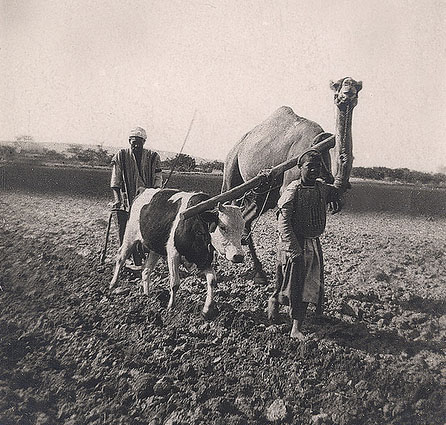
Gelatine silver print (probably made in the mid-1920s) of an American Colony photograph taken in southern Palestine between 1898 and 1911; from the John Garstang collection

“Be ye not unequally yoked together with unbelievers; for what fellowship hath righteousness with unrighteousness? And what communion hath light with darkness?” 2 Corinthians 6:14, KJV

The admonition of the Apostle Paul in his second letter to Corinth is the ultimate justification for separatism. Orthodox Jews, Fundamentalist born-again Christians and ultra-conservative Muslims all have taken to heart the sentiment of this advice, often making it into an outright ban. The latest news sensation is about a Muslim “catacomb sect” in Russia’s Tatarstan region:

Four members of a breakaway Muslim sect in Russia’s Tatarstan region have been charged with cruelty against children for allegedly keeping them underground.

Police discovered 27 children and 38 adults living in catacomb-like cells in an eight-level underground bunker.

The sect’s elderly leader, Faizrakhman Sattarov, had reportedly wanted to build his own Islamic caliphate beneath the ground…

Officials said the children, aged between one and 17 years, had never left the compound, gone to school or been treated by a doctor, and had rarely seen the light of day.

According to the Russian website Islam News, Mr Sattarov, 83, declared himself an Islamic prophet in the mid-1960s after interpreting sparks from a trolleybus cable as a divine light from God.

He and his followers began to shun the outside world in the early part of this century.

One is not sure to laugh or cry at a prophet who gets his revelation from the sparks of a trolleybus cable, but in the end a vision is a vision no matter what the alleged divine source. All three major religions have had their break-away, nothing-to-do-with-this-life prophets and the few sheep that inevitably follow them over the cliff of rationality. The problem here is what may be labeled a dogmatic emphasis on the “unsocial contract.” In other words, this is a kind of cultural suicide, hardly the umma envisioned by the Prophet Muhammad.

The metaphor in the old photograph above is what intrigues me. The supposed rationale is that a team of domestic animals should be the same, generally two oxen. That is all well and good if you actually have two of these rather expensive beasts, but what if you don’t? In many cases farmers in the region had to make due with either a donkey or a camel, but hitching two different animals may not have been as rare as assumed, nor as problematic. Notice in this image that a little boy leads the camel, allowing it to keep the pace of the ox while the ploughman bears down on the blade. Rather than focus on there being two separate animals, think about the social cooperation of boy, man, ox and camel as a unit.

When the emphasis is on what makes the animals different either from each other or from humans, the broader point of cooperation is easily lost. The same is true in religion. Separatists are doomed to failure by their very nature, except as oases sustained within a wider pluralistic context. Those sects which survive learn to adapt to competing views and accept change, no matter what level of reticence. Consider the early Mormons, who were so far out of the mainstream that they were persecuted everywhere they went. No matter the doctrines still enshrined on the main webpage of the Church of Latter Day Saints, the church has embraced the very kind of patriotism that once forced them to the arid wilderness of Utah. This is the only way they could have survived.

I am certainly no prophet, even though I have seen trolleycar sparks in my youth, but I suspect that the future of Islam will see increasing rather than decreasing pluralism. As a religion which has spread well outside its Arabian geographic origin, the ways of being Muslim are far too many to ever be bottled into one halal variety. Even in the heyday of Islamic power there was never a unanimity of belief. Like Judaism and Christianity there will continue to be those who insist they represent the “true” faith, but no religion can resist the perpetual cultural change that envelops the entire globe. Think of that Palestinian fellah in the 1920s photograph above. He could never have imagined the technological and social change in his own backyard today. Today we think we can imagine, but the future is probably not best revealed by looking at a trolleycar, sparks or not.
Yemen Conference at Harvard


This past Friday and Saturday a conference was held on “Yemen in Transition.” While I was originally scheduled to give a presentation, I was not able to attend. But here is an overview of the conference, with complete details on the conference website.

Date: October 19, 2012 (All day) – October 20, 2012 (All day)
Speaker: various
Yemen in Transition: Challenges and Opportunities
Organized by Steven C. Caton, Harvard University, and the Yemen Working Group, this conference brings together Yemeni American professionals and academics along with some of their counterparts from Yemen, and academics from the U.S., Europe, and Yemen to discuss the future of Yemen and what might be done to help the country as it transitions into its new historical phase. It also brings together students from Harvard and the Boston area who are from Yemen. The main topics to be discussed are: women and youth, economic development, politics and political reform, and the water crisis. As an academic conference, the focus will be on theory and analysis, though concrete proposals and recommendations will also be presented.

The panels and the keynote address are open to the public. These presentations will be videotaped and made available on the website of the Harvard Center for Middle Eastern Studies but they will not be published as part of a conference proceedings. The use of recording devices by anyone other than the organizers is strictly prohibited.

A new Salafi politics


by Will McCants, Foreign Policy, The Middle East Channel, October 12, 2012

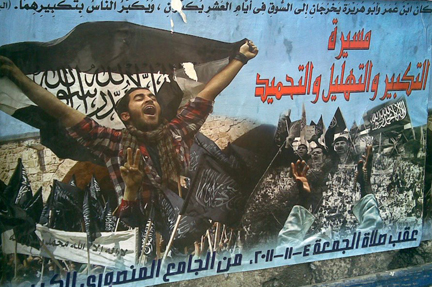
Salafis, or Sunni puritans, have been much in the news since they sparked riots at U.S. embassies throughout the Arab world protesting film clips lampooning the Prophet Muhammad. A television personality on a Saudi Arabian-funded Salafi satellite channel in Egypt first fanned the flames, and Salafis ranging from the militant Mohamed al-Zawahiri (the brother of al Qaeda’s chief, Ayman al-Zawahiri) to the mainstream Salafi political party al-Nour fueled the blaze when they blamed the U.S. government and called for protests against U.S. embassies. Salafis in Egypt, Tunisia, Libya, and elsewhere took up the torch, resulting in attacks on U.S. and other Western diplomatic installations across the Middle East.

Others were involved, of course, and the protests were small compared to the protests over the Muhammad cartoons several years ago. Nevertheless, the Salafi-driven protests are one more sign the ultra-religious right is asserting itself as the guardian of the moral order in Sunni-majority countries revolting against the ancien régime. Their noisy performance on the public stage poses a major challenge to emerging democratic systems, fueling polarization inside and fears abroad. But the new political realm also poses challenges to the Salafis who are on unfamiliar ground politically and ideologically.

To understand the political behavior of Salafis today, keep four things in mind: their religious beliefs do not predict their political behavior; they are a minority in almost every Middle Eastern country; the countries where they are a majority are incredibly wealthy; and their appeal and power arises from their commitment to an ultraconservative creed that is out of step with the mainstream. Continue reading A new Salafi politics