Category Archives: “Arab Spring”

Sic gloria mundi transit


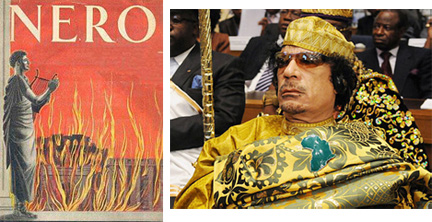
There is a phrase in Latin that seems to have been invented for the free fall of dictators in this year’s Arab Spring. Italian Prime Minister Berlusconi mentioned it when commenting on the death of Libya’s Qaddafi. Sic gloria mundi transit: the glory or fame in this world is fleeting. The man once styled the king of African kings is dead; long live an alternative to the agony and bloodshed that military coups and foreign meddling create. The killing of Qaddafi is a celebration for those who were brutalized during his regime of more than four decades and understandably so. But vengeance and reprisals need to be transit, in the Latin sense, as well. The focus of positive hate must be to change the system of corruption that allows any single person to have such absolute power. Countries do not need dictatorial “fathers” and citizens are not children to be ordered about or slaves to be disposed of at the whim of a self-styled master.

There is a deeper lesson in the Latin phrase, a poignant reminder that Rome had its Nero and Caligula. Every age and every place has its would-be masters, who have a tendency it seems to become delusional when there are no checks on their ability to control wealth and weaponry. The Abbasid caliph Mansur, for example, attempted to exterminate his main opposition of Shi’a who questioned the legitimacy of his caliphate. The story is told that after his death, his annointed heir and son al-Mahdi found a locked room in which there were carefully placed the mummified bodies of all the prominent Shi’a men that his father had killed, each with a name plate attached; all of this monstrous monument enmeshed in a trove of gems, precious jewelry and dinars. The gloria of the Roman Empire and of the Abbasid Empire (and the list goes on and on and will never end) is fleeting in hindsight, but not, of course, to those who fell victim to the brutalities or lived to mourn the atrocities.

All eyes are on Libya now to see what will come out of the ashes of a madman’s playground. Hail to the Libyan people but hell to the would-be caesars…

The Peace Push and Shove

As readers of Tabsir can easily see, I am no friend of dictators or military rulers masquerading as democratic demagogues. The fall of Ben Ali, Mubarak and Qaddafi is a welcome sign, even though it is not clear that the people will be able to achieve the kind of government most want. In Yemen the handwriting and a smatter of twittering is on the wall for Ali Abdullah Salih. He has held on to power far too long, allowing for an ugly power grab that could have been avoided if he had done the noble thing and stepped aside earlier, when given ample chance. But Salih is not Asad and Yemen is not Syria. The swell of the Arab Spring has somehow thrown all the dictators into one soup, one overly ladled with self-righteous indignation. Hatred for the man at the top is clouding the pragmatic need for effective political reform.

Yesterday the recent Nobel Peace Prize recipient, Tawakkul Karman, came to New York and demonstrated outside the U.N. It should be noted that her efforts in Yemen, as one among many individuals organizing the widespread protests, have not yet resulted in the exit of Salih or the emergence of a new viable government. Since she is now center stage as a symbol of peaceful protest, it is strange that she would leave Yemen and vow to stay in New York until Salih’s assets are frozen and he is put on trial in The Hague. Does she really think that this is a bargaining point? Receiving a peace prize is indeed a great honor, but it hardly makes someone into an effective powerbroker. The last thing Yemen needs at this time is for the United Nations or the United States to meddle into the political mess by dictating rather than working with the various Yemeni parties in negotiation. Karman is opposed to the GCC transition proposal because it grants immunity to Salih, but is it really so important to seek revenge on the man at the top when the entire governmental system has been corrupt and military men like Ali Muhsin have as much blood on their hands as the president? Continue reading The Peace Push and Shove

Plot of the day


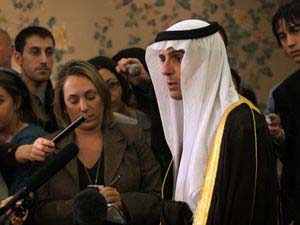
The Saudi ambassador to the US Adel al-Jubeir speaks during Middle East peace conference in Maryland in 2007

The news dominating coverage of the Middle East today catapults Iran and the Palestinians over the ongoing Arab Spring. Even the fact that tens of thousands of Syrians turned out in Damascus to support the Asad regime pales in relation to the James Bond scenario of Iranians, drinking tequila with Mexican drug runners in order to set up the assassination of the Saudi ambassador in Washington. It sounds like a movie plot, but then so does the whole Arab spring since February. American officials are acting as though they have slam-dunk proof, which is a dangerous sign when no one has seen even an iota of that proof apart from the allegations given by Attorney General Holder. And it seems the culprit has confessed, so what more needs to be said? The plot is plausible to most Americans, I suspect, because one expects Iran to engage in terrorism and the government officials in Iran despise the Saudis as much as they do the United States. It sure makes Eric Holder, who has come under blistering attack by Republican hawks, smell like a rose.

Also headlining the news today is the agreement between Israel and Hamas in which some 1,027 Palestinians being held in Israel jails will be exchanged for one Israeli soldier, Gilad Shalit, captured some five years ago. And the plot thickens, because the exchange of 1000/1 is taken as a victory by both sides. The dark side is that such a deal reinforces the notion that Israel lives are more valuable than Palestinian lives at the same time as individuals are being freed rather than blown up. Given previous hard-line rhetoric of Netanyahu, the idea of such a trade also seems something dreamed up in a novel.

There are serious plots in which people die every day, such as more bombs in Iraq. And there are, in biblical terms, rumors of plots. These two events today would be earth-shaking on any day, but are especially ripe for punditry at this juncture in the region. What will the impact of this release mean on the Palestinian quest for statehood in the U.N.? What new sanctions can be brought out against Iran? And if the Saudi ambassador had been killed, along with a number of Americans, what would have been the response of the Obama administration? I can only imagine the re-election landslide if Obama and the Israelis were to successfully launch an attack to destroy Iran’s nuclear plant. He would be drinking tea all the way to a second term in the White House.

Let’s see what new plot unfolds tomorrow…

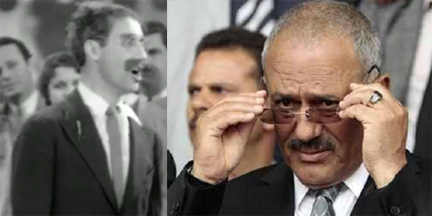
Salih and Groucho: “Hello, I must be going”


Get ready to roll the dice again. The almost off-again, persistently on-again Ali Abdullah Salih has once again signaled his stage exit. After some seven months of his citizens shouting “Irhal, ya Ali,” the embattled president of Yemen is once again on the ropes. When he announced yesterday that he would be handing over power, most Yemenis were somewhat skeptical. The old phrase “three times and you are out” rings true in American baseball but hardly in contemporary Yemeni politics. Nor does “the third time’s the charm” charm the majority of Yemenis who want a major change at the top. Does he mean it this time?

There is something about the roller coaster politics in Yemen this year that makes a perfect Marx Brothers (and I don’t include Karl in this family) movie. When I heard Salih’s latest swan song, I could not help but think of the classic song by Groucho Marx as Captain Spaulding: “Hello, I must be going”:

Hello, I must be going.
I cannot stay,
I came to say
I must be going.
I’m glad I came
but just the same
I must be going. Continue reading Salih and Groucho: “Hello, I must be going”

Letter from Islah to Tawakkul Karman


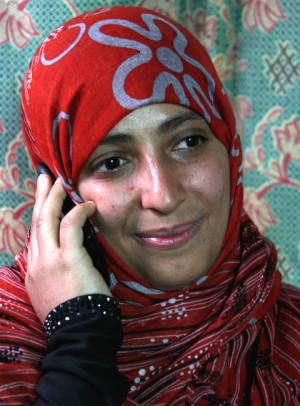
Tawakkul Karman

Yesterday I wondered how the Yemeni party Islah would respond to the Nobel Prize being given to one of its members. Here is the official letter, congratulating her, sent to Karman from Muhammad Abdullah al-Yadumi,

بسم الله الرحمن الرحيم

الأخت المناضلة / توكل عبدالسلام كرمان

رئيس منظمة صحفيات بلا قيود, عضو مجلس شورى التجمع اليمني للإصلاح

تحية وتقدير وبعد :

بكل ابتهاج تلقينا في التجمع اليمني للإصلاح إعلان فوزكم بجائزة نوبل للسلام كأول امرأة عربية تحظى بهذا التكريم وأول شخصية يمنية تمنح هذه الثقة الدولية الهامة.

إننا ونحن نهنئكم بهذا الإنجاز التاريخي نعتبر هذا الفوز مكسبا للثورة اليمنية السلمية وللمرأة اليمنية المناضلة والواعية القادرة على صنع النجاح رغم عوائق التخلف وموروثات الإستبداد التي حالت بين شعبنا وبين الإبداع لعقود من الزمن.

كما أن تكريمكم اليوم بجائزة نوبل للسلام يعد تتويجا مستحقا لجهود سنوات من نضالكم السلمي الدؤوب وكفاحكم المرير ضد منظومة الجهل والظلم والفساد في مختلف الميادين الإعلامية والحقوقية والسياسية ونصرة المظلومين وغيرها من المجالات وصولاً إلى العمل الثوري السلمي الذي مازال شعبنا برجاله ونسائه وشبابه وشيوخه يخوضه دون استكانة أو لين حتى يتحقق له ما يصبو إليه من حرية وكرامة وعدالة وحكم رشيد .

كما أننا نرى في هذا التكريم شهادة أممية على حضارية شعبنا اليمني وعدالة مطالبه وسلامة نهجه السلمي في التغيير، متمنين في هذا السياق ان يرافق هذا الإعتراف من المجتمع المدني الدولي بعدالة المطالب اليمنية إعتراف سياسي دولي بهذه المطالب وان يسارع العالم بأسره الى الوقوف مع الشعب اليمني التواق للحرية والتغيير.

نكرر تهانينا الصادقة لكم ولكل ذوي المبادرات الرائدة في وطننا الحبيب ، مع تمنياتنا لكم بالتوفيق والنجاح ومزيداً من العطاء.

والسلام عليكم ورحمة الله وبركاته،،

أخوكم /

محمد بن عبدالله اليدومي

رئيس الهيئة العليا للتجمع اليمني للإصلاح

Yemeni woman shares Nobel Peace Prize


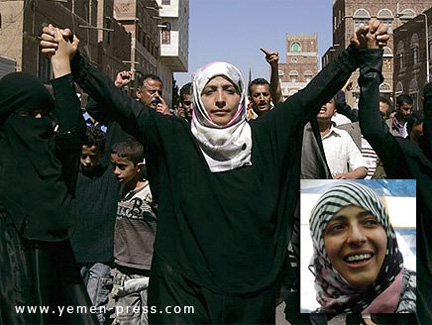
The Nobel Peace Prize for 2011 has just been released with three recipients: Ellen Johnson Sirleaf, Lehmah Gbowee and Tawwakul Karman. All three were chosen “for their non-violent struggle for the safety of women and for women’s rights to full participation in peace-building work.” Karman is Yemeni; but beyond this she is the first Arab woman to win a Nobel prize, a point proudly noted on the Yemeni media site Yemen Press. It will be interesting to watch the reaction to the choice. Here is an activist who took to the streets to promote a peaceful transition from the corrupt secular dynasty of Ali Abdullah Salih. She is one of many Yemenis sharing the same goal and not a principle organizer, although her superb English skills attracted attention in the foreign media. She is also actively involved in the powerful Islamic party of Islah.

As always there will be much second guessing as to why these particular individuals were chosen. I suspect that Karman was not near the top of any speculation list. The Nobel Peace Prize, however, is the most symbolic of these “dynamic” Swedish awards, with the aim of promoting an idea more than finding the “best qualified” candidate. The stated aim this year, however, was a focus on the role of women as peacemakers. Fortunately there are many women activists peacefully advocating against corrupt politics and prejudicial practices. The choice this year appears to be a consciously rounded decision, also including the Liberian president Ellen Sirleaf and Lehmah Gbowee, a social worker also involved in the peace movement in Liberia. If it had just been Sirleaf, one might have dismissed the choice as yet another politician, no matter how worthy, but including Gbowee and Karman may have more to do with inspiring more women to participate at the local level than their actual accomplishments or impact.

As a senior member of the prominent Yemeni Islamic party Islah, Karman does not fit the mold most Westerners hold of Muslim women. She covers her hair with a scarf, but without the extreme niqab or even the more ubiquitous Yemeni sharshaf ( a full-length black outer veil introduced to Yemen by the Ottoman Turks). While the media is for the most part fixated on the masculine culture of Al Qaida, the role of women in Yemen is either ignored or stereotyped. So this choice will draw attention to the fact that there are women who are proud to be Muslim and do not view themselves as servile slaves. But it will also, I suspect, result in detractors within Yemen who will be jealous of the attention she is receiving and perhaps even dismiss it as yet another “Western” intrusion. Will the leaders of Islah promote this honor to one of their members? Will rival Islamic groups use her as a wedge issue? Continue reading Yemeni woman shares Nobel Peace Prize