Category Archives: “Arab Spring”

Drone Strikes


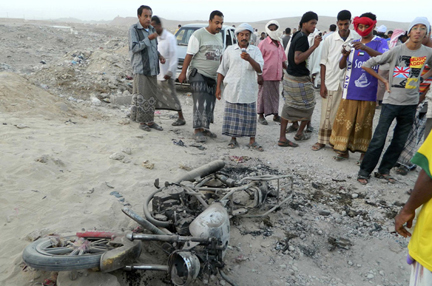
New America Foundation says that US drone attacks in Yemen have risen from 18 in 2011 to 53 in 2012 [Reuters]

[Drones are now at the top of the news cycle. This commentary was originally published in the January online edition of Anthropology News.]

The Error in the War on Terror

In 1978 I arrived in the Yemen Arab Republic to begin 18 months ethnographic fieldwork. At the time North Yemen, as it was called, was in full development mode. A protracted civil war after the fall of the traditional Zaydi imamate had ended only a decade before. Aid was pouring in from the United Nations, the United States, Germany, France, The Netherlands, Russia and mainland China as the country was in the throes of building itself up by its sandalstraps. Once settled in my field site, the beautiful spring-fed highland valley of al-Ahjur, I could not help but notice that just about everyone was armed, many with kalashnikovs. This was a tribal area, where the central government exercised little control, but I never felt safer in my life.

I felt safe because as a foreigner I was protected under tribal customary law. At this time the United States was well liked, often in contrast to the atheist communists of the Soviet Union who supported the socialist regime in South Yemen. This was before any hint of terrorism, before the Iran hostage affair and long before al-Qaeda. Osama Bin Laden had just turned 21 and was still in college. In this tribal area there was an honor code, exemplified by the Yemeni term qabyala, that required protection of unarmed guests, as it did women and children. In 2004, on a return visit to the valley, I found myself in the difficult situation of explaining why I did not support the U.S. invasion of Iraq. One of my Yemeni friends noted that he used to think that America was different, but now he believed that the U.S. president was as bad as his own, Ali Abdullah Salih. Continue reading Drone Strikes

Sex in the Muslim City


by Carlin Romano, The Chronicle of Higher Education, January 14, 2013

Is it possible all those young men clashing in the streets of Cairo and Damascus aren’t getting enough?

Democracy? No, I mean that other thing people seek and are willing to die for.

Talk of the “Arab Spring” now forms a clichéd part of pundit chatter in America, with plays on “Arab Winter” and “Arab Fall” depending on the politics of the speaker and the troubled country dissolving at the moment. But few talking heads know enough about Arab culture to tie the massive Mideast street actions we’ve seen to matters behind surface politics. And those background matters include the state of Arab marriage, the tension between so-called Western norms and Islamic pieties, and the suppressed sexuality among Arab youth who face financial and theological obstacles to fulfilling their desires.

Is it tasteless to mix somber stuff like political rebellion with sub-rosa lust and denial? Could be it’s truthful rather than tasteless.

Thank you, then, Shereen El Feki—Cambridge-educated immunologist, former science writer for The Economist, current vice chair of the U.N.’s Global Commission on HIV and Law—for adventuring beyond the headlines in Sex and the Citadel: Intimate Life in a Changing Arab World, forthcoming from Pantheon Books. It’s a trenchant exploration of the uncertainties filling the humble abodes that Tahrir Square demonstrators go home to. A truthful book may not set you free when you’ve suffered under centuries of misguided interpretations of Islam and sex, but one prays that El Feki gets an Arabic edition.

In the West, her blunt examination of sex and its attendant practices and paraphernalia—topics include vibrators, Viagra, virginity codes, marital rape, and homophobia—would hardly raise an eyebrow. We Westerners live now in a Fifty Shades world, a publishing culture in which Naomi Wolf’s Vagina gets reviewed on the front page of The New York Times Book Review by former ballerina Toni Bentley—she of The Surrender (a title meant to evoke the offering of another body part)—and one hopes the kids aren’t watching. Continue reading Sex in the Muslim City

Remembering Arab Spring Photographer Rémi Ochlik


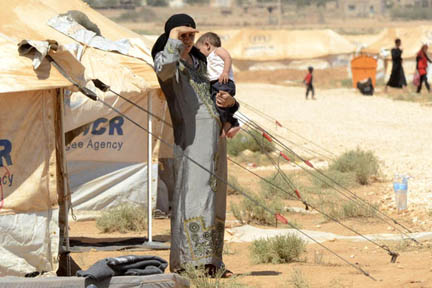
Photographer Rémi Ochlik who was killed last year in Syria at the age of 28 (Photo: Corentin Fohlen)

By Adeline Sire, PRI’s The World, February 1, 2013

Many journalists have died covering the Arab uprisings.

Last year, 17 were killed in Syria.

One of them was award-winning French photojournalist Rémi Ochlik.

He was only 28-years-old.

Ochlik documented the revolutions in Tunisia, Egypt, and Libya.

Then last year, he headed out to Syria. Continue reading Remembering Arab Spring Photographer Rémi Ochlik

More of the Sham of al-Sham


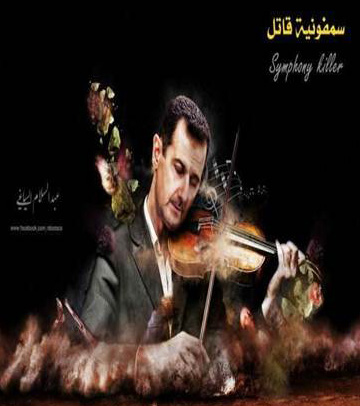
Image source: alhadath.yemen

The demise of Bashar al-Assad continues its downward spiral with bodies strewn all over Syria in the process. What makes him hang on? Can he not see what just about every pundit outside of Syria and increasingly most Syrians see in blood red letters: mene mene tekel upharsin? Even vain Belzhazzar saw the gig was up in Babylon when those lines cracked his banquet hall. Or is he raving mad in the style of Nero, who plucked his lyre while Rome burned? Or is he just a chicken without a head, but who is still trying to bury his head in the sand?

He hangs on for a variety of reasons. First and foremost, because for the time being he can. Russia has not yet told him he has to go and the United States has basically given him leave to do whatever he wants to his own people except gas them. The military has not yet deserted him in sufficient numbers and they are, thanks to Russia, very well armed. Even the hint from the U.N. envoy Lakhdar Brahimi that Assad has been in power long enough is not likely to move the last of the pre-Arab-Spring dictators (not counting kings, sultans and emirs for life) into retirement.

The Syria of 2013 is not that conquered by Umar ibn al-Khattab, not that of Ayyubid Saladin, nor that run over by the Mongols, nor that ruled briefly at the end of World War I by Faisal of Arabia (patron of Lawrence of Arabia and vice versa), nor that which joined the ill-fated United Arab Republic initiated by Gamal Abd al-Nasser in the 1960s. But there are indeed historically-stretched fault lines. Continue reading More of the Sham of al-Sham

Arab Constitutions and American Freedoms


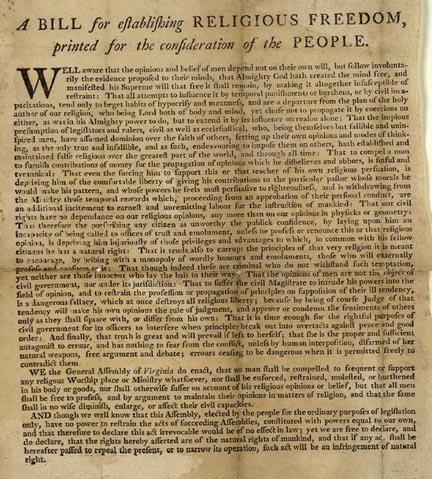
Virginia Bill for Establishing Religious Freedom; source, Library of Congress

By Anouar Majid, Tingis Redux, January 8th, 2013

The deeply contentious referendum on Egypt’s new constitution last December 2012 gave me some hope that not all is lost to Arabs and Muslims in the aftermath of the revolutions that toppled dictators in the last two years. Given the rapid Islamization of the public sphere in much of the Arab world in the last few decades, I was expecting something close to a landslide, not a small voter turnout and a modest 63.8 percent in favor of the charter. As it turns out, there are still pockets of resistance that oppose the Muslim Brothers and their agenda, even though, as the New York Times columnist Thomas Friedman noted at that time, the divisions are not necessarily between Islamists and secular liberals. The fault lines in Egypt seem to be more varied than what is broadcast in the United States.

Be that as it may, the thing that concerns me the most is what the Western media is talking about, i.e., the clash between those who want a nation governed by divine law and those who don’t want religion to be the absolute reference in legislation. In November 2012, I had the opportunity to make the case for the separation of state and religion to people who participated or are actually participating in the drafting of constitutions in Morocco and Tunisia, a person who ran in the last presidential race in Egypt, members of the Tunisian parliament, a leader of a major Egyptian political party, and many others who are playing some role in the future of North Africa and the Middle East. I also explained why, at this crucial juncture in the region, Arabs and Muslims can’t do better than learn from the American constitutional process and especially the reasons for separating state and religion.

Fewer documents explain more powerfully the reasons for doing so than the Virginia Statute for Religious Freedom, first written by Thomas Jefferson in 1777–only a year after he drafted the Declaration of Independence–and enacted into law in January 1786, with the crucial help of James Madison. Jefferson was so proud of Virginia’s Religious Act that he wanted it noted on his epitaph. Continue reading Arab Constitutions and American Freedoms

Tribes and Terrorism: Myth and Reality


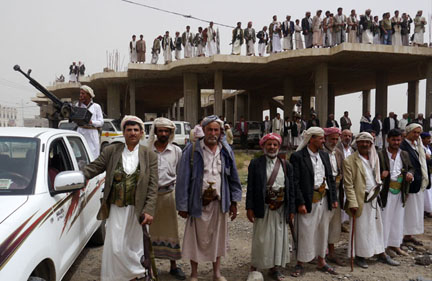
Tribesmen from Yemen´s Bakil tribal confederation waiting for a decision at a tribal law-based conflict resolution session (Mikael Strandberg)

by Khaled Fattah, opencanada.org, October 18, 2012

With the recent stepping up of controversial U.S. drone attacks in tribal areas of Yemen, and post-Arab Spring confrontations with militant jihadist groups in tribal areas of Egypt, Libya, and North Africa, a number of misconceptions surrounding the links between tribes and terrorism in the Arab Middle East continue to plague press coverage and policy reports. The first of these misconceptions is that tribal areas are lawless, ungoverned spaces – a modern-day Wild West. Another misconception is that the ultra-conservative culture of Arab tribes is fertile ground in which to root the violent ideology of transnational terror cells. The truth is that much of the current commentary about tribes and tribalism in the Arab Middle East reflects the Pentagon’s experiences so far in the American-led “War on Terror.” This war has now shifted from boot-heavy invasions to ghost wars in which drones hover over countries with significant tribal populations: Yemen, Pakistan, Afghanistan, Somalia, Libya, and Mali. The War on Terror is now primarily carried out via “open secret” predator drone missions that increasingly target exclusively tribal areas.

Tribal Areas Today Are Not the Wild West

Over the last 10 years, many comparisons have been drawn between the fabled “Wild West” of America toward the end of the 19th century, and present-day tribal areas of the Middle East. The “Wild West” conjures up images of adventurous cowboys facing off in a dusty street in front of a gambling den or brothel, pistols drawn. The image suggests a lawless era in U.S. history, where violence prevailed in American frontier towns, might made right, and the weak were punished for crimes they did not commit. The Wild West was an anarchic social world shaped by outlawed individuals and their henchmen. This period in American history bares little resemblance to life in the tribal areas of the Arab world today, which are highly socialized, with clear normative controls. The association of tribal areas in the Middle East with the Wild West is simply an attractive analogy to intermittent foreign observers and army generals. Continue reading Tribes and Terrorism: Myth and Reality

Breaking the Syria Stalemate


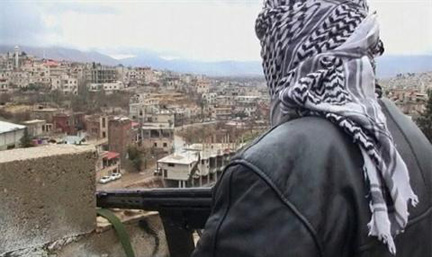
A member of the Free Syrian Army stands guard during a patrol in the western border town of Zabadani; photograph from The Daily Star

by Amr Al-Azm, The Cairo Review of Global Affairs, December 18, 2012

There are two possible trajectories for the current Syrian crisis. The first is a purely military scenario in which the opposition forces engage the regime in a bitter war of attrition until its annihilation. The success of such a course of action, however, is difficult to guarantee, and the cost to the country, its infrastructure and its civilian population is likely to be catastrophic. In fact the more probable outcome is a protracted bloody stalemate, leading to the collapse of the state, sectarian genocide and the fragmentation of the country with significant blowback into neighbouring states such as Lebanon, Jordan and Iraq.

The second trajectory would feature a political resolution. Negotiations would bring about the departure of the Bashar Assad’s regime along with a peaceful transition to democracy. Such a political outcome is the one clearly favored by the international community and was strongly endorsed at the latest friends of Syria meeting held in Marrakesh on December 12 both in statement and in action (by not publicly agreeing to the provision of any military assistance to the Syrian opposition). It is also the option that should be favored by the Syrian people since they too have no interest in seeing their country succumb to the fate described above.

There are certain conditions that must prevail in order for the preferred political outcome to have any chance of success. The first and foremost of these is that both sides must be prepared to engage in a political process with the ultimate outcome of a peaceful transition of power to a newly elected government. Currently, however, the situation in Syria is one of stalemate on political and military fronts; progress on both is needed simultaneously in order to break this stalemate. Continue reading Breaking the Syria Stalemate