Category Archives: “Arab Spring”

Al-Masry al-Youm wa-la-bukra

Goodbye, Al-Masry Al-Youm
by Sarah Carr, Egypt Independent, April 26, 2013

In 2010, Abdel Moneim Saeed, then the chairperson of state mouthpiece Al-Ahram, oversaw an outrageous bit of Photoshopping on the newspaper’s front cover, when US President Barack Obama was replaced with Hosni Mubarak at the head of a group of leaders striding out of a meeting in Washington.

This Photoshop-gate inspired the inevitable deluge of derision on social media. As well as being breathtaking and hilarious in its own right, it was a bit of light relief from the tense and strange months leading up to the revolution and, in particular, another photo that went viral in 2010 thanks to social media — that of the mutilated corpse of Khaled Saeed.

Al-Ahram’s big cheeses remained belligerent in the face of the ridicule. Its editor-in-chief, Osama Saraya, described it as an “expressionist” photograph that gave a “brief, live and true expression of the prominent stance of President Mubarak in the Palestinian issue.”

In a 2010 interview with Al-Ahram Weekly, Abdel Moneim Saeed, meanwhile, insisted that the paper did nothing wrong, condemning the “herd mentality” that dominated the response to the picture and pointed out that the Economist “often employs graphics, pictures and illustrations to make its point.”

According to the weekly, Saeed was particularly piqued by the fact that nobody had bothered to read the report below the Photoshopping, penned by him.

He also lamented that “some in this profession mix opinion with news, thus becoming the jury and the judge. We have a long way to go on the road to advanced journalism.”

Coming from the man who ran Al-Ahram for almost four years, this statement is extraordinary. It is like a mosquito complaining about buzzing noises. Al-Ahram, like virtually all state press in Egypt, has wildly — shall we say, “expressionist” — content. It gives itself the license to report the news as it appears in the daydreams of whoever is Egypt’s most influential player on any given day, and the public purse funds this. Continue reading Al-Masry al-Youm wa-la-bukra

What is Terrorism?


by Laura Beth Nielsen, Al Jazeera Opinion, April 17, 2013

The Boston Marathon bombing once again has Americans asking, “Is this terrorism?” And more broadly, “What is terrorism?”

We asked ourselves those questions the moment we heard the news. Our news anchors asked for the next 24 hours (though they were clear to say at first that they did not know if it was terrorism). President Obama – thankfully – was careful not to use the word in his first press conference on the day of the bombings. But later on the following day – on Tuesday – Obama said, “Any time bombs are used to target civilians, it is an act of terrorism.”

What does it mean when we say something is “terrorism” and why does it matter?

As a professor of Sociology and Law, I study how ordinary people understand the law and how the law itself, including law’s categories and terms affect how people understand the world around them.

Using terms like “terrorism” shapes what ordinary people expect of the police, the justice system and our government. It affects what kind of punishment we want and the level of fear we feel about what is going on around us.

But what is terrorism? The most obvious definition is that terrorism is a crime meant to terrorise. We know what these kinds of crimes are: they are the kind that make us afraid to send our children to school, like Columbine; make us afraid to go to work, like 9/11; or make us afraid even just to spend beautiful spring day competing with our friends competing in a footrace. Continue reading What is Terrorism?

Fatima’s Head

By Ziad Majed, al-Jadid

It is hard to imagine what happened to Fatima,* and it is hard to describe the silence that engulfed the witnesses of her death. I think the artistic works on Facebook that restored her head and depicted a rose garden or the moon or the sun have tried to compensate for that terrible silence and ease the pain of Fatima and her loved ones and all of us together.

What can be done to a Syrian child who “lost” her head?! And what can be said to a girl sprawled in her dress on the ground, arms spread wide, her small, drooping shoulders clinging to the wall directly?

Fatima Maghlaj did not understand what happened to her; she was headless all of a sudden. In an instant she lost the ability to dream and focus. She was paralyzed. She wanted to feel the dryness of her throat and ask for water. She wanted to call mother or father, but she could not make the words with her tongue and she could not find their picture in her memory. She tried to look around her to reassure herself that she was sleeping in a safe place to wait until these strange feelings of emptiness had ended. But her eyes and eyebrows and eyelashes were out of reach, scattered in the emptiness of the cold room. She found nothing but a tuft of hair that her mother had combed in preparation for her uncle’s wedding that evening. Continue reading Fatima’s Head

Syria Has a Massive Rape Crisis

by Lauren Wolfe, The Atlantic, April 3

One day in the fall of 2012, Syrian government troops brought a young Free Syrian Army soldier’s fiancée, sisters, mother, and female neighbors to the Syrian prison in which he was being held. One by one, he said, they were raped in front of him.

The 18-year-old had been an FSA soldier for less than a month when he was picked up. Crying uncontrollably as he recounted his torture while in detention to a psychiatrist named Yassar Kanawati, he said he suffers from a spinal injury inflicted by his captors. The other men detained with him were all raped, he told the doctor. When Kanawati asked if he, too, was raped, he went silent.

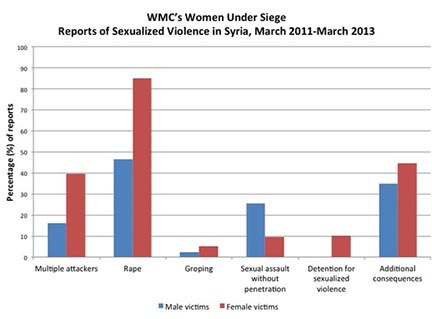
Although most coverage of the Syrian civil war tends to focus on the fighting between the two sides, this war, like most, has a more insidious dimension: rape has been reportedly used widely as a tool of control, intimidation, and humiliation throughout the conflict. And its effects, while not always fatal, are creating a nation of traumatized survivors — everyone from the direct victims of the attacks to their children, who may have witnessed or been otherwise affected by what has been perpetrated on their relatives.

In September 2012, I was at the United Nations when Norwegian Foreign Minister Espen Barth Eide shook up a fluorescent-lit room of bored-looking bureaucrats by saying that what happened during the Bosnian war is “repeating itself right now in Syria.” He was referring to the rape of tens of thousands of women in that country in the 1990s.

“With every war and major conflict, as an international community we say ‘never again’ to mass rape,” said Nobel Laureate Jody Williams, who is co-chair of the International Campaign to Stop Rape & Gender Violence in Conflict. [Full disclosure: I’m on the advisory committee of the campaign.] “Yet, in Syria, as countless women are again finding the war waged on their bodies–we are again standing by and wringing our hands.”

We said after the Holocaust we’d never forget; we said it after Darfur. We probably said it after the mass rapes of Bosnia and Rwanda, but maybe that was more of a “we shouldn’t forget,” since there was so much global guilt that we just sort of sat back and let similar tragedies occur since and only came to the realization later — we forgot.

Could we have forgotten that the unfolding human catastrophe in Syria exists before it’s even over? Continue reading Syria Has a Massive Rape Crisis

Whose body is it anyway?

Last Thursday was dubbed “Topless Jihad Day,” a call by the feminist group FEMEN for women to protest in support of a Tunisian woman who posted photographs of herself topless (with remarks on her body that many would consider tasteless) on her Facebook site and soon received condemnation and calls for punishment. The result was hardly an outpouring of indigenous support like the “Arab Spring” that flooded the main squares of Tunis, Cairo and Sanaa. The FEMEN website has posted images of women baring their breasts in Rio de Janeiro, San Francisco, Montreal, Paris, Milan, Kiev, Brussels, Berlin and a few other major cities. Two things stand out about this day of protest. First, it takes place only in cosmopolitan Western cities, not in Muslim-majority countries. Second, several of the scenes focus on the protesting women being arrested for breaking the law. The patriarchy that is being protested is not, therefore, only an issue about Islam.

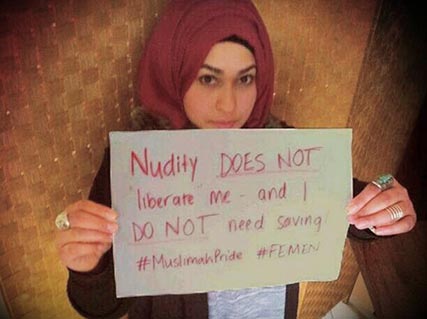
There is a basic principle of physics that every action results in a reaction. The moral code that would cause a Tunisian cleric to condemn a young Tunisian woman for exposing her breast on Facebook causes a protest from an international feminist organization. And, not surprisingly, there is a counter to this from a “Muslimah Pride” network. As the young woman in the image above indicates, she does not feel liberated by exposing her body. But perhaps even more poignant is her comment that she does not need saving. It is not clear if this Muslim woman is condemning the Tunisian woman at the center of the current protest, but she is definitely making a statement about her own body. Whose body is it anyway?

FEMEN has attracted followers for a variety of reasons. I suspect that some testosterone-loaded males in the West cheer wildly whenever a woman shows her bare breasts. These hardly support the stated goal of FEMEN: “sextremism serving to protect women’s rights, democracy watchdogs attacking patriarchy, in all its forms: the dictatorship, the church, the sex industry.” Historically there is no question that women have not had equal rights with men in economic, political or legal contexts; this is true for almost all cultures, ranging from those with despicable patriarchal rules to democracies with permanent glass ceilings. Secularism has challenged many (but not all) of these inequalities, giving women the right to own property, vote, and theoretically have equal opportunities in education and the workplace. Appeals to women’s rights resonate with most people, whether secular or religious, but the devil is in the details.

There is also an elephant in the room, in everyone’s room: who decides what women’s rights are? Continue reading Whose body is it anyway?

هل أمة العليم السوسوة نموذج للمرأة اليمنية ؟!


المساء برس- المساء برس التاريخ : 21-03-2013

أمة العليم السوسوة ظلت تبحث عن مكان للمرأة في الصفوف الأولى لمؤتمر الحوار الوطني فلم تجد أي مكان شاغر لها أو لغيرها حتى في منصة القاعة التي كانت مخصصة للرئيس ولرؤساء الأحزاب السياسية نواب الحوار الوطني .

السوسوة لم تعترض على ذلك كما فعل البخيتي ولكنها أكتفت بتوجيه رسالة عبر وسائل الإعلام حول غياب المرأة عن قيادة الحوار وإختراقها لمستوى التمثيل وظهور بعض الوجوه الجديدة من خلال بعض القوائم .

السوسوة كانت حرة في طرح آرائها ولم تنقاد وراء القوى السياسية وهذا ما جعلها تكسب إحترام الجميع وتقود قضية المرأة اليمنية بإمتياز فتاريخها يدل على ذلك فيما تسعى بقية المشهورات من النساء اليمنيات الى الصعود السياسي من بوابة الأحزاب ما جعلهن يتعرضن للنقد بسبب إتباع مواقف بعض القادة السياسيين ومراكز النفوذ كما فعلت توكل كرمان مؤخراً من إتباع لحميد الأحمر في الإنسحاب من الحوار بعد كانت تستجدي ضمها للحوار وهو ما جعل الرئيس في نهاية الأمر يوافق على ضمها في قائمة بعد أن تخلى الإصلاح عنها حتى أنها اشادت بقرار الرئيس وأعتبرت هادي أنه باقي في قائمتها .
Continue reading هل أمة العليم السوسوة نموذج للمرأة اليمنية ؟!