Category Archives: “Arab Spring”

The right barnamaj for Egypt

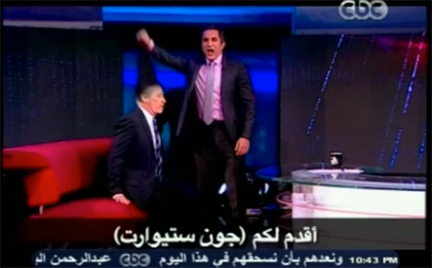
“If your regime is not strong enough to handle a joke, then you don’t have a regime.” Such was the sentiment of satirist Jon Stewart, who made a surprise appearance on the popular Egyptian television comedy show, al-Barnamaj, starring Bassem Youssef. If the Arab Spring protests were not simply an exercise resulting in one kind of intolerance replacing another, then this may be one of the most important lessons to be learned from the prevailing winds of post-people-revolution hopes. Obviously Moubarek did not handle jokes well, nor did Ben Ali, nor Qaddafi, nor Ali Abdullah Salih. Neither does Bashar al-Asad, who is desperately trying not to be the next ex-dictator in the Middle East. But then the ruling parties in the Islamic Republic are not exactly comedy-friendly. Bin Laden was the butt of millions of jokes, but it is hard to imagine him having success as a stand-up comedian.

The irony is that most of the people I have met in Egypt and Yemen are fond of jokes and have a rich tradition making fun of those in power, corrupt regimes and religious hypocrisy. Many have a sharp edge of “othering” one group or another, but some are self-deprecating. Satire has a way of getting to the crux of problems, which is probably why it is so irritating to those in power. Consider the following joke about the Syrian regime of Hafez al-Asad, a joke I heard from a Lebanese friend when Syria was basically in control of much of Lebanon.

The heads of the CIA, the KGB and the Syrian intelligence agency met at a conference and were bragging about their abilities to track down and find terrorists. Continue reading The right barnamaj for Egypt
Yemen’s National Dialogue Behind Closed Doors

by Sama’a al-Hamdani, Atlantic Council, June 17, 2013

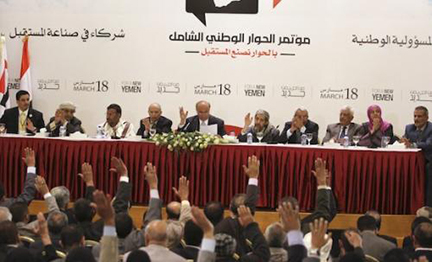
Yemen’s National Dialogue Conference (NDC), which began on March 18 and just reached the halfway point of its six-month mandate, was conceived as a core part of the transition process and is intended to bring together Yemen’s diverse political, social, geographic, and demographic groups to address the most critical issues plaguing the beleaguered country. Unfortunately, the way the dialogue was developed, designed, and directed created intrinsic flaws that may undercut its success. Some argue that the large number of participants and the lack of genuine representation outside of political parties are the reasons it is doomed for failure. Others feel that the process is advancing too quickly, leaving honest reconciliation out of the equation. One of the other major concerns is the lack of clear communication with the Yemeni public, transparency of the proceedings, and oversight of expenditures.

Although some Yemen experts remain pessimistic about the future of the country, they refrain from critiquing the dialogue because the outcome is still unclear and many perceive the dialogue as the only way to prevent a descent into civil war. Particularly because the process is opaque and because there is genuine skepticism about the Gulf Cooperation Council (GCC) transition agreement and the dialogue itself, the NDC should pro-actively report on all working group and plenary proceedings, publish all records and modifications, and disclose all financial contributions and allocations. This is the time to measure the discrepancy between the dialogue’s stated intention and the reality on the ground, if there is hope for effective progress. Continue reading Yemen’s National Dialogue Behind Closed Doors

Gezi Park and the Sound of Music

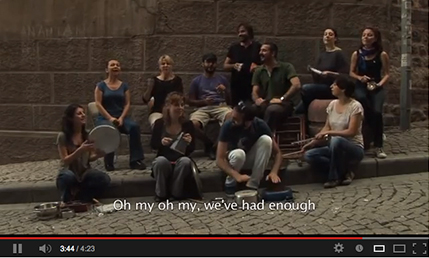
Omid Safi has a fine post (Sounds of Protest: Les Miserables, Gezi Park, and the Power of Music) on his blog at Religious News on the music in the recent protests in Turkey. Check it out for a nostalgic journey through protest songs since Joan Baez. Here is one of the songs he discusses, made at Gezi Park by Kardeş Türküler and called Sounds of Pots and Pans. Check out his commentary for far more. There is also a Turkish website with many tracks of protest music at http://capulcular.bandcamp.com/

GOOOOOOOAAAAAALLLLLL for Morsi?

Egypt’s Morsi turns to Syria and soccer to polish his tarnished image

By James M. Dorsey, Mideast Soccer Blogspot, June 17, 2013

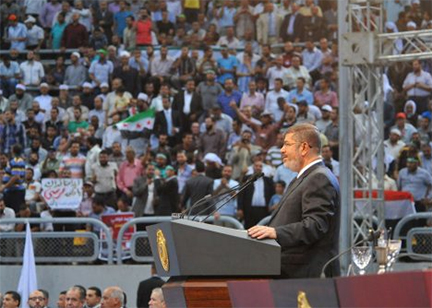
Egyptian President Mohammed Morsi and his flailing Muslim Brotherhood have turned to foreign policy and soccer to improve their battered image in advance of a planned mass anti-government protest at the end of this month and mounting calls for his resignation.

In a bid to distract attention from his domestic woes, curry favor with the United States and Gulf countries and restore Egypt to a leadership position in the Middle East and North Africa, Mr. Morsi chose a Cairo stadium to announce to his rallied supporters that he was cutting diplomatic ties with the regime of embattled Syrian President Bashar al-Assad.

The president’s ruling Muslim Brotherhood at the same time said it would field candidates for the board elections of storied Cairo soccer club Al Zamalek SC and other major football teams. The move is an effort to gain control of clubs in a soccer-crazy country whose huge fan base played a key political role in and since the toppling of Hosni Mubarak two years ago.

The fans, one of the largest civic groups in Egypt, are likely to participate in a mass opposition Tamarod (Rebel) march on the presidential palace scheduled for June 30, the first anniversary of Mr. Morsi’s inauguration as Egypt’s first freely-elected post-revolt leader, to demand his resignation and early elections. Egyptian media report that a petition calling for Mr. Morsi’s resignation has so far attracted 15 million signatures, two million more than the 13 million votes the president garnered a year ago. A significant number of militant soccer fans are believed to be among the signatories. Continue reading GOOOOOOOAAAAAALLLLLL for Morsi?

Game changer? Game on?


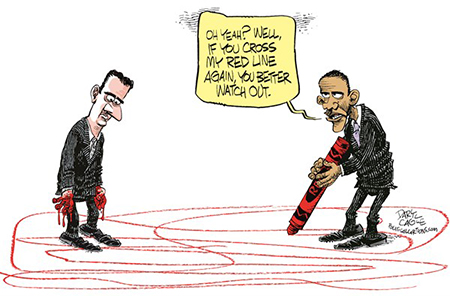
There is always a problem with drawing a line in the sand, especially the shifting sands of Middle East conflicts. President Obama is surely aware of this now, after unguardedly saying that use of chemical weapons by the Syrian regime would be a “game-changer.” The devastation in Syria, where the death toll is now estimated at around 93,000, is no game for the people of Syria or its neighbors, who are absorbing hundreds of thousands of displaced Syrians. In hindsight, President Bush’s “Mission Accomplished” banner summarizes with non-irenic irony the ineptness of his administration’s handling of the last (hopefully the last) Iraq War; will “Game Changer” haunt Obama’s record for future historians? To be blunt, is “game-changer” morphing into “game-on”?

In the rhetorical build-up to the last Iraq War, the hawkish mantra was WMD. Forget the fact that the U.S. gave tactical support to Saddam’s regime in his bloody 80’s war with Iran or had the opportunity to take him out in the earlier Iraq war. The intelligence icing on the “yellow cake” was that Saddam had become a threat to the U.S. (surely Israel was not absent in the equation), even though he had zero to do with 9/11 and was intolerant of any Islamic extremism at home. Although Libya did not seem to have WMDs, it did have the crazy loon Qaddafi, an easy target for removal by an air campaign of the U.S. and its NATO allies. Tunisia and Egypt sprung out of their respective dictatorial nightmares on their own, as the U.S. was basically reduced to observer status. The conflict in Yemen drones on, with the Saudis and the GCC doing the dirty work to redesign Yemen. Forget about changing the scene in Bahrein, where the U.S. docks its naval ships.

So the focus now is on Syria. Well, not just Syria. Continue reading Game changer? Game on?

The Gezi Occupation: for a democracy of public spaces


Occupied Taksim, June 10

by Nilufer Gole, Open Democracy, June 11, 2013

“Respect” has become a new slogan tagged on walls all over the cities, and expressing the need for a return to civility and call for politeness in Turkish public life. Gezi occupation reveals to us all, how “public square” becomes literally vital for our democracies.

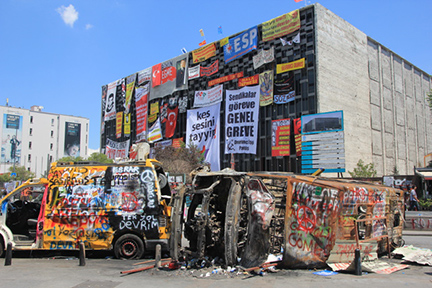
Over the past week, protest movements have spread across Turkey’s largest cities, and appear to become widespread urban uprisings. Despite often violent police intervention, people have not hesitated to take to the streets and block avenues, neighbourhoods, and their cities’ central spaces. Others participate from their balconies, with whole families chiming in to the protesters’ chorus, banging on pots and pans. They have found pacifist means of protest that require no arms or political slogans to express their discontent and frustrations with the Erdogan regime.

This urban movement, started by young people, supported by the middle classes and featuring a strong female presence, has not weakened in the face of impressive displays of force by riot police who use tear gas without hesitation. Clouds of gas cover the sky in town centres, making breathing difficult; but these clouds, symbols of pollution and the abuse of power, have only bolstered the anger of ordinary citizens.

The public sphere has been suffocating for some time in Turkey. Restrictions on freedom of expression and the crackdown on the opposition, particularly journalists who have lost their jobs and the mass media which has changed its editorial line, have put a muzzle on public discourse. The most recent protests in Taksim, which were not covered by the major television stations, are ample proof of this. Continue reading The Gezi Occupation: for a democracy of public spaces

Displaced in Yemen: A Life on Hold

IRIN’s film, A Life on Hold, tells the story of Qasim and his family, who for the past three years have been living in a camp for internally displaced people (IDPs) in northwestern Yemen.

Years of conflict in the region between the Houthi tribe and government forces has led to the displacement of more than 300,000 civilians, who have to cope with a decline in health and educational services. Malnutrition is common in the IDPs camps, as well as in the apartments, mosques and schools where many have found shelter.

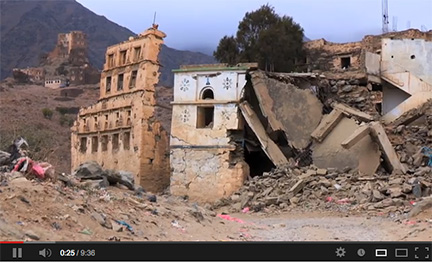
Authorities have tried to encourage the displaced to go back to their homes, but renewed clashes in 2012 actually increased the IDP numbers in the north. Extensive damage to houses and infrastructure, continuing insecurity, fear of reprisals and the lack of livelihood opportunities and basic services all serve as deterrents to return.

For more information on the situation in Yemen, please visit:

http://www.irinnews.org/Country/YE/Yemen

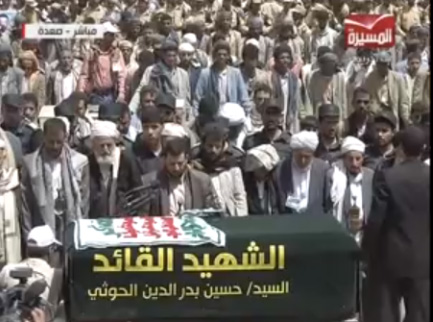
الحوثيون يشيعون زعيمهم الروحي حسين الحوثي في صعدة بعد 9 سنوات على مقتله


عبدالملك الحوثي يؤم بعشرات الآلاف في صعدة شمال اليمن في صلاة الجنازة على شقيقه “حسين”

  • المصدر أونلاين – خاص
    الأربعاء 5 يونيو 2013 06:14:48 مساءً

    شيع عشرات الآلاف في محافظة صعدة شمال اليمن، اليوم الأربعاء، جثمان الزعيم الروحي لجماعة الحوثيين حسين بدرالدين الحوثي بعد تسع سنوات من مقتله على يد قوات الجيش.

    وتوافد الآلاف من أنصار الحوثيين من مدن يمنية إلى صعدة حيث تتركز قوة جماعة الحوثيين، للمشاركة في تشييع الحوثي، وشدد مسلحو الجماعة من إجراءات الأمن وعززت نقاط تفتيش التي ينصبونها في أرجاء المحافظة.

    وحسين الحوثي المولود في 1965 قتل في عام 2004 خلال الحرب التي اندلعت بين الجيش وجماعته، إبان حكم نظام الرئيس السابق علي عبدالله صالح الذي أطاحت به انتفاضة شعبية انطلقت قبل عامين.

    وبدأت مراسم التشييع بأداء صلاتي الظهر والعصر وراء الدكتور المرتضى المحطوري وهو أحد أبرز منظري المذهب الزيدي في صنعاء.

    وصعد شقيقه الأصغر عبدالملك الحوثي وهو القائد الحالي للجماعة، على منصة محاطة بالحراس، يدعو فيه الموجودين في ساحة كبرى بالمدينة إلى أداء صلاة الجنازة وبدء مراسيم التشييع.

    Continue reading الحوثيون يشيعون زعيمهم الروحي حسين الحوثي في صعدة بعد 9 سنوات على مقتله