Category Archives: “Arab Spring”

Egypt Erupts


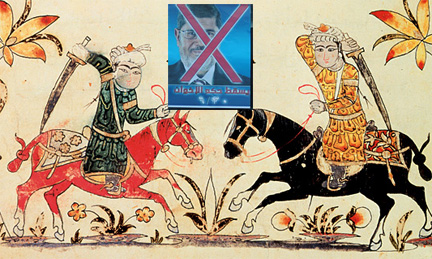
I have been reading a number of Mamluk historians recently and the turn of events in Egypt since the removal of President Morsi is an eerie reminder that the history of Egypt is more than the Nile, as Herodotus once put it; Egypt is the home of coup after coup from the Pharaohs to the Greeks to the early Muslims who founded Cairo to Fatimids, Ayyubids, Mamluks, Ottomans, Napoleon, the British and Nasser. The Nile still flows and the blood still spills out in the ongoing history of civil strife. The history of Egypt beyond the pyramids that the tourists photograph is very much about the military.

Today the Egyptian military and security forces followed through on their warning that they would clear the Muslim Brotherhood sit-ins in Cairo. The rhetoric for the past month has literally gone ballistic. The government has painted the Brotherhood as a band of intolerant terrorists, while the Brotherhood has made it seem as though they are martyrs for democracy. In all of this there must be some who wish for the days of Mubarak, just as some Iraqis long for the relative security of Saddam Hussein. The Arab Spring, which brought down dictator after dictator, has sprung a leak and a steady flow of blood is oozing out, literally hemorrhaging in the case of Syria, Iraq, Afghanistan and now Egypt.

Reports this morning from both sides in the conflict stretch the meaning of hyperbole. The government claims only 16 or so dead in all of Egypt, while a spokesman for the Brotherhood said thousands have been killed and tens of thousands injured. The truth is quite obviously in between. Continue reading Egypt Erupts
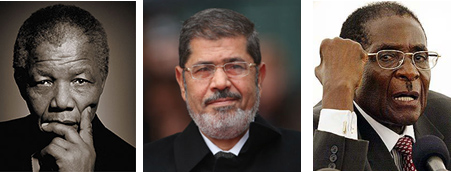

Morsi: The Arab World’s Wannabe Mugabe

I wonder if the judges who dole out the increasingly meaningless Nobel Peace Prize ever have second or third thoughts. In 2011 the Yemeni journalist Tawakkul Karman shared the prize for her visible opposition to the regime of Yemen’s Ali Abdullah Salih. The prize is symbolic to be sure, so it is not surprising that a recipient becomes hyperbolic with the international public attention. Karman was picked because of her advocacy work in Yemen, not because she was a savy expert on Middle East politics. A week ago she decided to cash in on her reputation and lend support to the sit-in followers of deposed President Morsi. The Egyptian authorities, not unsurprisingly, denied her entry for an obvious propaganda tour for the Muslim Brotherhood. Karman is shocked, it seems, that a military regime that would oust a sitting president would then deny her entry to come into Cairo and provide support for the opposition.

Foreign Policy has posted a commentary by Karman entitled Morsy Is the Arab World’s Mandela, with the subtitle Why we must stand and support the Muslim Brotherhood’s fight for democracy. Nelson Mandela? At a time when this fellow recipient of the Peace Prize (in 1993) is rumored to be near death’s door, this is an insult to the work of Mandela to end South Africa’s apartheid. My point is not to vilify or defend Morsi, but to compare him to Mandela is pure media hype. Continue reading Morsi: The Arab World’s Wannabe Mugabe

Punditry: Pondering or Pandering?

Having established this blog a little less than a decade ago, I was initially excited about the possibility of responding to things I read about the Middle East and Islam in virtual “real time.” I still have several letters (the kind put on paper) to the editor that never were published where I sent them. Even if they had been eventually published, it would have been a bit late. Blogs seemed a new and accessible way to play the role of a pundit. But there are different paths for punditry. The best kind is pondering about events; the least useful is pandering to a particular point of view.

To ponder is to wonder, which requires taking risks with ideas and sentiments. Pondering goes beyond posturing, which is simply repeating a polemical mantra no matter where it falls on the left-right political spectrum. Pandering results from preaching to the choir, fixating on speaking a specific truth to power that others may not think is a valid “truth” at all. The contentious issues surrounding representation of Islam, Muslims, Arabs, Jews and the gamut of issues that smolder in the region known as the Middle East are not resolved by rhetorical crossfire. I think that sometimes there is so much speech clutter on the internet that voices of reason have little chance of being heard.

Everyone has pet issues and I am certainly no exception. The reader of my posts over the years will find that for the most part I preach tolerance of diverse views with one glaring exception: I am loathe to tolerate intolerance. A dialogue of disagreement, in my mind, is always better than a monologue of “I am right and you are wrong.” To ponder an issue, then, should be to probe it, test it, play with it, throw it around and see what falls out, make it transparent. Dogma ends all dialogue. Continue reading Punditry: Pondering or Pandering?

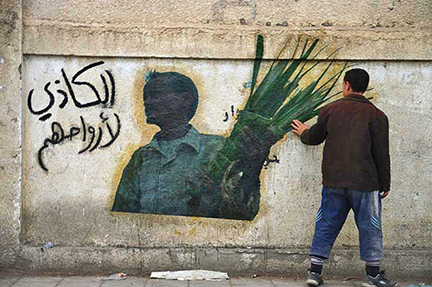
Street Art in Sanaa


Pasted photography on wall, Sana’a 2012; photograph by Jameel Subay

From Street Politics to Street Art in Yemen
By Anahi Alviso-Marino, Nafas Art Magazine, July 2013

In January 2011, demonstrations inspired by the contentious mobilizations taking place in Tunisia and Egypt started to be carried out in Yemen. Gradually, anti-governmental demonstrators came to modify old repertoires of contention, such as the demonstration or the sit-in, into what became a permanent camp and a new space of contention in Sana’a named “Change Square.” Among the self-proclaimed “revolutionary youth” of a sit-in that lasted until April 2013 were a number of visual artists. Their presence in the Square contributed in giving political demands an artistic expression, alongside using artistic practices as a means of contention. Contributing to the symbolic aspects of this mobilization, artistic practices developed inside and outside the tents. As a continuation of street politics acquired in the Square, certain visual artists incorporated dissent, transgression, and civil disobedience in their artistic practices. Among such cases, street art techniques such as graffiti, free writing, mural painting or stenciling participated throughout 2011 in reproducing political slogans that aimed to overthrow Ali Abd Allah Saleh’s regime.

In 2012 this contentious street art underwent certain changes. Continue reading Street Art in Sanaa

Irrational Monologue vs. National Dialogue in Yemen


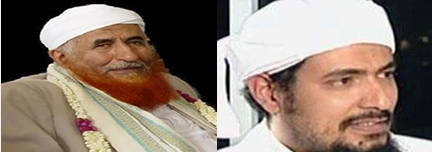
Al-Zindani, father and son

The winds that ushered in the “Arab Spring” were less a simoon, in the sense of a gust that stirs up everything in sight, than they were variable. Regime change has not been the same in every case. Take the case of Yemen, where Ali Abdullah Salih was ousted after three decades in power, but still remains free and influential in Yemen. Such a situation would be impossible for Mubarak, Ben Ali, Qaddafi and especially Bashar al-Asad. Although lives were lost in the Yemeni protests, these were few compared to the bloodshed that rocked Libya and Syria and escalates in Egypt with the recent protests against President Morsi’s removal by the military. Currently Yemen is in the process of a “National Dialogue.” This is admittedly a financially bloated endeavor that only the United Nations could create, but it has brought in a broad array of Yemeni views and has proceeded peacefully and with dignity.

Dialogue is always a plus. Monologue is the problem, whether it is a military dictator or a self-important religious cleric. Now the National Dialogue has been compromised by an irrational monologue carried on by Sheikh Abd al-Majid al-Zindani, a Salafi whose henna redness in his beard is in direct contrast to any common sense and good will. Al-Zindani reminds me of the “moral majority” preacher Jerry Falwell, who founded his own university and soaked up all the lavish praise his accolades could offer. Al-Zindani founded and runs, in his spare time it would seem, al-Imān University, which teaches hate more than it professes tolerance. The United States considers him a “Specially Designated Global Terrorist”, for his links to al-Qaeda, but this has not stopped his constant monologue of self-promotion.

Apparently upset that he was not getting enough attention in the media, al-Zindani has written a letter to the Yemeni people claiming that the National Dialogue is against Islam and that the only constitution possible is that of the shari’a (I suspect he has long forgotten about the Constitution of al-Madina). Continue reading Irrational Monologue vs. National Dialogue in Yemen

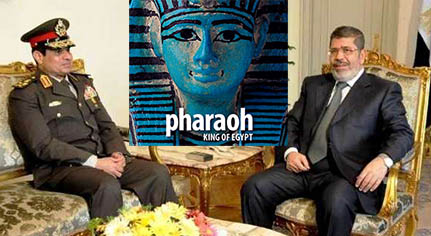
On Pharaohs, Pundits and Scholars

by Daniel Martin Varisco, Middle East Muddle, Anthropology News, July, 2013

The removal of Mohammed Morsi as president of Egypt has generated a frenzy of talking head punditry that shows little sign of abeyance, at least until another Middle Eastern leader bites the dust. Was it a coup? Was it yet another people’s revolution? Was it a failure of democracy? Did the Obama administration support the ouster? Was Morsi trying to make himself into a modern day Pharaoh? Tut, tut, sings the chorus of pundits.

Beyond the rhetoric back and forth, here is a reality check. The military has always been in charge of Egypt since Nasser took power in a well-recognized coup in 1952 that toppled a puppet king. Sadat and Mubarak came from the military, no matter what the status of their election. The military owns Egypt, quite literally, and is its main economic player. Morsi was not elected over the objection of Egypt’s top brass, but his attempt to weaken the power of the military is probably the main reason for his downfall.

In one sense of course it is a coup. It was the military, not the protesters, who really stormed the Bastille. It is the military who is keeping charge of Morsi and pushing for legal action against him. But in another sense it can hardly be called a coup when the military never gave up its power. Morsi was given slack, perhaps to let him fail on his own, but he never had any real power. Despite the official rhetoric, the leaders of most, if not all, Western nations are quite happy to see Morsi out of the way. At least a bloody corpse was not posted on state television, as happened at times in old-style army coups in the region. No American or European policy makers wanted to work with the Muslim Brotherhood any more than they do with Hamas in Gaza or with the militants calling for a new caliphate in Syria.

But here is the dilemma for scholars who study Egypt and have lived there. Egypt’s history, ancient, post-Arab conquest and modern, is a gold mine for researchers in a number of disciplines…

For the rest of this commentary, click here.

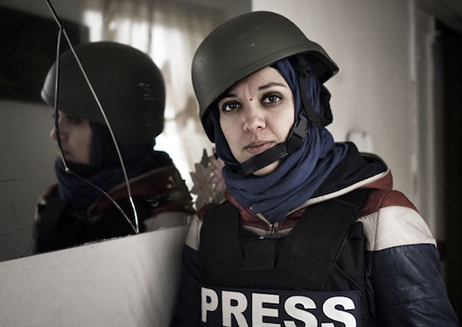
Freelancing the Syrian Conflict


A dark, rancid corner Borri says journalists have failed to explain Syria’s civil war because editors only want ‘blood.’ (Alessio Romenzi)

Woman’s Work
The twisted reality of an Italian freelancer in Syria

By Francesca Borri, Columbia Journalism Review, July 1

He finally wrote to me. After more than a year of freelancing for him, during which I contracted typhoid fever and was shot in the knee, my editor watched the news, thought I was among the Italian journalists who’d been kidnapped, and sent me an email that said: “Should you get a connection, could you tweet your detention?”

That same day, I returned in the evening to a rebel base where I was staying in the middle of the hell that is Aleppo, and amid the dust and the hunger and the fear, I hoped to find a friend, a kind word, a hug. Instead, I found only another email from Clara, who’s spending her holidays at my home in Italy. She’s already sent me eight “Urgent!” messages. Today she’s looking for my spa badge, so she can enter for free. The rest of the messages in my inbox were like this one: “Brilliant piece today; brilliant like your book on Iraq.” Unfortunately, my book wasn’t on Iraq, but on Kosovo.

People have this romantic image of the freelancer as a journalist who’s exchanged the certainty of a regular salary for the freedom to cover the stories she is most fascinated by. But we aren’t free at all; it’s just the opposite. The truth is that the only job opportunity I have today is staying in Syria, where nobody else wants to stay. And it’s not even Aleppo, to be precise; it’s the frontline. Because the editors back in Italy only ask us for the blood, the bang-bang. I write about the Islamists and their network of social services, the roots of their power—a piece that is definitely more complex to build than a frontline piece. I strive to explain, not just to move, to touch, and I am answered with: “What’s this? Six thousand words and nobody died?” Continue reading Freelancing the Syrian Conflict

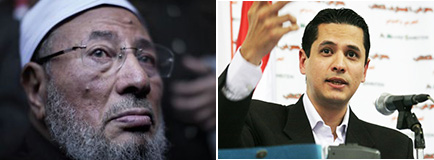
Qaradawi on Qaradawi

The following is a letter from Abd al-Rahman Qaradawi to his famous father, Shaykh Yusif Qaradawi, telling him to stay out of politics…

رسالة عبد الرحمن القرضاوي ابيه يوسف القرضاوي: آن لهذه الأمة أن تخوض الصعب، وأن ترسم الحدود بين ما هو ديني، وما هو سياسي، لكي نعرف متى يتحدث الفقهاء، ومتى يتحدث السياسيون!

وجه عبد الرحمن القرضاوي رسالة الى ابيه يوسف القرضاوي انتقد فيها اصداره فتوى يوم أمس بضرورة تأييد الرئيس المعزول محمد مرسي، واعادته الى منصبه، معرباً عن المه الشديد لتصرف والده ودعم الظلمة بدعوى حماية الشرعية والشريعة.

نص الرسالة كما وردت على موقع اليوم السابع:

أبي العظيم فضيلة الشيخ العلامة يوسف القرضاوى …
عرفتُكَ عالمًا جليلا وفقيهًا موسوعيًا متبحرا، تعرف أسرار الشريعة، وتقف عند مقاصدها، وتبحر في تراثها، ونحن اليوم في لحظات فاصلة في تاريخ مصر، مصر التي تحبُّها وتعتز بها، حتى إنك حين عنونت لمذكراتك اخترت لها عنوان “ابن القرية والكُتـَّــاب”ØŒ وأنا اليوم أخاطب فيك هذا المصري الذي ولد في القرية، وتربى في الكتّاب .
يا أبي الجليل العظيم … أنا تلميذك قبل أن أكون ابنك، ويبدو لي ولكثير من مريديك وتلامذتك أن اللحظة الراهنة بتعقيدها وارتباكاتها جديدة ومختلفة تماما عن تجربة جيلكم كله، ذلك الجيل الذي لم يعرف الثورات الشعبية الحقيقية، ولم يقترب من إرادة الشعوب وأفكار الشباب المتجاوزة، ولعل هذا هو السبب في أن يجري على قلمك ما لم أتعلمه أو أتربى عليه يوما من فضيلتكم .
Continue reading Qaradawi on Qaradawi