Category Archives: Humor and Satire

Gender Takes a Licking

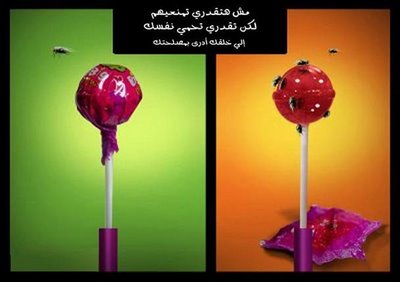
One thing that ethical reflection by most Muslims, Christians and feminists can agree upon is that female sexuality in advertising is degrading to women, turning them into objects for the male gaze. There is no question that sex sells and not just on Madison Avenue. A recent video commercial for Wall’s Magnum chocolate bar, starring Pakistani model Neha Ahmed, is as suggestive as any MTV video. Indeed Bollywood rivals Hollywood in depicting the female body as a focus of attraction. But exploitation is not only from companies out to make a buck by subliminally changing the letter “b” to the letter “f.” Sometimes those sincere individuals who think they are defending women’s honor end up reinforcing the stereotype. Such is the case for the image pictured above and posted on an Islamic website. There are many reasons why a woman would choose to wear hijab, but in this metaphor their gender takes a licking. The issue is not the wrapping, whether hijab or sticky paper, but the fact that flies will go for the candy no matter what you try to do. Does it occur to the creator of this image that the problem is not with candy, which is tasteful in the right context, but the nuisance of unzipped flies. Someone go find the fly swatter, please.

Luke R. E. Publican
Introducing “Reading Orientalism”


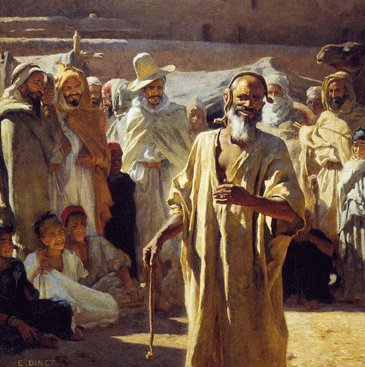
The Snake Charmer, Etienne Dinet, 1889


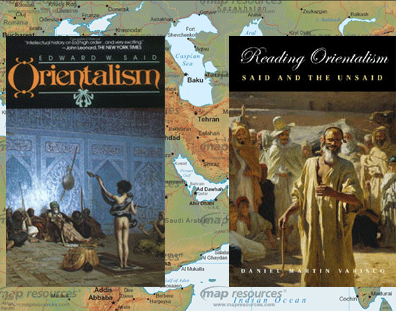
Last November I published Reading Orientalism: Said and the Unsaid with the University of Washington Press. The issues surrounding “Orientalism” and the legacy of Edward Said’s corpus are ongoing, but much of the debate still centers on personalities rather than pragmatic assessment of the complex intertwining of ethnocentrism, racism and sexism that extends far beyond anything imagined as an “Orient” or a “West.” Here is part of the introductory note to my book.

To the Reader

As an intellectual, I feel challenged by the theoretical incoherence; I feel driven to strive for an answer that, if it has not yet attained universal validity, will at least have transcended the evident limitations of the dichotomized past. Wilfred Cantwell Smith

And is it not further tribute to his triumph to see more clearly what he was battling? Maria Rosa Menocal

You have before you two books about one book.

The one book is Edward Said’s Orientalism, a copy of which should preferably be read before and after you tackle my critical engagement with this powerful text and the ongoing debate over it. More than a quarter century after its first publication, Orientalism remains a milestone in critical theory. Yet, as the years go by, it survives more as an essential source to cite rather than a polemical text in need of thorough and open-minded reading. I offer a commentary, not a new sacred text. Continue reading Introducing “Reading Orientalism”

Neoconceit and the Iraq Debacle

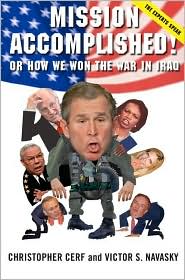
By now all but the most ardent of Bush administration admirers must face the obvious: the mission in Iraq was never accomplished, only botched. Historians and pundits will devote tomes upon tomes in assessing one of the most egregious blunders in American foreign policy. But it is not that difficult to see how it happened. Take a horrific tragedy (9/11), a convenient scapegoat (Muslim extremists), a personal grudge (Saddam surviving the first Gulf War and bragging about it), ideological nitwits (Cheney, Rumsfeld, Wolfowitz, Feith, and the list goes on), a bottom line (oil supply), a fear factor (WMDs) and outright lies. Much of the evidence for the Iraq Debacle survives on videotape. Now Christopher Cerf and Victor S. Navasky have documented what the “experts” bungled in their recent Mission Accomplished or How We Won the War in Iraq: The Experts Speak (New York: Simon & Schuster, 2008).

Cerf and Navasky operate out of The Institute of Expertology, an outside the Beltway anti-think tank that reveals that most would-be intellectual emperors have no clothes, and many of these stand stark naked without shame, even after being exposed. The case for the prosecution is both cute (without having to change a word of the neocon experts) and acute, as the architects of the Bush Iraq Debacle walk the planks they themselves imagined out of hot air. Here is a sampling of the neoconceit anti-principles that got us into this mess: Continue reading Neoconceit and the Iraq Debacle

STAND UP for Muslims Comics

America at a Crossroads, PBS, May 11, 2008

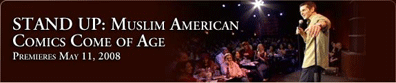
It’s an age-old American tradition: immigrant groups take up comedy to fight against discrimination. One path to understanding is to make people laugh. Now Muslim-Americans have come forward to help dismantle the stereotypes and hatred that have surged since September 11, 2001.

STAND UP: Muslim American Comics Come of Age is the story of five comedians: Ahmed Ahmed, Tissa Hami, Dean Obeidallah, Azhar Usman and Maysoon Zayid.
Tissa Hami

Each of these artists felt the aftershock of 9/11 personally. At a time when people of Middle Eastern origin were advised to lay low, they all chose to stand up — and tell jokes. This film explores how they are responding to 9/11, each in a different way, but all using humor to define who they are.

STAND UP is the story of Ahmed’s battle to get beyond playing “Terrorist No. 4.” It’s about Obeidallah’s journey to discover his Arab heritage. It’s about Zayid’s resolve to turn being “a Palestinian Muslim woman virgin with cerebral palsy from New Jersey” into a career asset. It’s about Usman’s quest to become the Muslim comedy role model he himself never found. It’s about Hami’s determination to challenge American conceptions about Muslim women. Continue reading STAND UP for Muslims Comics

Mean Girls

Shhhhhhh!!! A rare opportunity to explore the intrigues of USA High School beckons. Quietly listen in, while Tiffany, Brittany, and Stephanie discuss the latest news (http://www.timesonline.co.uk/tol/news/world/us_and_americas/us_elections/article3897414.ece):

Tiffany: “Did you hear what Bobby Malley did?”

Stephanie and Brittany, together: “No!”

Tiffany: “He works at International House of Pies on the weekend, and he delivered a pizza to Sammy Haniyeh’s party Saturday night.”

Brittany and Stephanie gasp. “Sammy Haniyeh? EWWWW!!”

Tiffany: “I know! He and his friends are so scruffy and obnoxious!”

Brittany: “What’s his problem? He’s always ragging on Zionsville High!”

Stephanie: “I heard it was because Zionsville beat his father’s team for the state championship in 1948.”

Brittany: “1948?? But that was, like, [pause]. . .a hundred years ago!” Continue reading Mean Girls

I Read It in the TLS

A very positive review of Daniel Martin Varisco’s recent book Reading Orientalism: Said and the Unsaid (University of Washington Press 2007), appears in this week’s issue of the prestigious Times Literary Supplement. In his examination of the evidence and logic of Edward Said’s argument in his classic book Orientalism, first published in 1978, Varisco provides an evenhanded exploration of the subject, thirty years on.

Aside from minor quibbles concerning Varisco’s tendency to pun (a common trait, regretfully, among scholars associated with the University of Chicago’s Anthropology Department), Robert Irwin, the Middle East editor of the TLS, praises the book’s careful research and insight. “Varisco’s book,” he concludes, referring in part to its magnificently detailed and informative footnotes, “makes for exhilarating reading.”

Given the tendency of right-wing pundits to claim that contemporary academe has fallen for Said hook, line, and sinker, what is one to make of a thoughtful and sensitive critique from within? Could it be that the field of contemporary Middle East Studies is no more homogenous and globally misguided than the field Said himself identified as “Orientalism”?