Category Archives: Gender and Sexuality

Memoirs Recount Limitations Of Life In Modern Iran


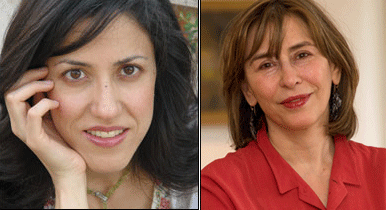
Azadeh Moaveni, left; Azar Nafisi, right

Memoirs Recount Limitations Of Life In Modern Iran

NPR, Morning Edition, February 10, 2009
Two new memoirs chronicle life in pre- and post-revolution Iran and offer a glimpse of a people struggling to find pockets of freedom within a repressive regime.

Azadeh Moaveni, a California-born journalist who lived in Iran from 1999 until 2002 and again from 2005 until 2007, is the author of Honeymoon in Tehran, in which she recounts the complexities of moving in with her boyfriend and becoming pregnant — before getting married — in a restrictive Islamic regime.

Moaveni describes modern Iran as an “as if” society, where young Iranians avoid the rules by acting as if they don’t exist and where what people do in private tends to be very different from the way they are forced to behave in public.

“For example, you have a middle class of young people who has premarital sex, drinks alcohol — behaves as young people around the world, and this is something the regime can’t do anything about because, for the most part, it all takes place behind closed doors,” Moaveni tells Morning Edition’s Rene Montaigne. Continue reading Memoirs Recount Limitations Of Life In Modern Iran
Lithographica Arabica 3: Druse Girl


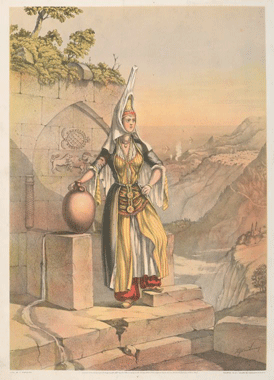
“Druse Girl”(1862) drawn by Henry J. Van-Lennep, Henry J. (1815-1889), Lithographer,
C. Parsons; Printer of plates, W. Endicott & Co. From “The Oriental Album: Twenty Illustrations, in oil colors, of the people and scenery of Turkey, with an explanatory and descriptive text.” By Rev. Henry J. Van Lennep. Online in NYPL Digital Gallery.

For Lithographica Arabica #2, click here.

Stoves for Darfur


The $30 stoves help keep Darfur’s women safe
by reducing their time away from the refugee camps
.

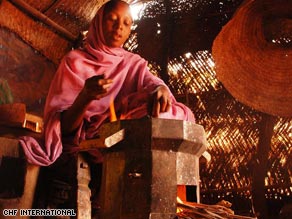
Stoves help keep Darfur’s women out of harm’s way
Larry Lazo, CNN

In Sudan’s Darfur region, where violence and genocide are rampant, women risk their lives every day performing tasks as seemingly mundane as seeking out firewood.

But, from his suburban home, one Maryland teen has dedicated himself to making life a little safer for those women. Continue reading Stoves for Darfur

The Mothers Of The Lashkar

The Mothers Of The Lashkar

by C.M. Naim, Outlook India, Dec 15, 2008

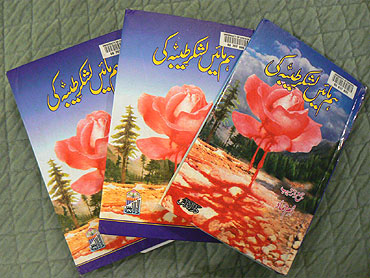
The book is titled Ham Ma’en Lashkar-e-Taiba Ki (‘We, the Mothers of Lashkar-e-Taiba’); its compiler styles herself Umm-e-Hammad; and it is published by Dar-al-Andulus, Lahore. Its three volumes have the same garish cover, showing a large pink rose, blood dripping from it, superimposed on a landscape of mountains and pine trees The first volume, running to 381 pages, originally came out in November 1998, and was reprinted in April 2001. The second and third volumes, with 377 and 262 pages, respectively, came out in October 2003. Each printing consisted of 1100 copies. Portions of the book—perhaps much of it—also appeared in the Lashkar’s journal, Mujalla Al-Da’wa.

Here is how the publisher, Muhammad Ramzan Asari, describes the book’s contents and purpose. Continue reading The Mothers Of The Lashkar

In Memoriam Elizabeth Fernea

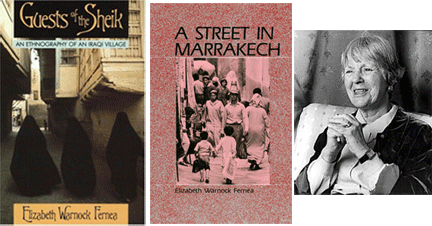
Webshaykh’s Note: For the many people whose lives crossed those of BJ Fernea this is a sad note from the University of Texas, where she taught for many years.

It is with great sorrow that we report that Elizabeth Warnock Fernea, Professor Emerita of Comparative Literature and Middle Eastern Studies at the University of Texas at Austin, passed away on Tuesday afternoon, December 2, 2008, at the home of her daughter, Laila Stroben, in La Canada, California. She is survived by her husband, Robert A. Fernea (Professor Emeritus of Anthropology and Middle Eastern Studies), daughters Laura Ann and Laila and son David, and several grandchildren. Continue reading In Memoriam Elizabeth Fernea

Rape in the Iraq War


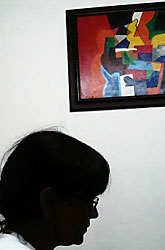
Khalida: The mother of two, shown in silhouette, was raped during the war.

Rape’s vast toll in Iraq war remains largely ignored

By Anna Badkhen, The Christian Science Monitor, November 24, 2008 edition

Amman, Jordan – As though recoiling from her own memories, Khalida shrank deeper into her faded armchair with each sentence she told: of how gunmen apparently working for Iraq’s Interior Ministry kidnapped her, beat and raped her; of how they discarded her on a Baghdad sidewalk.

But her suffering did not end when she fled Iraq and became a refugee in Jordan’s capital, Amman. When Khalida’s husband learned that she had been raped, he abandoned her and their two young sons.

Rumors spread fast in Amman; soon, everyone on her block knew that she was without a man in the house. Last month, her Jordanian neighbor barged into her apartment and attempted to rape her. Continue reading Rape in the Iraq War

Reclaiming my Religion


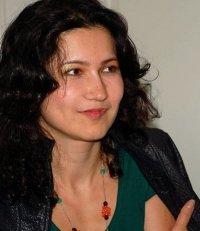
Nadira Artyk

Reclaiming my Religion

By Nadira Artyk, International Herald Tribune, November 28, 2008

My relationship with Islam has never been straightforward. I grew up in Soviet Uzbekistan, hearing my grandfather recite the Koran on a daily basis. Sometimes he would translate a few verses for us. I was drawn to the beauty of the prose. I sensed a strong connection and especially admired the values of social justice, equality and generosity of human spirit.

On the other hand, I was a Soviet Young Pioneer and later a Komsomol activist. Despite all my respect and love for my pious grandfather, I saw a mismatch between his words and my reality, at least in one area – there was no equality or justice to be found in Muslim families. The superiority of men over women was deeply entrenched and never questioned. Continue reading Reclaiming my Religion

Mixing Dall with Scottish Oats


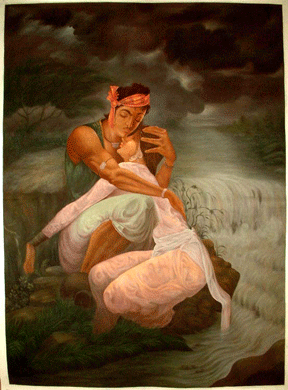
Heer Ranjha (Grieving Emotions of Two Desperate Hearts) by Giri Raj Sharma.

Lovers, Religion and Inhumanity

by Amanullah De Sondy, BBC Radio Scotland, Thought for the Day, Monday 1st December 2008

‘Porridge for my breakfast and Dall for my lunch, I’m a typical Scots-Asian’ said the main character in the Glasgow adaptation of the famous Punjabi love story, Heer Ranjha. I went to watch the play at the Tramway in Glasgow at the weekend. It’s an interesting and tragic tale of a rich Sikh girl, Heer, and a poor Pakistani Muslim boy, Ranjha, who is given a job in one of Heer’s father’s Indian restaurants. Ranjha cannot be accepted by the Sikh family, because of his Pakistani Muslim roots, and he’s taunted by the Sikhs around him.

In the end, Heer is forced to marry a famous Bollywood movie star, Sikh of course, but at the final moment Ranjha re-appears and is killed by her uncle. In a tragic finale, Heer kills herself so that she can to be with Ranjha. Continue reading Mixing Dall with Scottish Oats