Category Archives: Gender and Sexuality

A Persian Anatomy Lesson

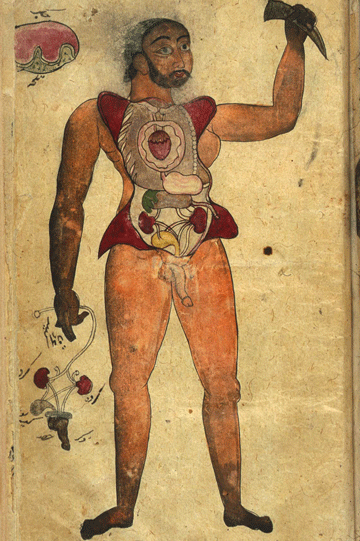
The National Library of Medicine has a splendid manuscript collection, including an 18th century Persian text with illustrations. Here is the information from the webpage, with two of the illustrations provided here.

Anonymous Persian Anatomical Illustrations. [Iran or Pakistan, ca. 1680-1750].
Anonymous Persian Anatomical Illustrations.

The National Library of Medicine owns approximately 300 Persian and Arabic manuscripts dating from the eleventh to the nineteenth centuries. Most of these manuscripts deal with medieval medicine and science and were written for learned physicians and scientists. Among them are a number of anonymous anatomical treatises or groups of anatomical drawings.

The two featured here consist of a Persian bloodletting figure and a venous figure, probably drawn in the 18th century but based on earlier models (MS P 5 fol. A); and six early-modern anatomical drawings showing some European and Indian influences (MS P 20, item 2).

Six Early Modern Anatomical Illustrations

Six anonymous anatomical drawings occur on folia 554-559 at the end of a volume containing Tibb al-Akbar (Akbar’s Medicine) by Muhammad Akbar, known as Muhammad Arzani (d. 1722/ 1134) in an undated copy probably made in the 18th century. The paper on which these figures are drawn, however, is distinct from that of the main text, though similar in many respects. The illustrations appear to be unrelated to the accompanying text and to draw upon Indian and early-modern sources.

One full-opening of the manuscript, folia 554b-555a, contains two full-figure anatomical illustrations, one of a female and one of a male. Continue reading A Persian Anatomy Lesson
The Liberation of Erotic Literature


Interview with Salwa al-Neimi
in al-Qantara, 7/2010

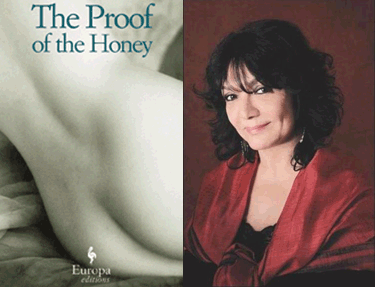
The novel The Proof of the Honey by Syrian author Salwa al-Neimi is celebrated by some as a milestone of modern Arabic literature and condemned by others as scandalous prose. In an interview with Rim Najmi, the author explains that despite the lightness of its literary style, her novel poses fundamental intellectual and political questions

Your first novel, The Proof of the Honey, attracted a great deal of attention from both readers and critics alike. The most frequent response had more to do with your “courage” in tackling one of the greatest taboo themes in Arab culture and less with the literary qualities of your novel. What do you think was the decisive factor for all the attention?

Salwa al-Neimi: Thank you for this question. I always say the success of the book is primarily based on its language and style. I make this claim even though most of the critics tend to emphasize the theme of the novel and the fact that it crosses the red line. Unfortunately, they have little interest in the actual text itself. Some critics constantly talk about freedom of expression, although this often turns out to be just an end in itself. When it comes to a contemporary text, it is often judged in terms of moral categories, which is just another form of censorship.

By Arab standards, your novel, The Proof of the Honey, sold in record numbers in only a short time. It has also been translated into many languages. What does the international publication of your work mean to you?

Al-Neimi: First and foremost, I wrote The Proof of the Honey for Arab readers. Continue reading The Liberation of Erotic Literature

Afghan Trucks 2

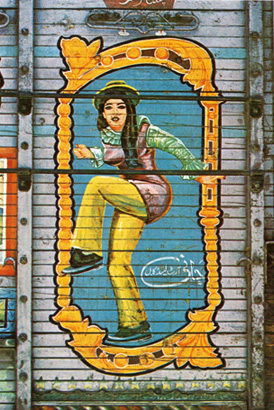
In a previous blog entry, I mentioned a photographic book by Jean-Charles Blanc on Afghan Trucks. In addition to legendary and technological themes, in this pre-Taliban world there was an interest in women as well, at least among truck drivers and those who appreciated truck driven art. Here is what the Introduction to the text says about the female image unveiled:

Occasionally another motif appears amongst these tablaux: that of women – a rare and daring theme for this Islamic society where tradition is so carefully guarded. they are depicted in the form of sensual, Felliniesque, sulphurous-eyed vamps whose looks are inspired from Indian statuary – the flesh of Marilyn and Sophia draped in Oriental clothing, and with just a few puffs of hashish their colored images spring to life …


to be continued

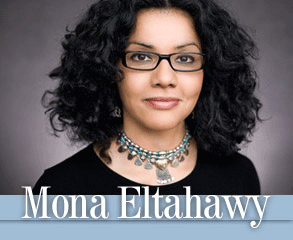
Me and the Feminists

By Mona Eltahawy, The Jerusalem Report, November 24, 2010

I was 23 years old and I was interviewing an Egyptian feminist who had just taken over as editor-in-chief of a women’s magazine of the cooking-and-fashion variety, which she had vowed to turn into the go-to magazine for women’s rights.

I was excited to meet her because she was one of the real-life feminists that my recently returned-to-Egypt self loved to meet to help me turn theory into action. Ever since I’d discovered feminist journals on the bookshelves at my university in Jeddah, Saudi Arabia, at the age of 19, I’d devoured all I could of the theory.

I had returned to Egypt at 21 hungry to put it into action. My first encounter with those essays was nothing short of terrifying. That’s how you know what you need – it scares the hell out of you because it encourages you to jump but you don’t know if you’ll ever land. Religious conservatism was suffocating me in Saudi Arabia and I was losing my mind. I didn’t care about landing. I was overdue for a jump.

So returning to Egypt at 21 after 14 years away was a chance to water that seed of feminism with the sustenance of real-life women who embodied it. I looked for them everywhere I could. Many of the older women practically adopted me, inviting me to their meetings, sending me their latest reports and alerting me ahead of important conferences they were holding. Continue reading Me and the Feminists

On Gadflies and Burlesque Phonies


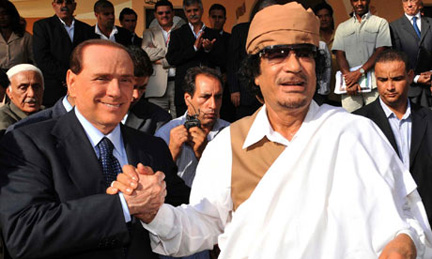
Some say a picture is worth a thousand words. Surely the above photograph above of two aging heads of state on opposite sides of the Mediterranean is worth a thousand or even more or less. If you did not know the headline, what do you think these two men would be talking about? If you guessed immigration, you would be almost right. If you guessed romance and cross-cultural marriages, you would be exactly right, if The Guardian is to be believed. The Libyan government is using the services of an Italian match-making site called hostessweb to bring Italian women to Libya. The site is even available in 53 different languages, including Arabic, Swahili and Persian. All you need is an Internet connection and a credit card and some mutual language besides the universal code of love.

It seems that both Colonel Gaddafi and Silvio Berlusconi are friends. One might speculate on what they have in common. Being unpopular perhaps for their dictatorial ways? A soft spot for the gentler gender? Or maybe just a penchant to do favors for nephews. It seems that Colonel Gaddafi is worried about his nephew’s matrimonial future. As The Guardian reports: Continue reading On Gadflies and Burlesque Phonies

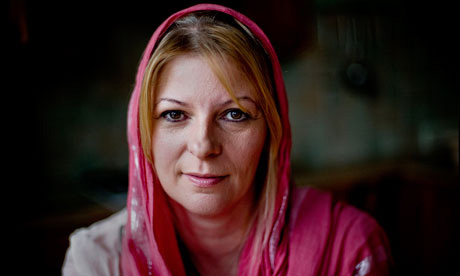
Lauren Booth on Lauren Booth


I’m now a Muslim. Why all the shock and horror?

by Lauren Booth. The Guardian, November 3, 2010

It is five years since my first visit to Palestine. And when I arrived in the region, to work alongside charities in Gaza and the West Bank, I took with me the swagger of condescension that all white middle-class women (secretly or outwardly) hold towards poor Muslim women, women I presumed would be little more than black-robed blobs, silent in my peripheral vision. As a western woman with all my freedoms, I expected to deal professionally with men alone. After all, that’s what the Muslim world is all about, right?

This week’s screams of faux horror from fellow columnists on hearing of my conversion to Islam prove that this remains the stereotypical view regarding half a billion women currently practising Islam.

On my first trip to Ramallah, and many subsequent visits to Palestine, Egypt, Jordan and Lebanon, I did indeed deal with men in power. And, dear reader, one or two of them even had those scary beards we see on news bulletins from far-flung places we’ve bombed to smithereens. Surprisingly (for me) I also began to deal with a lot of women of all ages, in all manner of head coverings, who also held positions of power. Believe it or not, Muslim women can be educated, work the same deadly hours we do, and even boss their husbands about in front of his friends until he leaves the room in a huff to go and finish making the dinner. Continue reading Lauren Booth on Lauren Booth

Abayas for backpacks


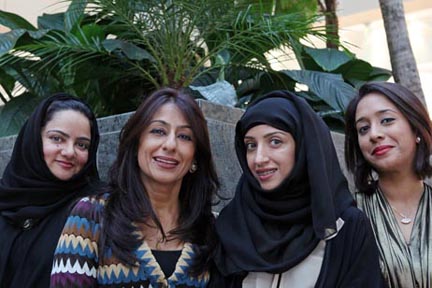
Left to right) Salwan Al Shaibani, 39, Hala Kazim, 47, Maha Jaber, 32, and Aida Al Busaidy, 27, all of Dubai. Kazim recently took the other women on an 80-kilometer hike in Austria through her program, Journey Through Change; Photo by Amy Leang / The National

Hike across Austria raises profile of Emirati women

by Maey El Shoush, The National, October 15, 2010

DUBAI // Five Emirati women who traded their abayas for backpacks have returned from a successful five-day hiking trip through Austria aimed not only at their own personal development but also at breaking down stereotypes outside the UAE.

Their tour was organised through Journey Through Change, a Dubai life coaching and organising company run by Hala Kazim, 47.

Mrs Kazim said: “I wanted to show the ladies and men in our communities, there are more things to life. This was not just a walking trip: I exposed them to different cultures, showed them how to absorb the beauty around them, and counselled them as we walked.”

The group, composed of women from their mid-20s to 40s, walked 80 kilometres, starting at Vienna through Fuschl towards St Wolfgang, across mountainous terrain and past green fields, farms and villages. Dressed down and wearing no makeup, with minimal internet access at the bed and breakfasts where they spent each night, the trip took the women back to basics. Continue reading Abayas for backpacks