Category Archives: Gender and Sexuality

Harun’s Harem Prime Time


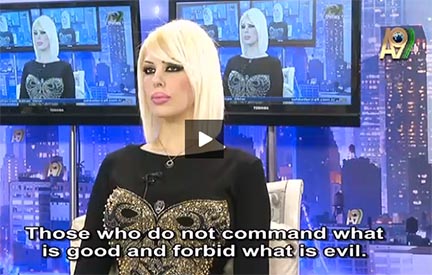
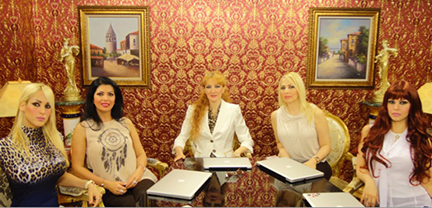
From left, the women of Turkey’s Building Bridges: Ebru, Ece, Aysegul (who occasionally joins the four hosts on their show), Aylin, and Ceylan; Courtesy of A9 TV

[Webshaykh’s Note: I previously posted a blog commentary on the media beauties of Harun Yahya. A recent article in Slate is on the same group, and I post the start of the article below.]

The Versace Harem
A group of Muslim women with tight shirts, bright lipstick, a feminist mission, and total devotion to a creationist guru.

By Jenna Krajeski. Slate, Thursday, May 2, 2013

I first agreed to meet Ece, Ceylan, Aylin, and Ebru because I didn’t really believe they existed. They host the Turkish talk show Building Bridges and had recently gotten some attention, but not for the interviews. The women look astonishing. They are mostly bottle blonds, save for Ece, who has raven hair. Neon lipstick gives their lips a whole extra dimension. They coordinate outfits. At one of our meetings, they wore brightly colored satin pantsuits and T-shirts with designer brand names that stretched over their chests. What they talk about on Building Bridges—interfaith dialogue, women and Islam, the greatness of Turkey—isn’t particularly sexy, but their outfits are designed to make up for that. They are also devout Muslims—conservative, even—a supposed contradiction that is also the show’s allure.

Guests often appear—usually by Skype—with their eyebrows arched in the manner of a serious person certain he is the victim of a practical joke. But they proceed. The women sweetly dare the guests to suggest the hosts are anything but what they claim to be—activists, political commentators, Muslims—because of how they dress. During one interview, which I observed in the studio, Ceylan right away asked a German diplomat if a “true religious education” could “combat bigotry.” Continue reading Harun’s Harem Prime Time
Too handsome for Saudi Women


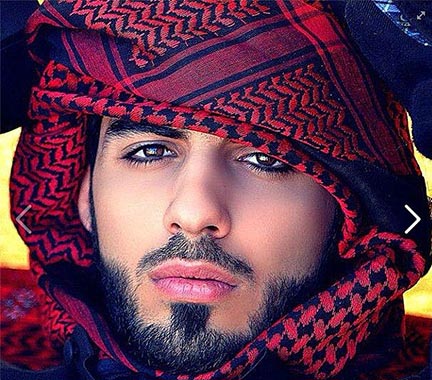
Omar Borkan Al Gala

The news from the Middle East and broader Islamic World is as dismal today as it was yesterday. Syria continues to be a spiraling bloodbath, as does Iraq as we near the 10th anniversary on May 1 of the notorious Bush the Younger declaration of “Mission Accomplished.” Several hundred garment workers may have lost their lives in the collapse of an 8-story sweat shop in Bangladesh and the list goes on. There are times when those of us on the comfortable outside looking in need to take a breath and find something to laugh about in the onslaught of absurdity. The fact that yesterday I heard a lecture on Waiting for Godot is not entirely irrelevant for posting this blog.

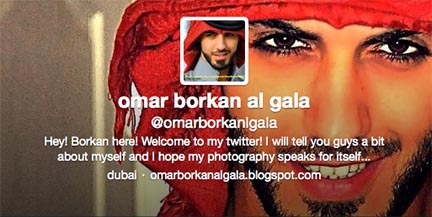
For the Saudi purity police it seems that it is possible for a visitor to be so media-savvy handsome that local women need to be protected by deporting him. The case in reporting-stupidity point is about a certain Omar Borkan Al Gala, a fashion photographer, actor and poet from Dubai. England’s authoritatively silly tabloid The Sun carries the following subline: “THE internet is awash with speculation that one of the men deported from Saudi Arabia for being “too handsome” is a fashion photographer from Dubai.” For a pretend news source that Murdoch-murders the truth every chance it can get, there seems to be a voyeuristic fascination with Arab men’s bodies, including Saddam in his undies.

So is this guy really so handsome that he is a whipped-up man of mass distraction to the Saudi regime? Continue reading Too handsome for Saudi Women

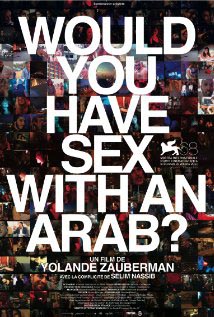
Would You Have Sex With an Arab?

Sleeping With the Enemy? Review of “”Would You Have Sex With an Arab?
By Clara Abdulaziz,http://ta3beer.blogspot.com, April, 19

“One in five Israelis is an Arab, but it is difficult to find places where they touch fingertips.”

In her latest feature-length documentary, French filmmaker Yolande Zauberman ventures out into the nightlife of Tel Aviv and asks the people she meets a deceptively simple question: “Would you have sex with an Arab?” It is clear that sex serves merely as a proxy to grapple with a much larger question: can individuals transcend identities rooted in long histories of conflict, or is identity so rigidly constructed that it in fact defines one’s humanity?

Zauberman has said that she produced the film to “give space for awareness.” It is meant to be “a little bit sexy, a little bit funny.”

It is also, quite frankly, pretty depressing.

Zauberman’s choice of Tel Aviv for her film was not arbitrary. It is famous for its non-stop club scene, and is one of the most LGBT and queer-friendly cities in the world. She shows that even here, where most young residents seem more concerned with partying than religion and politics, the boundaries of Jewish and Arab identity remain stubbornly situated within the larger Arab-Israeli conflict. Continue reading Would You Have Sex With an Arab?

Syria Has a Massive Rape Crisis

by Lauren Wolfe, The Atlantic, April 3

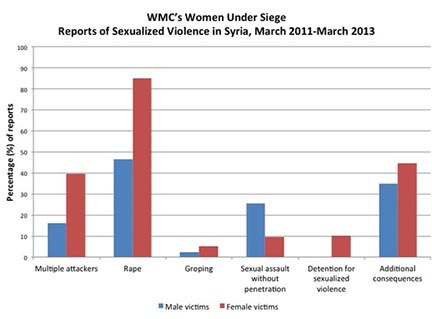
One day in the fall of 2012, Syrian government troops brought a young Free Syrian Army soldier’s fiancée, sisters, mother, and female neighbors to the Syrian prison in which he was being held. One by one, he said, they were raped in front of him.

The 18-year-old had been an FSA soldier for less than a month when he was picked up. Crying uncontrollably as he recounted his torture while in detention to a psychiatrist named Yassar Kanawati, he said he suffers from a spinal injury inflicted by his captors. The other men detained with him were all raped, he told the doctor. When Kanawati asked if he, too, was raped, he went silent.

Although most coverage of the Syrian civil war tends to focus on the fighting between the two sides, this war, like most, has a more insidious dimension: rape has been reportedly used widely as a tool of control, intimidation, and humiliation throughout the conflict. And its effects, while not always fatal, are creating a nation of traumatized survivors — everyone from the direct victims of the attacks to their children, who may have witnessed or been otherwise affected by what has been perpetrated on their relatives.

In September 2012, I was at the United Nations when Norwegian Foreign Minister Espen Barth Eide shook up a fluorescent-lit room of bored-looking bureaucrats by saying that what happened during the Bosnian war is “repeating itself right now in Syria.” He was referring to the rape of tens of thousands of women in that country in the 1990s.

“With every war and major conflict, as an international community we say ‘never again’ to mass rape,” said Nobel Laureate Jody Williams, who is co-chair of the International Campaign to Stop Rape & Gender Violence in Conflict. [Full disclosure: I’m on the advisory committee of the campaign.] “Yet, in Syria, as countless women are again finding the war waged on their bodies–we are again standing by and wringing our hands.”

We said after the Holocaust we’d never forget; we said it after Darfur. We probably said it after the mass rapes of Bosnia and Rwanda, but maybe that was more of a “we shouldn’t forget,” since there was so much global guilt that we just sort of sat back and let similar tragedies occur since and only came to the realization later — we forgot.

Could we have forgotten that the unfolding human catastrophe in Syria exists before it’s even over? Continue reading Syria Has a Massive Rape Crisis

Whose body is it anyway?

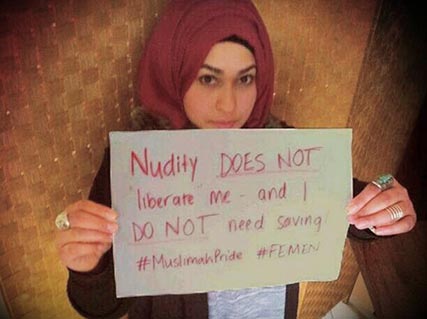
Last Thursday was dubbed “Topless Jihad Day,” a call by the feminist group FEMEN for women to protest in support of a Tunisian woman who posted photographs of herself topless (with remarks on her body that many would consider tasteless) on her Facebook site and soon received condemnation and calls for punishment. The result was hardly an outpouring of indigenous support like the “Arab Spring” that flooded the main squares of Tunis, Cairo and Sanaa. The FEMEN website has posted images of women baring their breasts in Rio de Janeiro, San Francisco, Montreal, Paris, Milan, Kiev, Brussels, Berlin and a few other major cities. Two things stand out about this day of protest. First, it takes place only in cosmopolitan Western cities, not in Muslim-majority countries. Second, several of the scenes focus on the protesting women being arrested for breaking the law. The patriarchy that is being protested is not, therefore, only an issue about Islam.

There is a basic principle of physics that every action results in a reaction. The moral code that would cause a Tunisian cleric to condemn a young Tunisian woman for exposing her breast on Facebook causes a protest from an international feminist organization. And, not surprisingly, there is a counter to this from a “Muslimah Pride” network. As the young woman in the image above indicates, she does not feel liberated by exposing her body. But perhaps even more poignant is her comment that she does not need saving. It is not clear if this Muslim woman is condemning the Tunisian woman at the center of the current protest, but she is definitely making a statement about her own body. Whose body is it anyway?

FEMEN has attracted followers for a variety of reasons. I suspect that some testosterone-loaded males in the West cheer wildly whenever a woman shows her bare breasts. These hardly support the stated goal of FEMEN: “sextremism serving to protect women’s rights, democracy watchdogs attacking patriarchy, in all its forms: the dictatorship, the church, the sex industry.” Historically there is no question that women have not had equal rights with men in economic, political or legal contexts; this is true for almost all cultures, ranging from those with despicable patriarchal rules to democracies with permanent glass ceilings. Secularism has challenged many (but not all) of these inequalities, giving women the right to own property, vote, and theoretically have equal opportunities in education and the workplace. Appeals to women’s rights resonate with most people, whether secular or religious, but the devil is in the details.

There is also an elephant in the room, in everyone’s room: who decides what women’s rights are? Continue reading Whose body is it anyway?

Harun’s houris


Harun Yahya, a.k.a Adnan Oktar

But what greater temptation than to appear a missionary, a prophet, an ambassador from heaven? Who would not encounter many dangers and difficulties, in order to attain so sublime a character? Or if, by the help of vanity and a heated imagination, a man has first made a convert of himself, and entered seriously into the delusion; who ever scruples to make use of pious frauds, in support of so holy and meritorious a cause?
David Hume, “Of Miracles” (1748)

David Hume, the eminent 18th century philosopher, was probably not thinking about Islam when he wrote his seminal essay “Of Miracles,” but his description resonates well with the media realm of the would-be Mahdi Harun Yahya (alias of Adnan Oktar). Put enough money and media-savvy glitz behind a delusion and the gullible will come to the trough. All you need to do is check out the main website of Harun Yahya to see a sexed-up Disney version of Islam. And even if you happen to be Igbo (yes Igbo), you can read what the Harun Yahya machine has to say about the “Koran.”

The checkered history of Adnan Oktar is hardly a secret, especially in Turkey. But his cyber-reach is massive, with multiple websites available in many different languages. If you have time to spare, spend a few minutes perusing some of his 160 websites devoted to attacking evolution, proving miracles, calling for an Islamic Union led by Turkey, the coming of the Mahdi, hell, atheism and beyond. Oktar recently made news by interviewing Israeli guests, despite earlier writings which include holocaust denial.

The latest twist in the televised adoration of Adnan Oktar might best be labeled “Harun’s houris.” Continue reading Harun’s houris

هل أمة العليم السوسوة نموذج للمرأة اليمنية ؟!


المساء برس- المساء برس التاريخ : 21-03-2013

أمة العليم السوسوة ظلت تبحث عن مكان للمرأة في الصفوف الأولى لمؤتمر الحوار الوطني فلم تجد أي مكان شاغر لها أو لغيرها حتى في منصة القاعة التي كانت مخصصة للرئيس ولرؤساء الأحزاب السياسية نواب الحوار الوطني .

السوسوة لم تعترض على ذلك كما فعل البخيتي ولكنها أكتفت بتوجيه رسالة عبر وسائل الإعلام حول غياب المرأة عن قيادة الحوار وإختراقها لمستوى التمثيل وظهور بعض الوجوه الجديدة من خلال بعض القوائم .

السوسوة كانت حرة في طرح آرائها ولم تنقاد وراء القوى السياسية وهذا ما جعلها تكسب إحترام الجميع وتقود قضية المرأة اليمنية بإمتياز فتاريخها يدل على ذلك فيما تسعى بقية المشهورات من النساء اليمنيات الى الصعود السياسي من بوابة الأحزاب ما جعلهن يتعرضن للنقد بسبب إتباع مواقف بعض القادة السياسيين ومراكز النفوذ كما فعلت توكل كرمان مؤخراً من إتباع لحميد الأحمر في الإنسحاب من الحوار بعد كانت تستجدي ضمها للحوار وهو ما جعل الرئيس في نهاية الأمر يوافق على ضمها في قائمة بعد أن تخلى الإصلاح عنها حتى أنها اشادت بقرار الرئيس وأعتبرت هادي أنه باقي في قائمتها .
Continue reading هل أمة العليم السوسوة نموذج للمرأة اليمنية ؟!