All posts by dvarisco

Yemen after Ali Abdullah Salih


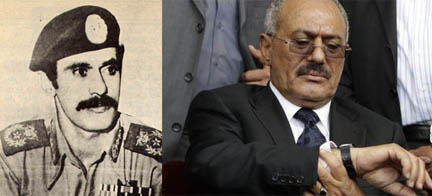
Ali Abdullah Salih, from 1978 to 2011

From the latest news reports in the region it appears that President Ali Abdullah Salih has agreed to step down within a month in an agreement brokered by the GCC. The plan calls for Salih to hand over power to his Vice President one month after the opposition signs on to the agreement, which they have reportedly done. Although, as I write this Salih’s decision to step down has not been broadcast in the state-run Yemeni newspaper al-Thawra or on his personal website. Two months later a national election is to be held. A possible sticking point is the immunity that this agreement provides President Salih and his family. The U.S. administration has already blessed the plan and it seems likely that it will be finally resolve Salih’s departure.

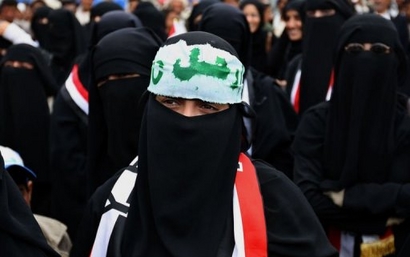
The protests against Salih have left the country divided and the economy, weak as it was to begin with, has basically ground to a halt. The poorest country in the Middle East is even poorer after three months of protests across the country. So what happens now?

The removal of President Salih will not solve the range of economic, ecological and social problems facing Yemen. Unemployment will continue, as the oil production nears an end; water tables will draw down even more drastically; imported Salafi conservatism will divide the population even more. In a sense Salih has been out of power for the past three months, simply hanging on as the protests gained more and more momentum. Unable, and apparently unwilling, to stop the street protests militarily (as Qaddafi is desperately trying), Salih deftly tried to garner his own supporters as a counter to those who wanted him to leave. But the hand writing was on the wall all along, given the wide coalition of groups who had grievances against his regime. The opposition seemingly united in its primary goal of removing Salih, but there is no single leading opposition party or leader waiting in the wings. Continue reading Yemen after Ali Abdullah Salih
History repeats itself: The case of Egypt


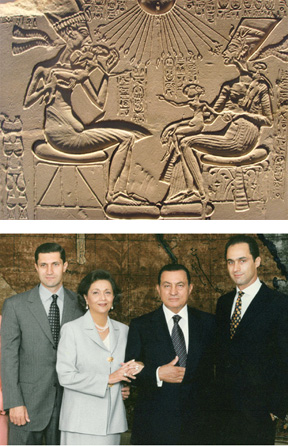
Ruling families not fondly remembered in Egypt

The history of divine kingship and dictatorial hubris has a consistent theme: elevating a ruler’s name above all others and stamping that name on just about everything in sight. In Saddam Hussein’s Iraq his image was everywhere, at times in the heroic proportions of a Babylonian king; visit Syria and you will find Assad and son lionized in every nook and cranny; Timur is resurrected in Uzbekistan. Then there is Hosni Mubarak, whose fall from power is now accompanied by an erasure of his public visage. As reported in Al Jazeera:

An Egyptian court has ordered the names of Hosni Mubarak, the country’s former president, and his wife Suzanne, to be removed from all public places, including streets and parks. Judge Mohammad Hassan Omar ordered on Thursday that Mubarak’s name and picture be removed from sport fields, streets, schools, libraries and other public establishments, according to the state-run al-Ahram newspaper. Currently, various public spaces, including squares, streets and about 500 public schools bear the names of either Hosni, Suzanne or Gamal Mubarak.

Continue reading History repeats itself: The case of Egypt

If Salih read the Qur’an


The rhetorical standoff in Yemen continues with only a limited amount of violence even while hundreds of thousands of people have been protesting, mostly against the decades-old regime of President Ali Abdullah Salih. Yesterday the New York Times commented that the protests in Yemen remain remarkably peaceful, with isolated cases of individual violence (mainly by those who support Salih) but no major clashes with the army or between tribal groups. President Salih holds a weekly rally of his supporters (some of whom have clearly been paid to come to the rally, as reporters note) as a counterpart to the far greater numbers protesting all over the country against his continued rule. He is holding on to power with a very thin string; indeed it is hardly even ‘power” any more given that much of the country is basically ignoring him and he is diplomatically isolated.

The only thing more incongruous than dictators (a military man installed in a coup after an assassination of the previous leader and who has remained in power for over three decades is at least an honorary dictator) talking about democracy is when dictators start talking about religion. Unlike Yemen’s Zaydi imams, whose millennium long rule was abolished in 1962, none of the military leaders of Yemen are noted as Quranic scholars; some could barely read and write when they came into office. Continue reading If Salih read the Qur’an

Pornographic War Gazing: Why We Don’t Look Away


[This commentary was origially published in Religion Dispatches, April 12, 2011.]

When it comes to grabbing attention bad news is the best news. Whether selling war or natural disaster or a fugitive serial killer, the competitive edge goes to the media outlet that can scoop the most violence, brutality or sheer inhumanity in an event.

The most recent news cycle of political protests started out on a hopeful note. As the spirit of frustrated youthful protest spread at tweet speed to dictatorial regimes and elitist monarchies, journalists flocked to North Africa and the modern day Holy Land. Live coverage has shifted from country to country, depending in large part on where the most violence is erupting. Yet, as much as the story may be promoted as one of hope and liberation, the hook is all about devastation. Continue reading Pornographic War Gazing: Why We Don’t Look Away

Racing from Dubai to Tripoli


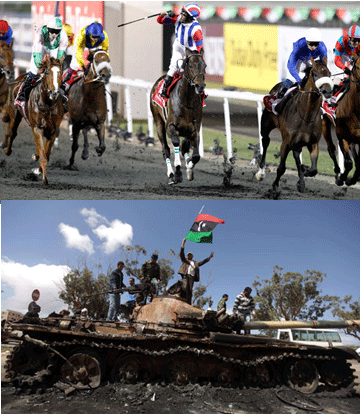
Top: Victorie Pisa from Japan, ridden by Mirco Demuro, middle, crosses the finish line of $ 10,000,000 Dubai World Cup race, the world’s richest horse race, followed by 2nd place Transcend , right, from Japan and 3rd place Monterosso from Great Britain, 2nd right. (The Associated Press); bottom:Libyan rebels on top of a captured tank

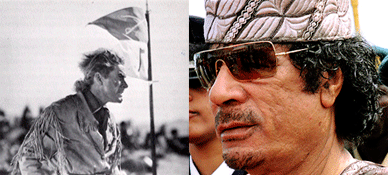
As I write this, the media are reporting major advances of the Libyan resistance to Qaddafi, supported in large part by the surgical air strikes of the U.S. and NATO aircraft. Qaddafi has bunkered down, vowing to fight until his last drop of blood, but as the race to Tripoli proceeds, more and more defections from his military are inevitable. It is hard to predict when this will end. In general I think most ruthless dictators are cowards at heart, which is why they need such massive security to perpetuate their narcissistic hold on power. But Qaddafi is deluded enough to go down with guns blazing, like Errol Flynn in Custer’s Last Stand.


Debate over the wisdom of U.S. involvement in the Libyan no-fly-plus zone has reached a level of feverish political overtones. Obama’s opponents, those lock-step GOP stalwarts who never challenged Bush when we foolishly entered into a ground war in Iraq, now seem concerned about the costs of tomahawk missiles (I suspect those senators with large arms manufacturers in their home states are biting their tongues as they speak). Winging it, a la Bush, is the American way in their mind and damn what any other civilized nation thinks. Actually forging a coalition with U.N. and some Arab country backing is heralded as weakness. Much of the debate swirling between the talking security expert heads is really an end-around around the end-game criticism. Continue reading Racing from Dubai to Tripoli

Yemen situation critical


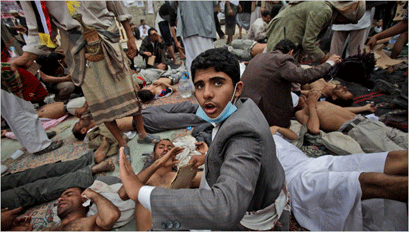
Antigovernment protesters received medical help at a makeshift field hospital after they were attacked Friday in Sana, Yemen; photo by Muhammed Muheisen/Associated Press

As reported today in the major news outlets, including The New York Times and Al Jazeera, the situation in Yemen is becoming critical. A few weeks ago I thought that President Salih would be able to ride the wave of protests, but the level of frustration and range of his enemies make that less likely with each passing day. Yesterday’s attack in Sanaa, which left at least 45 protesters dead, is a shock not only because of the number killed, but also because it suggests an overall strategy of violence rather than negotiation. Even if the killings were not ordered from the top, neither the police nor the army were protecting the people protesting or any other innocent Yemenis who happen to stray in the way of a bullet.

The details continue today, with ongoing clashes in Aden. Before that there were reports of people killed in Hodeidah. If one thing emerges from the political upheaval of the past three months, I believe it is that we should never underestimate the stimulating power of frustration to foment political change. As the world become more and more a wired village, fewer and fewer people are willing to have village idiots dominate their lives. The days of kings, sultans, dictators and presidents-for-life are measured. Their palaces must inevitably become museums to a past. Their legacies subject to the scrutiny of historians shaking their heads. Continue reading Yemen situation critical

A “no fly” in the ointment


For days we have been watching the ebb and flow of frustration protests in Libya, echoing but not matching the overthrow of long-time despots in Tunis and Egypt, but seemingly less capable of driving the longest terminator of all into an exilic tent (though probably outside one of Berlusconi’s mansions rather than above a madrasa in Saudi Arabia). A week ago it looked like “rebel” forces might march on Tripoli; such was the rhetoric of liberation on the lips of those who took back the streets east and west of the capital and rattled the very tent pegs of the leader’s Tripoli holdout.

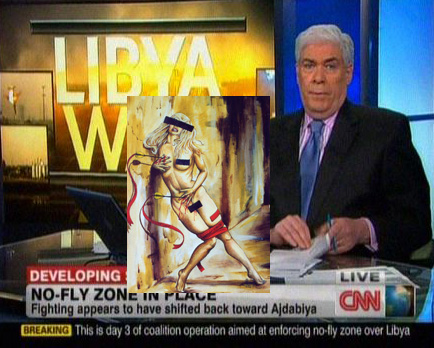
Last night, amidst reports of an escalating disaster alert at a Japanese nuclear reactor, the U.N. Security Council met to deal with Qaddadi, the colonel not known for fried chicken wings but with a distinct love of his female guard’s hidden charms. To no-fly or not to no-fly: that was the dramatic question debated. Would Russia and China resort to Cold War negativism or embrace pragmatic realpolitic and let French planes scramble to destroy the older planes the French probably supplied Qaddadi with at some point? Would international involvement lead to a land invasion? Another Iraq or Afghanistan? The pundits were all over the map. Many had their predictions; none of the crystal balls seemed very trustworthy. Continue reading A “no fly” in the ointment

When in Paris


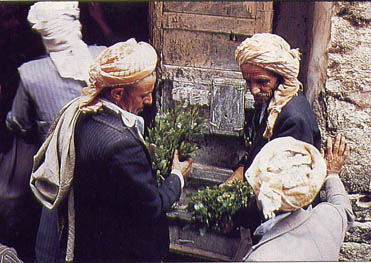
Qat market in Yemen; photograph by Pascal Maréchaux

For anyone reading this in Paris, I am giving a talk in the afternoon on qat in Yemen. Here are the details:

CONFÉRENCE
Prof. Dan Martin Varisco (Anthropologie, Hofstra university)
Qāt, Sex and Traditional Healing / Qāt, sexe et médecine traditionnelle

Abstract/Résumé
There is a substantial corpus of analysis about “Catha edulis”, or qāt in Arabic, both for Yemen and East Africa. Much of this focuses on the origin and distribution of the plant and its legality in an Islamic context. Prof. Varisco has previously published articles on both these aspects of the plant’s history. This talk will focus on the proposed medical benefits of qāt chewing in traditional Yemeni culture, with a focus on the issue of sexual
performance and libido. Although relatively late as an introduction into the medicinal and pharmacological literature, qāt was placed within the existing humoral system. Qāt was considered cold and dry, which explains why the recommended preparation for its use is eating a meal of ‘hot’ food like sorghum porridge or meat. Opinions differ about its impact on the libido. Prof. Varisco examine relevant historical sources (including legal
and medicinal texts), ethnographic accounts, poetry and contemporary scientific analysis of “Catha edulis” for his talk.

Un corpus est déjà constitué sur le qāt ou Catha edulis, aussi bien pour le Yémen que pour l’Afrique de l’Est. Il porte essentiellement sur l’origine et la distribution de cette plante, ainsi que sur son caractère légal en Islam. Ces deux aspects ont déjà fait l’objet de plusieurs publications du Prof. Varisco. Dans sa conférence de Paris, il s’intéressera plutôt aux vertus médicales du qāt, selon la culture yéménite, en particulier aux performances sexuelles et l’accroissement de la libido qu’il est considéré procurer. Bien que le qāt ait été introduit dans la théorie médicale et pharmacologique de manière tardive, il n’en fait pas moins partie du système des humeurs. Il est classé parmi les matières froides et sèches, ce qui explique qu’il doive être absorbé avec des mets Ë‹chaudsËŠ, tel que brouet de sorgho ou viande. Cependant, les opinions varient à propos de son effet sur la libido. Pour les besoins de sa communication, le Prof. Varisco aura donc recours à des sources historiques variées, incluant les textes légaux et médicaux, à des relevés ethnographiques, à la poésie et, enfin, aux analyses scientifiques contemporaines de « Catha edulis ».

La conférence se tiendra le 10 mars 2011 entre 15h et 17h, à l’Institut National d’Histoire de l’Art (INHA), en salle Vasary, Paris, France