All posts by tabsir

An 1873 Geography Lesson #3

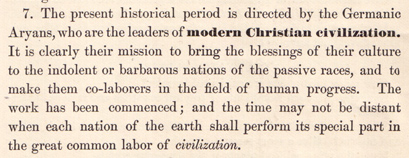
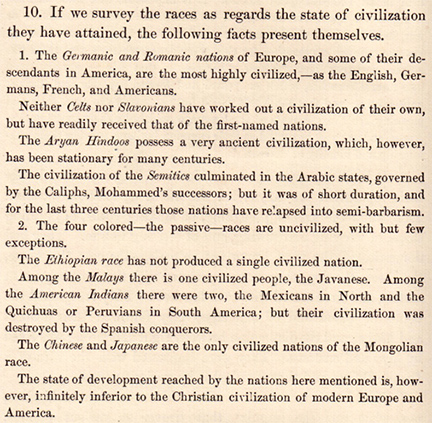
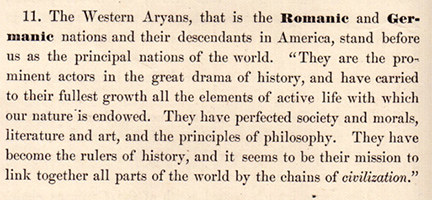
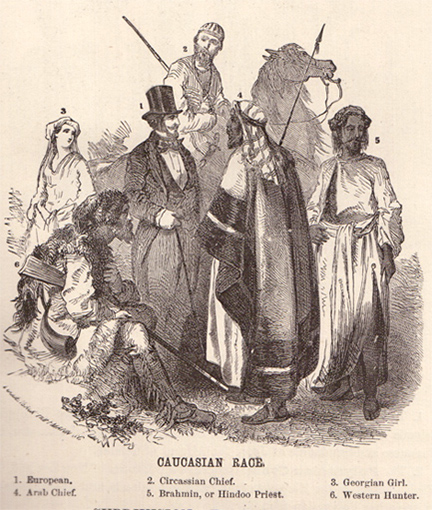
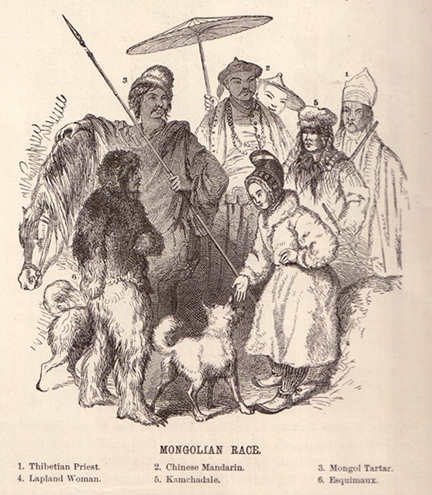
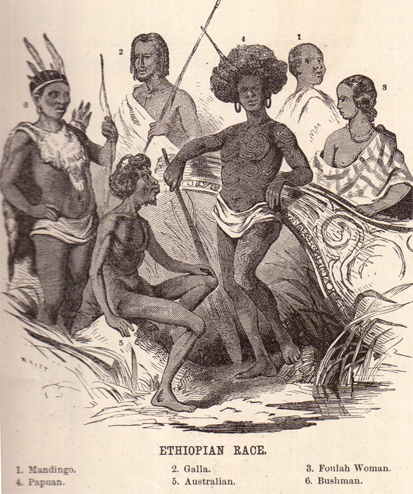
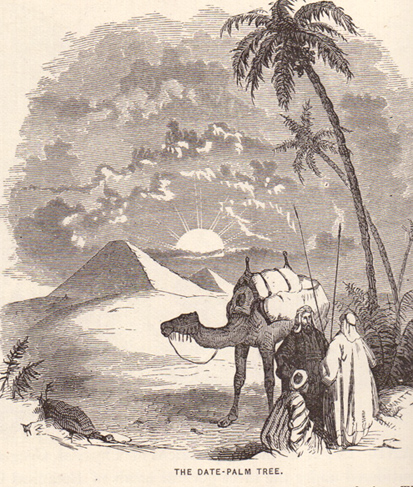
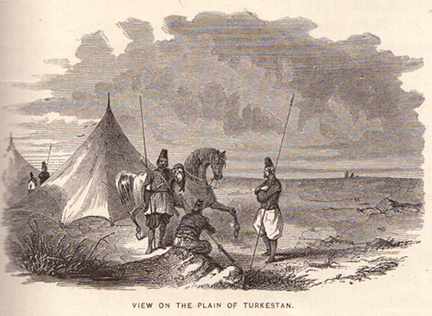
My grandmother’s aunt, Ms. Ida Hoyt, owned an 1873 geography textbook entitled An Elementary Treatise on Physical Geography by D. M. Warren (published by Cowperthwait & Co of Philadelphia). For Part 1, click here and for Part 2, click here. A vital part of geography at the time was the issue of “race,” which was as misunderstood after the American Civil War as before it. “Arabs” were admitted into the Caucasian Race, on a par with the “Western Hunter.” The five major racial categories are shown below.

Continue reading An 1873 Geography Lesson #3

Yemeni Artists


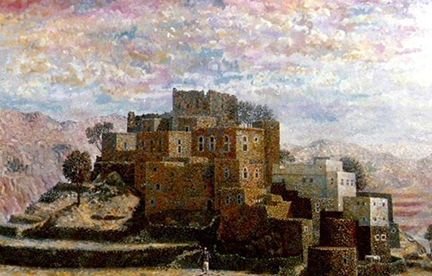
Yemeni artist Ziad Nasser al-Ansi, who won fourth place at the Dubai Cultural Innovation Awards, blends Yemeni architecture with local decoration and patterns. Above, al-Ansi’s painting that won the President’s Award in 2006.

Yemenis take home top awards at Dubai cultural competition

by Faisal Darem, Al-Shorfa, September 6, 2013

Yemeni Bassam Shamseddine was taken by surprise when his wife told him she had submitted his novel, “Laanat al-Waqif” (The Curse of the Stander), to the 2013 Dubai Cultural Innovation Awards without his knowledge.

A bigger surprise awaited him when his book placed fifth in the novel category, he told Al-Shorfa.

Shamseddine is one of three Yemenis who placed at the eighth edition of the awards.

Khaled Abdul Haleem al-Absi placed second in the short story category for his collection, “Wa Alam Adhaat Sihruha” (And the Pains Have Lost Their Magic), while Ziad Nasser al-Ansi placed fourth in the fine arts category.

The winners’ names were published in the September issue of the Dubai Cultural Magazine.

Awards were distributed across eight categories, including UAE cultural personality of the year, poetry, short story, novel, fine arts, dialogue with the West, theatre writing and documentary film.

“This is the first time I have taken part in a literary competition, and the award is a significant moral support for me to continue writing novels and stories,” Shamseddine said. Continue reading Yemeni Artists

An 1873 Geography Lesson #2

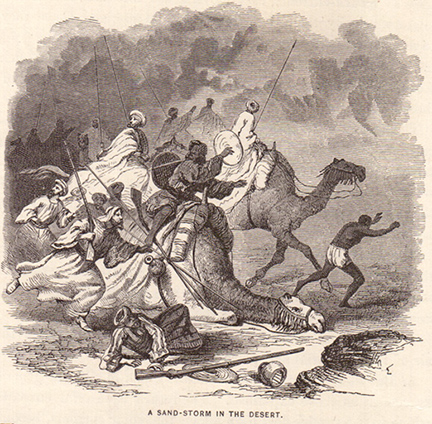
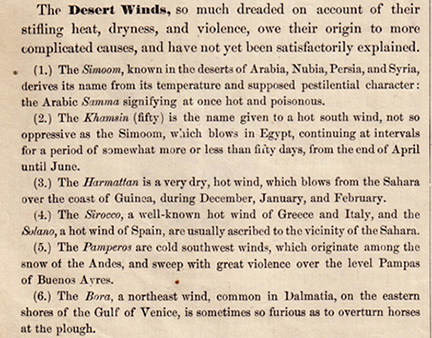
My grandmother’s aunt, Ms. Ida Hoyt, owned an 1873 geography textbook entitled An Elementary Treatise on Physical Geography by D. M. Warren (published by Cowperthwait & Co of Philadelphia). The book itself, which I recently leafed through, is falling apart, but it is worth taking a brief look at some of the lithographic images. For Part 1, click here. Here is the section on the winds.

to be continued

Père Etienne Renaud: In Memoriam, 3


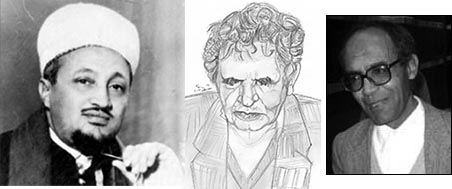
Yemeni poets Muḥammad al-Zubayrī, Abd Allāh al-Baraddūnī, Muḥammad al-Shalṭāmī, left to right

Yemeni Poetry in Translation

[This post continues a thread on the work of the late Père Etienne Renaud. The following French translations of Yemeni Arabic poetry were made by Etienne and are taken from his chapter “La vie culturelle en République Arabe du Yémen,” in Paul Bonnenfant, editor, La Péninsule arabique d’aujourd’hui (Paris: CNRS, 1982) Vol. 2, pp. 135-153.]

Nous avons refusé de vivre dans une nation
Foulée aux pieds par ses maîtres
Et nous sommes partis pour échapper à la bassesse
Fuyant la honte
Et combien de serpents rampaient autour de nous
Mais nous avons échappé à leur morsure

Muḥammad al-Zubayrī, Thawrat al-shi‘r, Cairo, 1962.

Amour et souffrance ont mêlé leurs deux âmes
Qu’est le Nord? Qu’est le Sud?
Deux coeurs qui ont rassanblé leurs joies et leurs peines
Ont été unifiés par la haine et par la souffrance,
Par l’Histoire et par Dieu.

Abd Allāh al-Baraddūnī, Fī ṭarīq al-fajr, Sanaa, n.d. Continue reading Père Etienne Renaud: In Memoriam, 3

Père Etienne Renaud: In Memoriam, 2


Père Etienne in Yemen

[In a previous post I commented on the life of Père Etienne Renaud, who rose to the position of leader of the Catholic White Fathers (Pères blanc), now known as the Missionaries of Africa. In 1987 he wrote a pastoral letter in the order’s in-house magazine, Petit Echo. This eloquent statement by a man who devoted his life to being a witness for humanity among Muslims and encouraging dialogue between Christians and Muslims deserves reading. It was originally written in French and translated into English in the same issue.]

Letter of Father General, Pére Etienne Renaud

Rome, 12 February 1987

Dear Fathers and Brothers,

Before taking up my pilgrim’s staff for West Africa, I should like to share some reflections with you.

After my election, several people asked me: “Is this going to change something in the Society’s commitment with regard to Islam?” One or another insisted more explicitly: “Is this going to increase our manpower in North Africa?” By way of riposte, I answered that a right wing government was well placed to make some left wing policy and vice-versa.

The fact remains that no one can make abstraction of his past, of all the missionary experience he has lived, and I must admit that my life in the Land of Islam, in North Africa as in Yemen, just as these last years teaching at the PISAI have deeply marked my general conception of mission.

My intention today, in this letter, is not to comment on the Chapter directives with regard to Islam, but to share with you some aspects of this conception of mission, which Islam has as it were forced me to deepen. I think that here it is a question of values important for every missionary, wherever he may be, even if they are values among others.

Respect for the other’s faith

In contact with Muslims, one is struck by the depth of their convictions, and more generally by the solidarity of the religious edifice of Islam. It is there, omnipresent. Study only reinforces this impression of massiveness, by helping us discover its centuries-old roots. Continue reading Père Etienne Renaud: In Memoriam, 2

An 1873 Geography Lesson #1

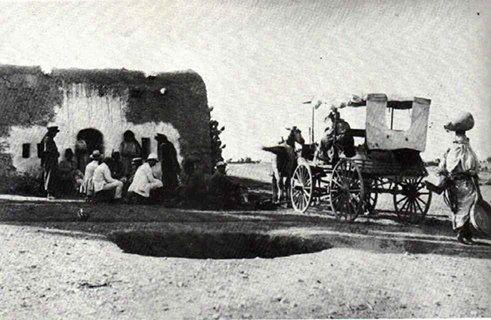
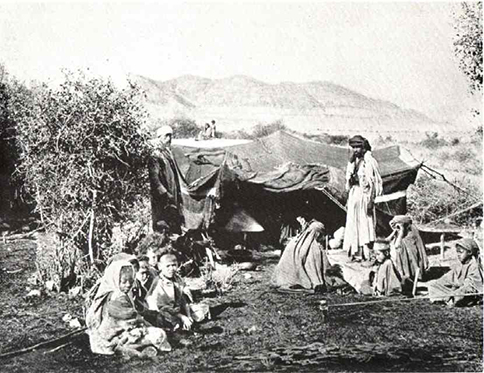
My grandmother’s aunt, Ms. Ida Hoyt, owned an 1873 geography textbook entitled An Elementary Treatise on Physical Geography by D. M. Warren (published by Cowperthwait & Co of Philadelphia). The book itself, which I recently leafed through, is falling apart, but it is worth taking a brief look at some of the lithographic images. The text itself shows how far we have come since 1873, especially for the dated views of “race” and the ethnocentric views of the time. I will start with several of the images, as shown here.

Continue reading An 1873 Geography Lesson #1

Making Music in Yemen


Photograph by Ali Abulohoom

The Yemeni Turbi

by Ali Abulohoom, Yemen Times, August 22, 2013

When he was 8 years old, Fuad Al-Qotari found a piece of wood lying around while playing with some neighborhood kids. He later learned that the object was actually a turbi, an instrument that had nearly disappeared from the Yemeni music scene after the 1920s.

Shortly after discovering his new find, Al-Qotari left Hashed district and moved with his family to the country’s capital, Sana’a, exposing him to more music. He began to follow many of the day’s most accomplished musicians and starting saving money for his own instrument.

His first instrument was the oud, and he was fascinated with its construction. “How [this] instrument was made interested me more than playing [it],” Al-Quotari said.

While he played some tunes of other musicians, his curiosity about the oud’s design was too strong. He put his instrument in water for hours and waited until it fell apart so that he could study each individual part. Continue reading Making Music in Yemen