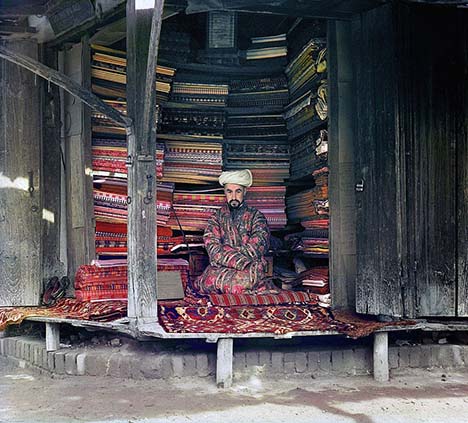
Samarqand merchant in 1911
There is a wonderful website with photographs of various places in Russia, including Islamic areas, from the early 20th century at Mashable.
Samarqand merchant in 1911
There is a wonderful website with photographs of various places in Russia, including Islamic areas, from the early 20th century at Mashable.
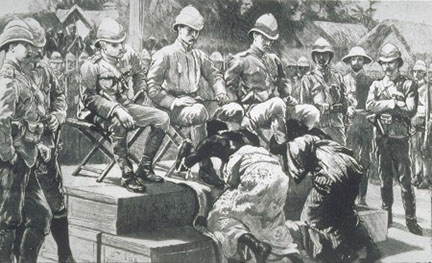
By Timothy Daniels, Guest Contributor, New Mandala, October 6, 2014
There appears to be no end to the war between several western powers—leaders in the global capitalist world order—and Muslim militants. Both sides are spiralling into some form of mutually assured destruction. Fragile “modern†nation-states, formed under the influence of European colonial forces in the early twentieth century, are crumbling and revealing their inability to deliver the promised fruits of secular modernity. Millions of Muslims are being killed, thousands are fleeing for their lives, and centuries old sites of Islamic civilisations are being decimated, while war-stressed western economies are declining into the shadows of China’s great industrial leap forward.
In the face of the current phase of this violent confrontation ushered in by the emergence and establishment of a militant-led Islamic State (IS) in Syria and Iraq, many officials of western governments and Muslim leaders are making public statements that include the positive representation of Islam as a “religion of peace.†Linguistic anthropologists or any other social scientists seeking to provide a serious scholarly analysis of such discourse would examine the context and what the speakers are trying to do. Here, some of the social meanings of these statements may include efforts to reinforce the peace-loving posture of the majority of Muslims and to calm the fears of non-Muslims, many of whom have already begun to resort to acts of violence against fellow citizens perceived to be Muslims. However, this scholarly tack is not the approach Clive Kessler chose.
Clive Kessler, a Columbia University trained Emeritus Professor of Sociology and Anthropology at the University of New South Wales, chose to interrogate the truth value of discourse expressing the positive representation of Islam “as a religion of peace.†In the article, “The Islamic State and ‘Religion of Peace,’†published online in the Quadrant on September 26, 2014, Kessler tells us that he finds this description of Islam to be “bland, disingenuous, intellectually lazy, delusional, politically evasive, and altogether simplistic.†He wants us to have a clear idea of what we’re confronted with in order to devise an “effective response.â€
Continue reading Islam, a religion of peace
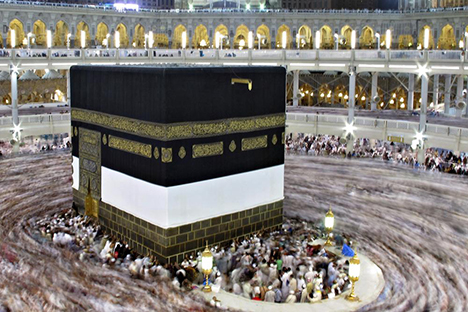
/© Muhammad Hamed / Reuters/REUTERS
Al Jazeera has a series of photographs of this year’s hajj to Mecca.
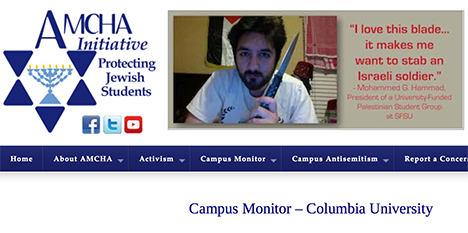
Statement by Jewish Studies Professors in North America Regarding the Amcha Initiative
Forward, October 1, 2014
We the undersigned are professors of Jewish studies at North American universities.
Several of us have also headed programs and centers in Jewish studies. Many of us have worked hard to nurture serious, sustained study of Israeli politics and culture on our home campuses and elsewhere.
It is in this latter regard that we call attention to the activities of an organization called the AMCHA Initiative whose mission is “investigating, educating about, and combatting antisemitism at institutions of higher learning in America.†Most recently, AMCHA has undertaken to monitor centers for Middle Eastern studies on American campuses including producing a lengthy report on UCLA’s in which that center is accused of antisemitism.
AMCHA has also circulated a list of more than 200 Middle Eastern studies faculty whom it urges Jewish students and others to avoid because, it asserts, they espouse anti-Zionist andeven antisemitic viewpoints in their classrooms.
It goes without saying that we, as students of antisemitism, are unequivocally opposed to any and all traces of this scourge. That said, we find the actions of AMCHA deplorable.
Its technique of monitoring lectures, symposia and conferences strains the basic principle of academic freedom on which the American university is built. Moreover, its definition of antisemitism is so undiscriminating as to be meaningless. Instead of encouraging openness through its efforts, AMCHA’s approach closes off all but the most narrow intellectual directions and has a chilling effect on research and teaching. AMCHA’s methods lend little support to Israel, whose very survival depends on free, open, and vigorous debate about its future. Continue reading Exposing Amcha
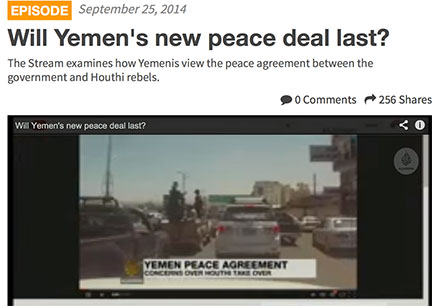
Al-Jazeera has been covering the Huthi conflict in Yemen. Here is one of their recent broadcasts.
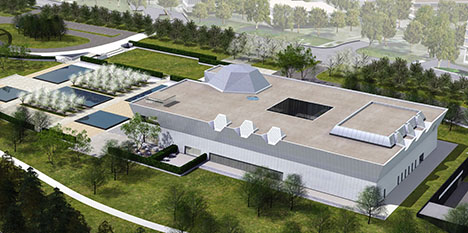
On September 14 the new Aga Khan Museum in Toronto, Canada opened. Details below:
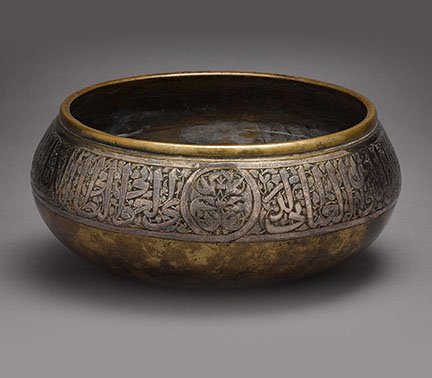
The Aga Khan Museum in Toronto, Canada offers visitors a window into worlds unknown or unfamiliar: the artistic, intellectual, and scientific heritage of Islamic civilizations across the centuries from the Iberian Peninsula to China.
Its mission is to foster a greater understanding and appreciation of the contribution that Islamic civilizations have made to world heritage. Through education, research, and collaboration, the Museum will foster dialogue and promote tolerance and mutual understanding among people.
As a vibrant educational institution, the Museum encourages the full spectrum of public engagement with its diverse Permanent Collection of more than 1,000 objects and its ever-changing roster of exhibitions and innovative programs – including music, performances, culinary traditions, lectures, debates, special events, or film.
The Aga Khan Museum has an international mandate. It maintains strong ties with such institutions as the Musée du Louvre in Paris, the State Hermitage Museum in St. Petersburg, and the Museum of Islamic Art in Doha, Qatar. It is also deeply committed to forging relationships with Canadian institutions and communities. Together, these global and local connections generate exciting opportunities to enhance scholarship, inspire temporary exhibitions, and produce public programs honouring the spirit of collaboration upon which the Museum is built.
by Antonella Vicini, Reset Doc, September 12, 2014
In the ‘Great Game’ developing in the Middle East and amidst constant changes in diplomatic equilibria, as well as the deployment of armed forces to try and stop ISIS’ advance, the only certainty for the moment is the role the Kurds have over time cut out for themselves and their mandate from the most important European countries and the United States. This concerns not only the often discussed Peshmerga, Iraqi Kurds who have rather effectively opposed the Islamic State’s penetration since the beginning of the summer, but also Syrian Kurds, active since at least 2012 and without doubt less visible at least from a media perspective.
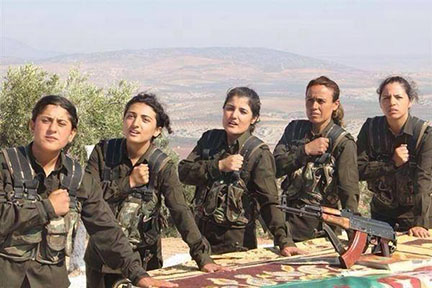
Syrian Kurdistan is a region mainly inhabited by Kurds in northern Syria and also known as Rojava, effectively the western part of the nation called Kurdistan. Since the Syrian civil war started, rather like what happened in Iraq after 2003, the Kurds have gained control over increasingly larger areas and achieved greater autonomy, although there has not as yet been formal acknowledgment as happened with Iraqi Kurdistan. The Syrian Kurds, after fighting Assad’s armed forces, have clashed with Islamists so as to defend their region, in a rather fragile area bordering with Iraq and subject to infiltrations from the Al Nabar province. They have become a force, fighting the Islamic State fanatics thanks to action taken by YPG, the Yekîneyên Parastina Gel (Kurdish for the People’s Protection Unit), a regular army of about eight brigades spread throughout the area and also the armed wing of the Kurdish Supreme Committee. The female wing of the YPG is called the YPJ, Yekineyen Parastina Jin, the Women’s Protection Unit. Continue reading Syrian Kurdistan: the role of women in the battle against IS
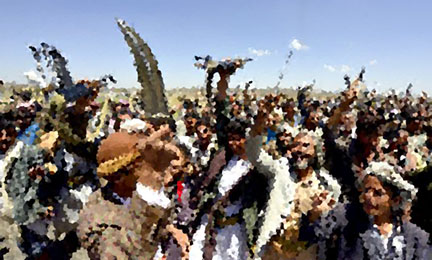
Are the Houthis a symptom of regional mistrust?
by Abdullah Hammidaddin, alarabiya.net, Saturday, 20 September 2014
Ten years ago this month Ali Saleh had ordered the field execution of Husayn al-Houthi. This was after a three-month war between government forces and Husayn’s supporters in a remote village in northern Yemen. At the time, Husayn’s supporters were few and I believe the matter could have ended there. But Saleh decided to push on and confront the rest of Husayn’s family who then reacted by picking up arms again. They ended up surviving five wars waged by the government. Today Abdulmalik al-Houthi – Husayn’s younger brother – has forces in Sanaa and this time he is threating the Yemeni government, forcing it to make concessions.
In the past year alone, the Houthis have altered the political landscape of Yemen. They pushed the Ahmar family out of their homes and overthrew their three hundred year sheikhdom and authority in the tribal federation of Hashid. They took the al-Jawf area as a strategic last stronghold for their adversaries. They’ve forged alliances with most tribes in the northern region and also in the south. And now in Sanaa they are fighting against both the militias of the Islah party (Muslim Brotherhood branch in Yemen) and military factions loyal to General Ali Muhsin Al-Ahmar in what could escalate into a major war in the fragile capital city. Continue reading Here come the Huthis…