All posts by tabsir

Exiting Through the ‘Alley Gate’

[Note: Numerous excerpts of this popular Syrian Ramadan serial can be found on Youtube, starting with episode 1. The following is a commentary in Asharq Alawsat.]

by Mshari Al-Zaydi, Asharq Alawsat, Saturday 20 October 2007

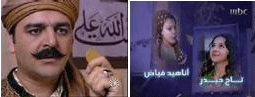
I will admit to watching the Bab al Hara (Alley Gate) series with the same fervor normally reserved for football finals. Moving from one café to another on Jeddah’s al Tahlia Street, I watched this session’s last episode. The young crowd present, dressed in t-shirts and baggy jeans, burst into a warm round of applause at the end of the show – which is quite a rare reaction among Saudi viewers.

This second-part sequel to the Syrian television series is, in fact, an undeniable phenomenon; some in Saudi even exchanged Eid ul-Fitr felicitations that were inspired by stories in the series.

But this phenomenon has reached farther and wider than just Saudi alone, many viewers in various Arab states; even Arabs living abroad, regularly tuned in and set their alarm clocks to the show’s airing time.

Perhaps this huge success is what prompted the show’s producers to make a third series for next year. Such was its popularity that even some clerics were involved in this commotion; among them was Sheikh Salah Kuftaro, son of the former late Syrian Grand Mufti Ahmad Kuftaro and the Director-General of the Sheikh Ahmad Kuftaro Academy, who publicly acclaimed the show and invited its cast to a Ramadan Iftar held in their honor. Likewise, Kuwaiti Islamist MP Walid al Tabtabai also praised the series. Continue reading Exiting Through the ‘Alley Gate’
The Clash of Knuckleheads Theory

by ARSALAN IFTIKHAR
Published in Islamica Magazine, September 2007

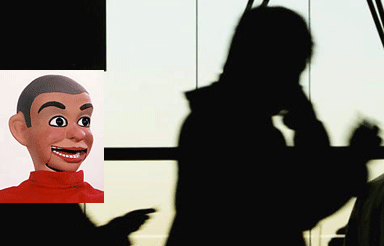
For seven of my twenty-nine years, my existence as an American Muslim public diplomat and human rights lawyer has revolved around being an honest public voice to the masses since the tragedy of 9/11. From high-level political delegations to regular TV appearances as the ‘Muslim Guy’ on international media (either condemning terrorism or swashbuckling notorious Islamophobes who demonize Muslims); a simple Google or YouTube search will have my record speak for itself.

I have condemned terrorist knuckleheads like Osama bin Laden & Company. Notwithstanding the categorical prohibition of suicide and civilian attacks in Islam, these murderous knuckleheads have done nothing but add madness to already existing madness in our world. From Bali to Madrid to London, my seething disgust increases exponentially each time their irreligious attacks occur. When a 9-year old child (anywhere in the world) is considered to be a ‘legitimate target’, you know that these maniacs have lost their bloody minds committing ungodly acts of mass murder. Continue reading The Clash of Knuckleheads Theory

Required Reading

by Brian Whitaker

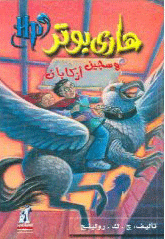
Visit an Arab bookshop and there’s a fair chance you’ll find more than a few copies of Shifra Dafinshi and the tales of Hari Butor. In case you haven’t guessed, I’m talking here about Arabic translations of The Da Vinci Code and Harry Potter.

While titles such as these find a ready market in the Middle East, just as they do elsewhere, people often lament the poor state of home-grown Arabic publishing and the dearth of worthwhile books translated into Arabic from other languages. Continue reading Required Reading

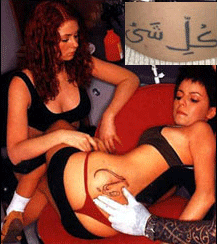
The Calligraphic Tattoo

Tattoo artists are often skilled calligraphers, but what do you do if you want a tattoo in Arabic script? If you can’t make it to Patterson, New Jersey or some hippy stranded in Casablanca, there is always the Internet. Google to the rescue:

If you are considering having Arabic writing tattooed, then you need the correct translation for the lettering as well as the outline to give to the tattoo artist. We can provide you with this service. We translate using either Syrian Arabic, Israeli Arabic, or Druze Arabic.

Ordering a translation from us is simple:

1. Go to the translation-page and make payment.

2. Include the word or phrase that you want translated

3. Within a few hours-days, we will email the translated phrase or word back to you. Your translation comes in the form of a picture (jpeg, jpg) which you can print out on your printer and take to your tattoo artist.

For Arabic you have to double your pain: the needle and pulling out your credit card to have an expert spell out “Ummi” or “Qalbi.” Just don’t let them sell you any “khara.”

By the way, when I tried the “contact” click, I found the following message:

This website is for sale.
Please send your purchase offer to:
mail at jandrewsmedia.com

The law of supply and demand strikes again. Ma’a laysh.

Right along with the Bible”: Innocents Abroad


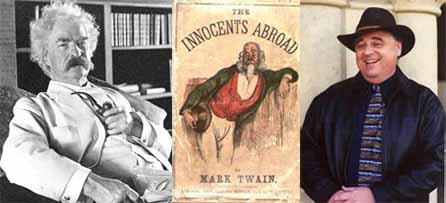
[Mark Twain, left; early cover of ‘Innocents Abroad’, center; Hilton Obenzinger, right]

by Hilton Obenzinger, Stanford University

Innocents Abroad’s manufacture of “Mark Twain” as the surrogate for the reader’s “own eyes” was immensely popular. The travel book, whose sales reached 100,000 even before the second anniversary of its publication, launched, even more than his celebrated jumping frog, Mark Twain’s national career. “Popular as are Mark Twain’s books at home,” an unidentified correspondent for the Hartford Courant reported in 1872, Innocents Abroad is “still more so abroad.”

“It sells right along just like the Bible,” Mark Twain remarked to William Dean Howells. Indeed, half a million copies had been sold by Twain’s death in 1910, at which time Innocents Abroad, with its central organizing principle of “Mark Twain” as “one of the boys” joined Adventures of Huckleberry Finn and The Adventures of Tom Sawyer as the titles (and two other boys) most commonly worked into political cartoons memorializing the author in the press. Today Innocents Abroad, still a pleasure to read despite the complications and vexations of history, remains durable, continuing to be hailed as “the most popular book of foreign travel ever written by any American.” Continue reading Right along with the Bible”: Innocents Abroad

A Qibla Query: Facing Mecca and Fasting in Outer Space


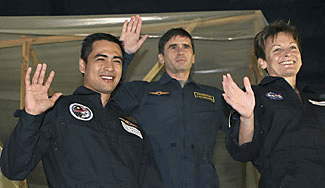
(left to right) Sheikh Muszaphar Shukor of Malaysia, Yury Malen¬chenko of Russia, and Peggy Whitson of the US will fly on a Russian rocket.

How does an Islamic astronaut face Mecca in orbit?

Decisions by a conference of Muslim leaders and scientists will help a Malaysian doctor stay observant in outer space.

By Bettina Gartner | Contributor to The Christian Science Monitor

Allah is watching – even in outer space. And that poses a problem for a devout Muslim astronaut who is scheduled to fly to the International Space Station (ISS) aboard a Russian rocket this week.

Imagine trying to pray five times a day in zero gravity while having to face an ever-shifting Mecca hundreds of miles below. How do you ritually wash yourself without water? And, now that it’s Ramadan, how do you fast from sunrise to sunset when you see a sunrise and a sunset every 90 minutes? Sheikh Muszaphar Shukor, a Malaysian astronaut, must decide before the Oct. 10 launch.

“I am Islamic,” Sheikh Shukor told a press conference in Moscow, according to the Associated Press, “but my main priority is more of conducting experiments.” Continue reading A Qibla Query: Facing Mecca and Fasting in Outer Space

It’s a Crime, Especially in Fiction

by Reeva S. Simon

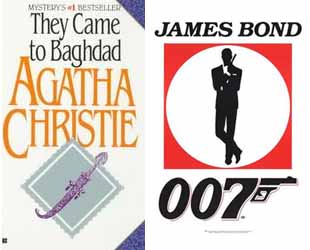
This perennial Western fear, that of a resurgent Islam, is a part of the Western historical memory. The sword-wielding Muslim thundering across the Straits of Gibraltar or laying siege to Vienna, the Old Man of the Mountain’s Assassins high on drugs launched to kill political leaders, white slavers, and Barbary pirates have been reincarnated as plane hijackers, embassy bombers, and nefarious creators of long gas lines. In the fiction of the “paranoid” and “vicious” categories, the conspiracy, the hero, and the villain are basic elements for thriller/spy novel success…

Thus, in fiction, anyone’s life can have meaning in the anonymous industrial and terrifying nuclear age. The reader identifies with the hero whose exploits become his own, and the fictional conspiracy becomes a personal threat on a world scale. Beating the gas lines during an oil embargo is transformed via fiction into vicarious vengeance against the villains, perceived as wealthy petrosheikhs who have created the oil crisis. But identification of the villain alone is not enough. In order to be thoroughly imbued with evil and to maintain credibility as a villain, the villain must be an impersonal figure; he is a stereotype; he mirrors the reader’s personal prejudices and fears. Only then is the reader hooked his villainy as he must also be on the hero’s noble character to such a degree that he can instantly and unconsciously root for the salvation of one and the damnation of the other. Continue reading It’s a Crime, Especially in Fiction

Chew Some Qat

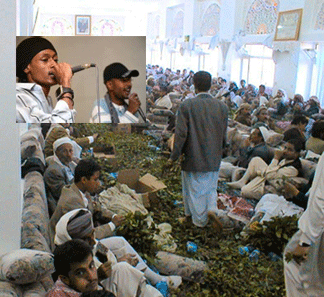
One of the unique aspects of living in Yemen is chewing qat, the tender young leaves of the shrub Catha edulis. In the late afternoon Yemenis often get together with their supply of qat, a water-pipe (narghila) and plastic bottles of spring water. Much has written about the plant and its use. For starters, check out the Qatalog on Yemen Webdate.

Youtube now brings you rap versions by Yemeni artists. Chew on this or this for awhile.