All posts by tabsir

Strolling Through Tarlabasi


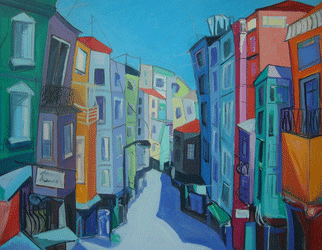
Tarlabasi, 2004, by Gamze Olgun, Oil Painting.

by Jenny White
Kamil Pasha Blog
Posted on January 24th, 2008

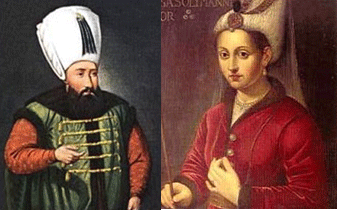
Tarlabasi is a district on the backside of the Beyoglu hill falling from the crest at Pera – where all the foreign embassies were in Ottoman times, now demoted to consulates – down in the direction of the Golden Horn. In The Abyssinian Proof, Kamil chases a wily criminal to his lair in Tarlabasi. The district is picturesque in the way of crumbling majesty on its last legs (a large part of Tarlabasi will be razed in 6 months, probably replaced by hotels). The steep, narrow lanes are strung with laundry, bustling with locals shopping at an outdoor market crammed into one of the lower streets. At the top of the hill near Istiklal Bouelvard are some lovely stone houses, now ruined or so shabby as to be nearly uninhabitable. A large stone house cracked down the side like an egg is posted for sale. As you walk down the hill, the houses become smaller, shabbier, sometimes outright ruins, less stone and more wood. In Ottoman times, Catholics and Greek Christians (Rum) lived near the top — shop owners, employees of the embassies — and poorer families near the bottom. Taylor Pepo’s apprentice lived in Tarlabasi with his family (The Abyssinian Proof). Today Tarlabasi is inhabited by Roma (gypsy), Kurds, the very poor, and social outcasts of various kinds. Continue reading Strolling Through Tarlabasi
Lost in the Lost Archive

The following is a reaction to the article “The Lost Archive” in The Wall Street Journal Jan 12, 2008, page 1 (US edition) by Michael Marx (marx@bbaw.de), Director of Research, Centre Corpus Coranicum (Berlin-Brandenburgische Akademie der Wissenschaften)

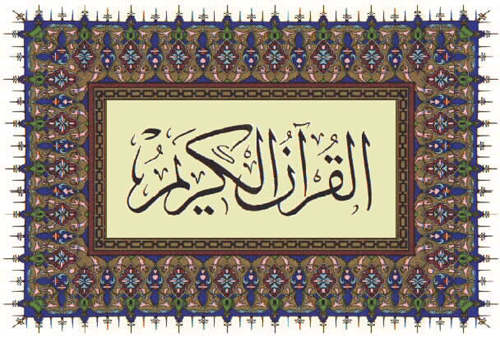
The lost archive, the myth of philology, and the study of the Qur’an
by Michael Marx

The belief in the myth that old manuscripts should be mysterious and powerful is part and parcel of the age of Modernity. That such expectations were operative in the discussion on the Qumran fragments is still remembered, and more recently the Da Vinci Code, in itself a quite shallow story, sold extremely well. The fact that the Wall Street Journal placed an article on the “lost Bergstrasser-film archive” of Qur’anic manuscripts on its front page on 12th of January seems to be due to the myth of “textual wars” taking place in the world. Labelled as a clash of civilizations or war of religions, conflicts today in the Middle East and Europe involving Christians, Muslims and Jews are likely to be perceived in isolation from their economical, social, or political preconditions. On September 12th 2001 a friend of mine bought a copy of the Qur’an in order to “understand what is going on”. Indeed, as if in the spirit of the protestant slogan of “sola scriptura” (= “through scripture only”), the idea of deciphering the software of “Muslim patterns of action” through the Sacred Book of Islam is tempting. As superficial as it may look, this very perception of the direct causal link between “what Muslims do” and passages of the Qur’an seems to be widespread. No article on the missing enlightenment in “Islam” without pointing to a still missing “but urgently needed” critical edition of the Qur’an. Almost no coverage on warfare in the Middle East and suicide bombings without the attempt to dig out passages from the Qur’an and pictures of praying and reciting Muslims. The cultural, social, and religious diversity of a whole region, the Middle East, that European and American history labels as the cradle of civilisation and the birthplace of Judaism and Islam appears transmuted into a “disturbing” monolithic religious monster. Continue reading Lost in the Lost Archive

Brothers of the Book

by Robert Lentz

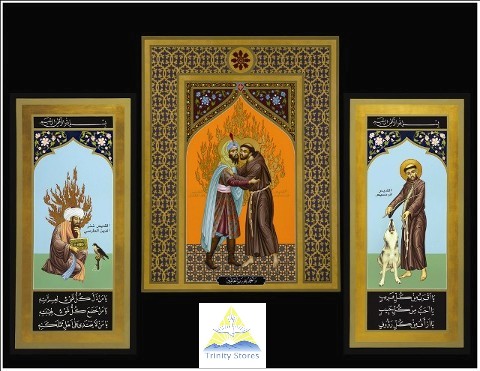
In 1219 St. Francis and Brother Illuminato accompanied the armies of western Europe to Damietta, Egypt, during the Fifth Crusade. His desire was to speak peacefully with Muslim people about Christianity, even if it mean dying as a martyr. He tried to stop the Crusaders from attacking the Muslims at the Battle of Damietta, but failed. After the defeat of the western armies, he crossed the battle line with Brother Illuminato, was arrested and beaten by Arab soldiers, and eventually was taken to the sultan, Malek al-Kamil.

Al-Kamil was known as a kind, generous, fair ruler. He was nephew to the great Salah al-Din. At Damietta alone he offered peace to the Crusaders five times, and, according to western accounts, treated defeated Crusaders humanely. His goal was to establish a peaceful coexistence with Christians.

After an initial attempt by Francis and the sultan to convert the other, both quickly realized that the other already knew and loved God. Francis and Illuminato remained with al-Kamil and his Sufi teacher Fakhr ad-din al-Farisi for as many as twenty days, discussing prayer and the mystical life. When Francis left, al-Kamil gave him an ivory trumpet, which is still preserved in the crypt of the Basilica of San Francesco in Assisi.

This encounter, which occurred between September 1 and 26, is a paradigm for interfaith dialog in our time. Despite differences in religion, people of prayer can find common ground in their experiences of God. Dialog demands that we truly listen to the other; but, before we can listen, we must see the other as a precious human being, loved by God. There is no other path to peace in this bloody 21st century. Continue reading Brothers of the Book

Politics of Piety: A Case Study in Cairo


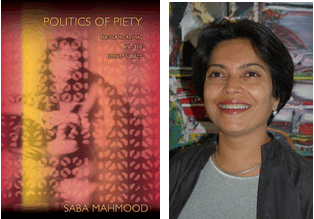
[In 2005 anthropologist Saba Mahmood published “Politics of Piety: The Islamic Revival and the Feminist Subject” (Princeton University Press). This important ethnography of the women’s mosque movement in Cairo not only presents an informative case study but challenges notions of how Muslim women’s involvement in pious movements should be analyzed in a feminist framework. The following excerpt is from the beginning of Mahmood’s book.]

Over the last two decades, a key question has occupied many feminist theorists: how should issues of historical and cultural specificity inform both the analytics and the politics of any feminist project? While this question has led to serious attempts at integrating issues of sexual, racial, class, and national difference within feminist theory, questions regarding religious difference have remained relatively unexplored. The vexing relationship between feminism and religion is perhaps most manifest in discussions of Islam. This is due in part to the historically contentious relationship that Islamic societies have had with what has come to be called “the West,” but also due to the challenges that contemporary Islamist movements pose to secular-liberal politics of which feminism has been an integral (if critical) part. The suspicion with which many feminists tended to view Islamist movements only intensified in the aftermath of the September 11, 2001, attacks launched against the United States and the immense groundswell of anti-Islamic sentiment that has followed since. If supporters of the Islamist movement were disliked before for their social conservatism and their rejection of liberal values (key among them ‘women’s freedom’), their now almost taken-for-granted association with terrorism has served to further reaffirm their status as agents of a dangerous irrationality. Continue reading Politics of Piety: A Case Study in Cairo

The Letters of Badr Shakir al-Sayyab: #14


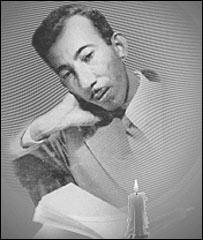
The Iraqi Poet Badr Shakir al-Sayyab

[Note: This is the 14th in a series of translations of selected letters of the noted Iraqi poet Badr Shakir al-Sayyab. For more information on the poet, click here.]

Letter #14

Basra 12/18/1961

My Dear Brother, Abdel Karim (al-Na’im),

I see you blaming me for the disruption of correspondence between us. However, I was the last one to send you a letter right before my departure for Italy………….. [paragraph omitted]…..

The Arabic Literature Conference in Rome was extremely successful. We have succeeded in making the West understand that the Arab writer today stands among the first rate writers of the world. Some voices were raised in an attempt to undermine the value of Islam and the Arabic literary heritage. However, we silenced these voices. Moreover, all the Orientalists, who have been more zealous about our cause than the protégés of Arabic literature, have supported Arabism and Arabic literature. Continue reading The Letters of Badr Shakir al-Sayyab: #14

Norma’s Take on Carthage: Part Two


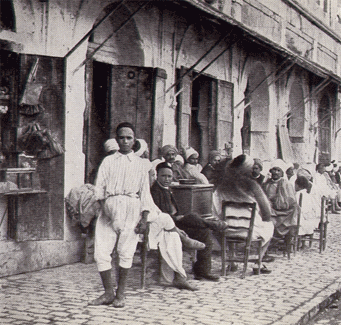
The Café in the Place Halfaouine.

In an earlier post I provided the Orientalist musings of Ms. Norma Octavia Lorimer, whose By the Waters of Carthage (1925) is classic put-down travel mongrelism. If you thought the first part was bad, read on below…

“OH, MY DEAR!

Come and take me to the desert; it lies over there, in the great Beyond, like Death — waiting — waiting — waiting.

I have seen camels in their proper atmosphere, lading their common everyday life of indifference, though so far, I must admit, I have not seen them trying to get through the eye of a needle. These strange supercilious leavings of the prehistoric past are almost as scornful of mankind as new-born babies. A Horse looks as foolishly modern besides a camel as an Englishman in his blue serge suit looks beside a burnoused and biblical Moslem…

I have been in the souks (bazaars), and it is true that there above all places you can hear the East ‘a-calling’; it is there that you forget that Tunis is under French protection and it has fine boulevards and theatres and a Petit Lourve, for all that is on the other side of the horseshoe gate (the porte de France, as it is called), and my hotel is within in. It is in the bazaars before midday that you get a glimpse of how the people live, for the pulse of the city is there, if an Arab city has a pulse. Continue reading Norma’s Take on Carthage: Part Two

The Sheik Comes to NPR


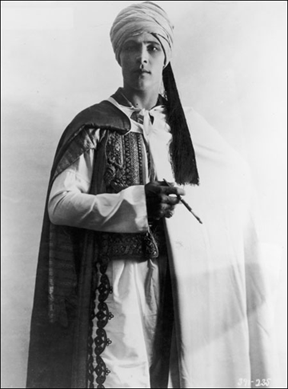
Italian-born actor Rudolph Valentino poses in costume in The Sheik.
Hulton Archive/Getty Images

NPR, Morning Edition, February 4, 2008

In 1921, a silent film transported American audiences to a mysterious, faraway place — and introduced an exotic, erotic character to millions of fans.

The Sheik starred a smoldering Italian immigrant named Rudolph Valentino and featured a title character who bore little resemblance to the venerated Arab leaders commonly known as sheiks. Instead, the character was drawn from the pages of a best-selling romance novel by the wife of a British farmer.

Written in 1919, Edith Maude Hull’s fictional The Sheik inspired a whole subgenre of desert romance, in which hot, swarthy Arabs kidnap reckless white women.

Valentino’s playful treatment of the character captivated female audiences and established him as Hollywood’s first male sex symbol. Mary Brewer Barkley, who was 13 years old when the film was released, recalls newspaper reports that young women were running off to the Middle East in the hope of being abducted by handsome Arabs. Continue reading The Sheik Comes to NPR