All posts by tabsir

So al-Qa’ida’s defeated, eh? Go tell it to the marines

Robert Fisk, The Independent, Sunday, 1 June 2008

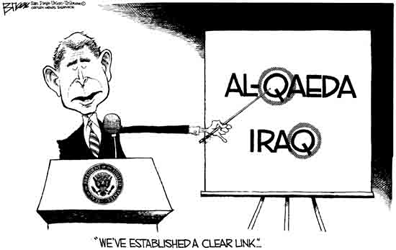
So al-Qa’ida is “almost defeated”, is it? Major gains against al-Qa’ida. Essentially defeated. “On balance, we are doing pretty well,” the CIA’s boss, Michael Hayden, tells The Washington Post. “Near strategic defeat of al-Qa’ida in Iraq. Near strategic defeat for al-Qa’ida in Saudi Arabia. Significant setbacks for al-Qa’ida globally – and here I’m going to use the word ‘ideologically’ – as a lot of the Islamic world pushes back on their form of Islam.” Well, you could have fooled me.

Six thousand dead in Afghanistan, tens of thousands dead in Iraq, a suicide bombing a day in Mesopotamia, the highest level of suicides ever in the US military – the Arab press wisely ran this story head to head with Hayden’s boasts – and permanent US bases in Iraq after 31 December. And we’ve won? Continue reading So al-Qa’ida’s defeated, eh? Go tell it to the marines

Another Arabesque: Arabs in Brazil

North American to release book about Arabs in Brazil

John Tofik Karam, a grandson of Lebanese born in the United States, should release up to the end of the year, in Brazil, book ‘Another Arabesque’. The work is on the valuation of the Arab tradesman in the country in the late 20th century. To write the book, initially a master’s degree thesis, he was in Brazil for over a year.

Isaura Daniel, ANBA, Brazil-Arab News Agency, 3/26/2008

São Paulo – The North American John Tofik Karam, of Lebanese origin, is going to release in Brazil his book “Another Arabesque” through Martins Editora publishing house. The work is the result of a doctoral thesis that Karam worked on about the Arab community in Brazil and shows the valuation of the Arabs in the late 20th century.

“It shows the greater visibility that the Arabs got during the neoliberal phase,” explained Karam in a telephone interview to ANBA. According to the Lebanese descendant, up to the middle of the 20th century, Arabs were marginalized due to the stereotype of good businessman, always wanting the greatest possible gain in trade. “This idea suddenly became an advantage in the neoliberal phase,” he said. Continue reading Another Arabesque: Arabs in Brazil

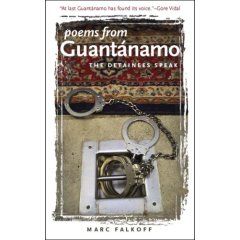
Poems from Guantánamo

Poems from Guantánamo: The Detainees Speak is a short but provocative book of poems from several of the detainees held at Guantánamo Bay. Much has been written about the legal issues and violations of human rights, but here we can hear the silenced voices of those dehumanized in detention without access to justice. Here is one of the poems:

Death Poem
by Jumah Al Dossari

Take my blood.
Take my death shroud and
The remnants of my body.
Take photographs of my corpse at the grave, lonely.

Send them to the world,
To the judges and
To the people of conscience.
Send them to the principled men and the fair-minded.

And let them bear the guilty burden, before the world,
Of this innocent soul.
Let them bear the burden, before their children and before history,
Of this wasted, sinless soul.
Of this soul which has suffered at the hands of the “protectors of peace.”

Jumah al Dossari, a thirty-three-year-old Bahraini national, is the father of a young daughter. He has been held at Guantánamo Bay for more than five years. In addition to being detained without charge or trial, Dossari has been subjected to a range of physical and psychological abuses, some of which are detailed in Inside the Wire, an account of the Guantánamo prison by former military intelligence soldier Erik Saar. He has been held in solitary confinement since the end of 2003 and, according to the U.S. military, has tried to kill himself twelve times while in the prison. On one occasion, he was found by his lawyer, hanging by his neck nd bleeding from a gash to his arm.

Puzzles and Precious Particularities of Yemen


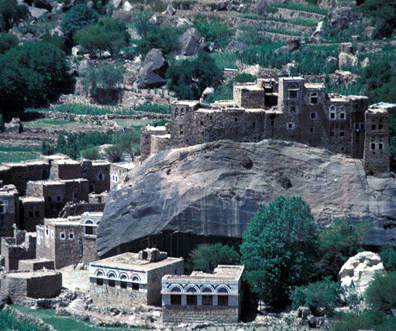
Hamlet of Mais in central Yemen; entrance is carved through the large rock.
Photograph by Daniel Martin Varisco

By: Khaled Fattah, Yemen Times

Outside observers of Yemen’s social and political life can not avoid noticing many conceptual puzzles and precious particularities. One of the widely known puzzles among researchers with political science background is the surprising fact that although Yemen is the least developed and weakest Arab state that governs a society characterized by fierce tribal traditions and structures, it’s a country with a party pluralism system. Precious particularities of Yemen, on the other hand, are numerous. To begin with, there is a coincidence of almost everything- from geographical and topographical destiny to the patterns of habitation and concentration of sects; and from the shades of experienced ideologies and insecurity of economic resources to the peculiar nature of colonialism and regional power interventions. This sharp multifaceted coincidence is not something of the past. Rather, it is being felt in every bone in the political, economic and socio-cultural skeletons of today’s fragile Yemen. Continue reading Puzzles and Precious Particularities of Yemen

Nadwi on Maududi: a traditionalist maulvi’s critique of Islamism


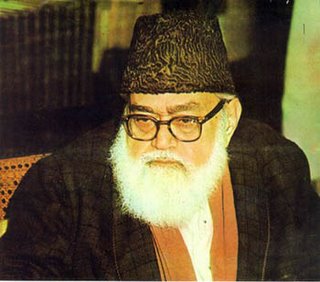
Sayyid Abul A’la Maududi (1903-1979)

By Yoginder Sikand, TwoCircles.net, May 18, 2008

The late Sayyed Abul Hasan Ali Nadwi (or Ali Miyan as he was also known) was one of the leading Indian ulema of modern times. A noted writer, he headed the famous Nadwat ul-Ulema madrasa in Lucknow from 1961 till his death in 1999. He was associated with several other Indian as well as international Islamic organisations, a mark of the high respect that he was accorded among Muslims all over the world.

Maulana Nadwi’s wrote extensively on a vast range of subjects, including on Islam and politics. On this issue, his views underwent a gradual process of change and maturation, beginning with his early association with a leading Indian Islamist formation and later making a forceful critique of some crucial aspects of its understanding of Islam. His views in this regard point to the little-known yet rich internal debate among Indian Muslim scholars about the relationship between Islam and politics, particularly on the question of what Islamists describe as an ‘Islamic state’.

In 1940, Maulana Nadwi came under the influence of Sayyid Maududi, the founder of the principal Indian Islamist outfit, the Jamaat-i Islami. Maududi, along with the Egyptian Syed Qutb, may be said to be among the pioneers of contemporary Islamism. Soon after joining the Jamaat, Maulana Nadwi was put in-charge of its activities in Lucknow. This relationship proved short-lived, however, and he left the Jamaat in 1943. He later wrote that he was disillusioned by the perception that many members of the Jamaat were going to what he called ‘extremes’ in adoring and glorifying Maududi as almost infallible, this bordering on ‘personality worship’. At the same time, he felt that many Jamaat activists believed that they had nothing at all to learn from any other scholars of Islam. He was also concerned with what he saw as a lack of personal piety in Maududi and some leading Jamaat activists and with their criticism of other Muslim groups. Continue reading Nadwi on Maududi: a traditionalist maulvi’s critique of Islamism

Marranci on the Anthropology of Islam

Note: The following is an excerpt from Gabriele Marranci’s latest book, The Anthropology of Islam (Oxford: Berg, 2008), which is well worth reading for insights on previous ethnographic study of Islam and guidelines for current research.

Books and ‘how-to’ guides about anthropological fieldwork are increasing in number within publishers’ catalogues. Among this large production, it is unusual to find even even chapters addressing the experience of conducting fieldwork among Muslim societies and communities. In the few cases in which some examples have been provided, they describe and discuss what I call ‘exotic’ fieldwork. Even less available is material containing reflections on the impact and issues that an anthropologist may face in conducting fieldwork within Muslim communities, in the west and in Islamic countries, during this endless ‘war on terror’. In this chapter, I have tried to start a reflection and discussion on what it means to conduct fieldwork among Muslims today. In doing so, I have provided examples from the experience of some anthropologists as well as my own. I have suggested that at the centre of a contemporary anthropology of Islam should be the human being even before the Muslim. This is vital if we wish to overcome a certain Orientalism and suppression of self-represented identities, as we can observe in classic works, from Geertz to Rabinow and Gellner. Continue reading Marranci on the Anthropology of Islam

Misreading the Arab Media

By LAWRENCE PINTAK, JEREMY GINGES and NICHOLAS FELTON, The New York Times, May 25, 2008

“ARABIC TV does not do our country justice,” President Bush complained in early 2006, calling it a purveyor of “propaganda” that “just isn’t right, it isn’t fair, and it doesn’t give people the impression of what we’re about.”

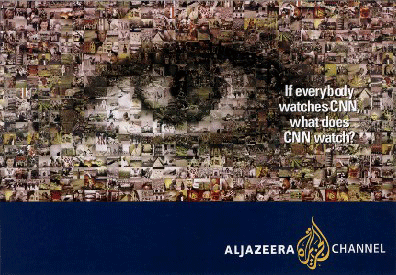
The president’s statement, along with the decision by the New York Stock Exchange to ban Al Jazeera’s reporters in 2003, is a prime example of how the Arab news media have been demonized since the 9/11 attacks. As a result, America has failed to make use of what is potentially one of its most powerful weapons in the war of ideas against terrorism.

For proof, in the last year we surveyed 601 journalists in 13 Arab countries in North Africa, the Levant and the Arabian Peninsula. The results, to be published in The International Journal of Press/Politics in July, shatter many of the myths upon which American public diplomacy strategy has been based.

Rather than being the enemy, most Arab journalists are potential allies whose agenda broadly tracks the stated goals of United States Middle East policy and who can be a valuable conduit for explaining American policy to their audiences. Many see themselves as agents of political and social change who believe it is their mission to reform the antidemocratic regimes they live under. When asked to name the top 10 missions of Arab journalism, they cited political reform, human rights, poverty and education as the most important issues facing the region, trumping Palestinian statehood and the war in Iraq. Overwhelmingly, they wanted the clergy to stay out of politics. And, aside from the ever-present issue of Israel, they ranked “lack of political change” alongside American policy as the greatest threats to the Arab world.

Though many Arab journalists dislike the United States government, more than 60 percent say they have a favorable view of the American people. They just don’t believe the United States is sincere when it calls for Arab democratic reform or a Palestinian state, as President Bush did again this month in Egypt.

Make no mistake, the Arab press has many flaws, including being subject to state control; only 26 percent of our respondents said they felt their fellow Arab journalists “act professionally” and only 11 percent said they were truly independent in their work. Nevertheless, Arab news outlets are more powerful and free today than at any time in history. If the next administration is going to try to reach out to the Arab people, it won’t get far by blaming the messenger.

Lawrence Pintak is the director of the Kamal Adham Center for Journalism Training and Research at the American University in Cairo and the author of “Reflections in a Bloodshot Lens: America, Islam and the War of Ideas.” Jeremy Ginges is an assistant professor of psychology at the New School for Social Research. Nicholas Felton is a graphic designer in Brooklyn.
Comparative Islamic Studies

The latest issue (Vol 2, No 2, 2006) of Comparative Islamic Studies, edited by Brannon Wheeler, is now available online. The articles in this special issue all deal with Islam and gender. While the articles are by subscription or for purchase, the book reviews can be read for free. Here are the article abstacts.

“Traditional” exegeses of 4:34
by Karen Bauer

Abstract: The beginning of Qur’an 4:34 (Men are qawwāmūn over women, with what God has preferred some over others, and with what they spend of their wealth) is often taken to legislate men’s authority over women. But many questions remain about the history of interpretations of this verse. In what ways have interpretations developed through time? Do pre-modern interpretations of this verse resemble modern interpretations, and what do such resemblances say about the attitudes of the exegetes? And what are the methods that pre-modern and modern exegetes use to arrive at their interpretations?

One way of empirically examining the variety in the pre-modern heritage, the methods of the exegetes, and the use of the pre-modern heritage in modern discourse is through the genre of Qur’ān commentaries (tafsīr al-Qur’ān). This verse has always been a source of controversy: pre-modern exegeses of it are varied. In the first part of this paper, I explore some of the variations in the content and methods of pre-modern interpretation, focusing on the ways in which content and method developed through time. I argue that some of the variations in content between the earliest and later pre-modern exegeses may be due to development in the exegetes’ methods of writing exegesis.

Continue reading Comparative Islamic Studies