All posts by tabsir

Move Over, You Tube

You Tube boasts one of the largest audiences on the web. There are plenty of videos put up by Muslims and many of these are in languages other than English. On July 11 there were 643,000 hits for the search “Islam” on You Tube. But move over, You Tube, and make room for Islamic tube, which has carefully selected videos on Islamic themes. You can find Quranic recitation, debates, numerous sermons and lectures and some rather raw anti-Zionist (and decidedly anti-Semitic) diatribes. This is a significant resource, but like all websites, should be consulted with caution.

Divided We Stand

Divided We Stand: A Woman’s Word about the Iranian-American Experience

by Dagmar Riedel

Gertrude Stein is alleged to have advised young Ernest Hemingway that he’d better stick to writing postcards if he had messages for his readers. It is understandable that Iranian-Americans want to reach American-American audiences with their stories about men and women with legs astride in two different cultures. But who is authorized to question a novel with a message, if its content is certified by the author’s traditional upbringing in Iran before the Islamic Revolution?

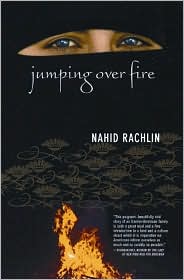
The fourth novel of Nahid Rachlin, Jumping over Fire (City Lights Books, 2005; cf. www nahidrachlin.com), has an intriguing black cover. Above the title a pair of blue eyes are staring intently at the viewer through the eye slit of a head scarf, while the bottom half merges a floral Arabesque with the yellow-red flames of a Nowruz bonfire. The title’s reference to the Nowruz purification ritual of jumping over fire is explained in the course of the novel. But on the cover the Zoroastrian tradition is presented as a variant of Western stereotypes of both the Oriental harem and Shia fanaticism because the collage promises a peek in the otherwise hidden world of a secluded Iranian woman and her burning desires. The reader has just to turn to the back cover to receive from Andre Dubus III, the son of the famous short-story author Andre Dubus, the confirmation that this is indeed a novel about a forbidden desire. The interpretation is further reinforced by the one-page biographical sketch in the back, written in the third person singular and designed to highlight in an objective language the author’s lifelong personal experience with displacement and gender-based social restrictions. Continue reading Divided We Stand

Not your Daily Bread


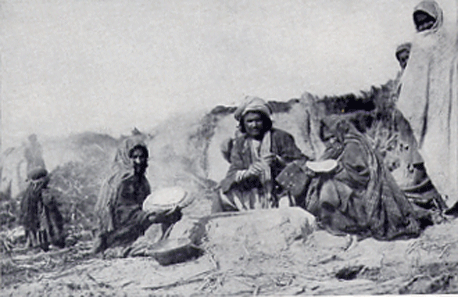
Baking bread in Seyistan on the Afghan Border

[It is hard to find a society in the Middle East without a thriving history of bread preparation. Before the modern loaf and bleached flour assaulted our tastebuds, a variety of flat breads were baked, either in clay overs or other makeshift ovens. Here is a description of both Afghan and Turcoman bread making from a century ago, as reported by Ellsworth Huntington in the National Geographic Magazine in 1909. Webshaykh.]

The method of cooking it was very different from that employed in the oases, where ovens of mud shaped like beehives, with a hole in the top, are heated with a fire of weeds, and the dough is stuck against the inside of the hot oven, where it hangs until it is so far cooked that it falls down into the ashes. The bread of the Afghan caravan was cooked by heating small, round cobblestones in the fire and then poking them out and wrapping dough an inch thick about them. The balls thus formed were again thrown into the fire to be poked out again when cooked. The bread tasted well there in the desert, although in civilized communities the grit and ashes would have seemed unendurable. Continue reading Not your Daily Bread

A Timely Lesson from Ibn Yaqzan

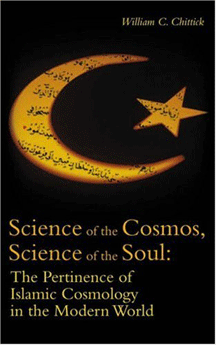
[In a recent and provocatively stimulating book. Bill Chittick examines the relevance of centuries of intellectual pursuit of Islamic cosmology for Muslims in the modern world. This is a fascinating book that is worth reading by Muslims and non-Muslims alike. It is a welcome relief from the constant drumbeat of Islam and politics. Order a copy today… Webshaykh.]

by William C. Chittick

It is commonly imagined that if our ancestors could be brought from the past in a time machine, they would be amazed and dumbfounded by the feats of modern science and civilization. But how would a Muslim intellectual of the past react to the modern world, and in particular to its intellectual ambiance? What would an al-Farabi, or an Avicenna, or a Mulla Sadra think of contemporary science and scholarship?

For the purpose of this experiment, I will borrow the name of our time-traveler from the famous philosophical novel of Ibn Tufayl, Hayy ibn Yaqzan, “Alive, son of Awake.” The name refers to the soul that has been reborn by actualizing the intellect. I will simply call him Ibn Yaqzan.

No doubt Ibn Yaqzan would be astonished by the ready availability of an enormous amount of information. However, he would be much more astonished by the fact that people have no idea that all this information is irrelevant to the goals of human life. He would see that people’s understanding of their true situation has decreased roughly in proportion to the amount of information they have gathered. The more “facts” they know, the less they grasp the significance of the facts and the nature of their own selves and the world around them. Continue reading A Timely Lesson from Ibn Yaqzan

Pox Britannica

The Shameful Islamophobia at the Heart of Britain’s Press

When a tabloid newspaper reports that a ‘Muslim hate mob’ is daubing abuse, can we believe them?

By Peter Oborne
The Independent, Monday, 7 July 2008,

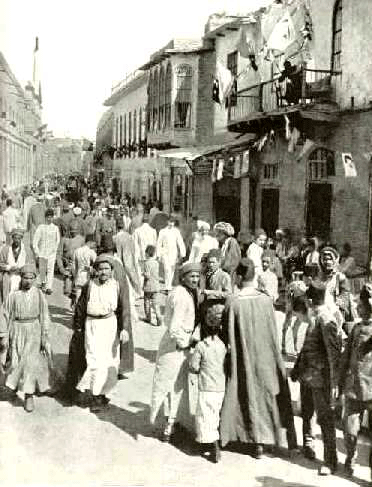
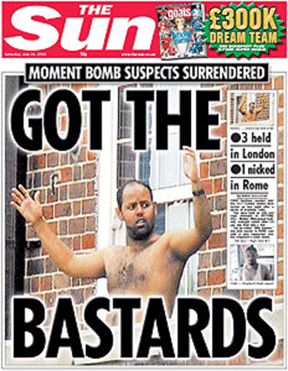
On the morning of 7 October 2006 The Sun newspaper splashed a dramatic story across its front page. The story – billed as exclusive – concerned a callous and cynical crime committed by Muslims. A team of Sun reporters described in graphic detail how what the paper labelled a “Muslim hate mob” had vandalised a house near Windsor. The Sun revealed that “vile yobs hurled bricks through windows and daubed obscenities. A message on the drive spelled out in 4ft-letters: ‘Fuck off ‘.”

One Tory MP, Philip Davies, was quoted venting outrage at this act of vandalism. “If there’s anybody who should fuck off,” Davies was quoted as saying, “it’sthe Muslims who are doing this kind of thing. Police should pull out the stops to track down these vile thugs”.

The Sun left its readers in no doubt as to why the outrage had been committed. Local Muslims were waging a vendetta against four British soldiers who hoped to rent the house on their return from serving their country in Afghanistan. The paper quoted an army source saying that: “these guys have done nothing but bravely serve their country – yet they can’t even live where they want in their own”. Continue reading Pox Britannica

From Failed Resolution 1696 to Real Diplomacy


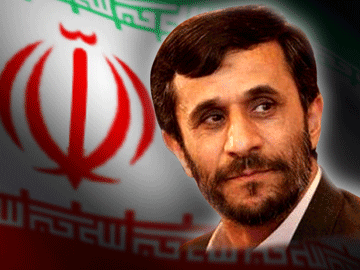
Iranian President Mahmoud Ahmadinejad

by William O. Beeman

The United Nations Security Council Resolution 1696 calling for Iran to suspend nuclear enrichment was passed on July 31, 2006 — nearly two years ago. Every sanction and demand placed on Iran since that time has been based on this Resolution (and its strengthened re-iteration, Resolution 1737 on December 23 of the same year).

Clearly after two years the Resolution and its follow-ups have not worked. Iran has not suspended its uranium enrichment activities, and indications this week are that it is not likely to do so in the future. The United States and its reluctant European allies obviously can not put enough pressure on Iran to cause it to abandon what the Nuclear Non-Proliferation Treaty — to which Iran (but not Israel, Pakistan or India) is signatory – provides as is its “inalienable right”: peaceful nuclear development. As long as it does not violate Provision One of the NPT, namely the agreement not to develop nuclear weaponry. Continue reading From Failed Resolution 1696 to Real Diplomacy