All posts by tabsir

New Book Stokes Fear of a Muslim Europe

New Book Stokes Fear of a Muslim Europe
Religion Dispatches, By Bruce B. Lawrence
August 13, 2009

Review of: Reflections on the Revolution in Europe: Immigration, Islam, and the West
By Christopher Caldwell(Doubleday, 2009)

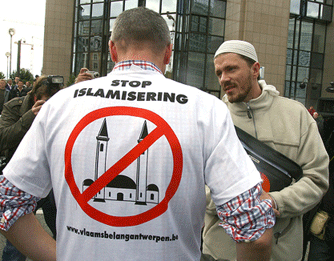
This is a full-throttle polemic, a meanspirited book meant to raise alarms, stoke fears, and tame a danger at once unseen and misunderstood yet pernicious and widespread.

The danger is Islam, the villains are Muslim immigrants, the terrain is the West, and the outcome is certain defeat for European culture—unless the tide of Muslim immigration, which threatens to become a tsunami, can be stemmed.

But how? This book, despite the myriad cases set forth in its 350 pages of rant and rave, offers no explicit steps to stem the Muslim immigrant tide allegedly sweeping Western Europe, ravaging its European culture, and threatening the future of Western civilization. Continue reading New Book Stokes Fear of a Muslim Europe

The Game of Kings


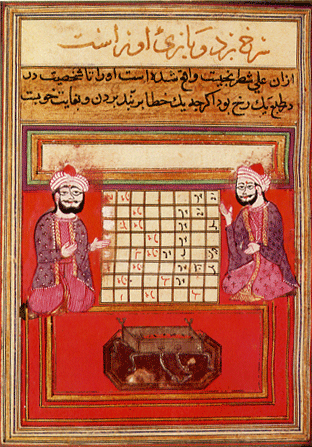
This illustration from a Persian treatise on chess, possibly dating from the 14th century, is notable for its expressive faces that hint at the “different kinds of pleasantry and jests” Mas‘udi recorded as customary among players at that time in Baghdad.

[The latest issue of Saudi Aramco World has an interesting article on the history of chess in the Middle East. Here is an excerpt.]

The Game of Kings

by Stewart Gordon

Arab writers on chess acknowledge that the game spread west from Persia, probably soon after the Islamic conquest in the mid-seventh century. The Arabic term for the game was and is shatranj, a standard linguistic shift from the Persian chatrang, and all the names of the chess pieces (with the exception of the horse) are Arabic versions of their Persian names. As it spread, however, the game did not always find itself welcome. The Eastern Church at Constantinople condemned chess as a form a gambling in 680, and al-Hakim, the Fatimid ruler of Egypt, banned it in 1005 and ordered all chess sets burned. Continue reading The Game of Kings

Syrian Cuisine, Two Centuries Ago

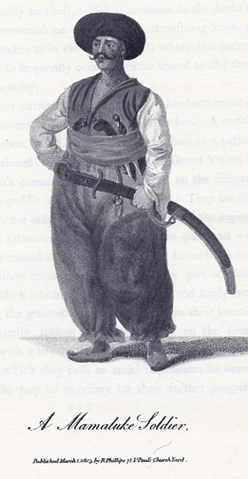
[Note: The following account is by the English traveler William Wittman, who commented on the foods and crops he saw while passing through the Levant in what was then Syria. The spelling is that of the original, from a time when proof reading was a distant concern and spelling was a democratic venture. The picture above is from the original 1803 edition.

Wherever the land is susceptible of cultivation, and has not been neglected, it affords abundant crops of wheat, barley, Indian corn (dourra), tobacco, cotton, and other productions. Fruits and vegetables are in equal abundance. Among the former are pomegranates, figs, oranges, lemons, citrons of an uncommonly large size, melons, grapes, and olives. The melons are large, and have a delicious flavour; as have also the grapes. of which we partook so late as the month of December, when we found they still retained their exquisite flavour. I have already adverted to the uncommon size of the water-melons, many of which weight from twenty to thirty pounds. they are a great and valuable resource to the inhabitants, who are so passionately fond of them, that, during the summer months, they form a great part of their subsistence. Notwithstanding they are as cooling and refreshing, as grateful to the taste, I was surprised to see the natives eat them in such immoderate quantities, without experiencing any unpleasant consequences. Continue reading Syrian Cuisine, Two Centuries Ago

Ramadan Greetings from the Oval Office


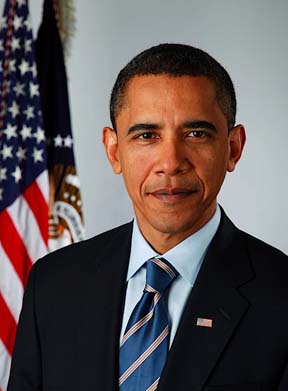
President Barack Obama

Ramadan Kareem
Posted by Rashad Hussain, The Official White House Website, August 21, 2009

As the new crescent moon ushers in Ramadan, the President extends his best wishes to Muslim communities in the United States and around the world.

Each Ramadan, the ninth month on the lunar calendar, Muslims fast daily from dawn to sunset for 29 or 30 days. Fasting is a tradition in many religious faiths and is meant to increase spirituality, discipline, thankfulness, and consciousness of God’s mercy. Ramadan is also a time of giving and reaching out to those less fortunate, and this summer, American Muslims have joined their fellow citizens in serving communities across the country. Over the course of the month, we will highlight the perspectives of various faiths on fasting and profile faith-based organizations making real impacts in American cities and towns. Continue reading Ramadan Greetings from the Oval Office

Burns on Afghanistan


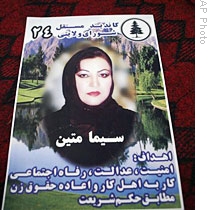
An election poster in Kapisa province for Sima Matin, a female candidate in a provincial council election, 28 Jul 2009

John Burns Answers Your Questions on Afghanistan

By John F. Burns, The New York Times, August 19, 2009

After more than 30 years as a Times foreign correspondent, I’ve grown used to looking out of the aircraft or jeep or train on arrival in unfamiliar and often inhibiting terrain, and wondering with a mixture of anticipation and anxiety how quickly, and capably, I’ll get my professional bearings — and justify the editors’ faith in assigning me. The boundary I’ll be crossing with this new venture for “At War,” our new and expanded blog on the conflicts of the post-9/11 era, is a different kind of challenge — but just as daunting, in its way, as those old forays into unknown lands.

In the first 48 hours after our Web editors invited readers to send in their questions, more than 220 of you responded, a degree of interest that is encouraging for what it suggests about the potential for us at the Times of this kind of interactive journalism. Just as much, the flow of questions, and the sophisticated commentaries woven into many of them, have been a reminder of how much many of our readers already know about the complex challenges America confronts abroad. Continue reading Burns on Afghanistan

Islam gets a Saudi facelift

Under the Veil, Nip and Tuck Makes New Saudi Faces

Asharq Alawsat, March 8, 2009

RIYADH, Saudi Arabia, (AP) — Does Islam frown on nose jobs? Chemical peels? How about breast implants?

One of the clerics with the answers is Sheik Mohammed al-Nujaimi, and Saudi women flock to him for guidance about going under the knife. The results may not see much light of day in a kingdom where women cover up from head to toe, yet cosmetic surgery is booming.

Religion covers every facet of life in Saudi Arabia, including plastic surgery. Al-Nujaimi draws his guidelines from the consensus that was reached three years ago when clergymen and plastic surgeons met in Riyadh to determine whether cosmetic procedures violate the Islamic tenet against tampering God’s creation. Continue reading Islam gets a Saudi facelift

On Fascist-Islamophobia

The Self-Fulfilling Prophecy of a Clash of Civilizations

Excerpt from “Fascist-Islamophobia”: A Case Study in Totalitarian Demonization by Dr. Robert Dickson Crane, published in The American Muslim, October, 2007. To read the entire article, click here.

The future of America and of global civilization will depend on whether and when the leaders of each of the world’s nations can join to bring out the best of each civilization in order to build a single civilization of global pluralism. The purpose must be to bring out the best of the past in order to build both for the present and the future a global federation of independent nations in the pursuit of peace through compassionate justice.

The opposite alternative is mutual demonization whereby members of one civilization join the extremists of another in supporting the extremists’ perversion of their own religion. In practice this would bring out the worst of the past to paralyze the present and destroy the future.

The many books by Robert Spencer and a host of lesser professionals in demonization typify a genre of books that have captured the imagination of an entire nation. Amazon’s list of books on Islam and Muslims available for purchase in the Year 2007 exceeds 75,000. Of the first 400 listed, fifty could be classified as Islam-bashing, and half of these are militantly or extremely so. A critique of any one of them could serve as a critique of them all, though Robert Spencer’s book is perhaps the most sophisticated in its virulence. The basic theme is a self-fulfilling prophecy that brands Islam as inherently terrorist and thereby provokes Muslims to become exactly what they are said to be. Continue reading On Fascist-Islamophobia