All posts by tabsir

Karim Ben Khelifa in Yemen


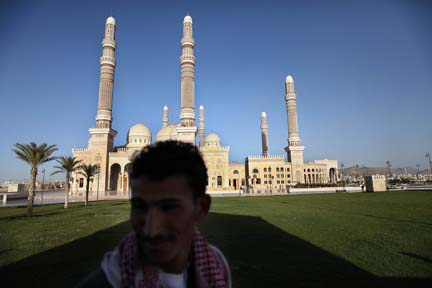
The newly built presidential mosque, which cost an estimated $60 million; photography by Karim Ben Khelifa

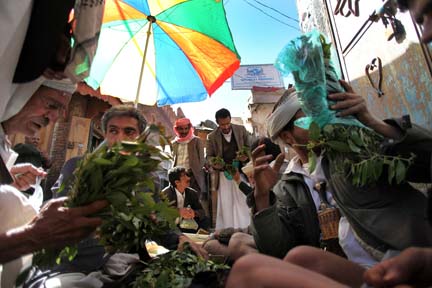
Much of the reporting on recent events in Yemen is pathetic. A rare exception is the work of photojournalist Karim Ben Khelifa, who is currently on assignment in Yemen. Thus far he has posted two sets of photographs, one on the Wall Street Journal, and the other for the New York Times. Check out these websites for superb photographs, two of which I reprint here with the permission of the photographer.


Qât market in Sanaa, Yemen; photography by Karim Ben Khelifa

Following Seward’s Folly: #2 Hopeless Arabia


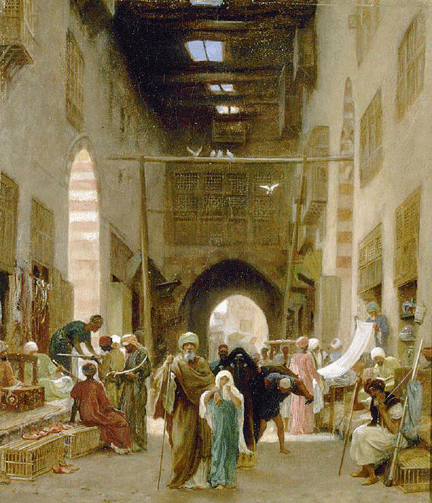
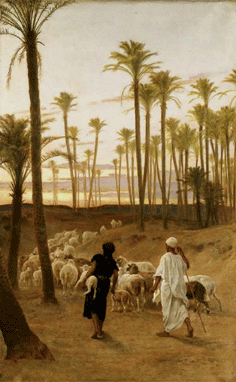
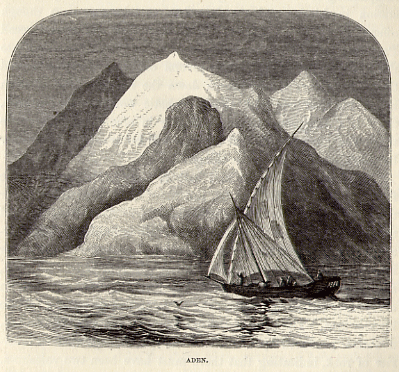
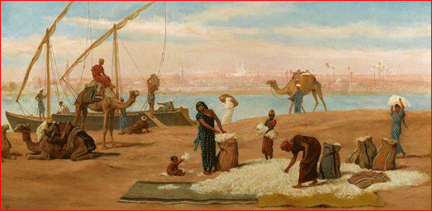
Illustration from Seward’s Travels (1873)

William H. Seward, the American Secretary of State who is forever linked with the “folly” of acquiring Alaska from the Russians, spent a year traveling around the world near the end of his life. In a previous post I recorded his comments on the British rule in India, as reported by his daughter. On April 27, 1871 the Seward party neared the Yemeni port (and British fueling station) of Aden. Here is how the approach is recorded by Ms. Seward:

April 27th. – After eight months travel in the incomprehensible East, with its stagnant civilization, we are now passing into another region still more incomprehensible and hopeless.

On the right hand is Yemen, once ‘Arabia the happy,’ and still known in poetry as a land of light and beauty, but now the dwelling of Arab hordes, who are sinking every day deeper into barbarism. On the left, wee are passing Somali, that part of Africa which stretches from Mozambique to Abyssinia. Continue reading Following Seward’s Folly: #2 Hopeless Arabia

IBLA tragedy

Institut des Belles Lettres Arabes (IBLA) in Tunis caught fire on January 5 and Father Gian-Battista Maffi was killed by the flames. Here is the information posted on the mission website:

Yesterday afternoon, Tuesday the 5th January, about 14.30, there was an explosion in the library of the Institut des Belles Lettres Arabes (IBLA), Tunis. Following the blast, a fire broke out and in spite of the rapid intervention of the city’s Fire Brigade, our confrere Gian-Battista Maffi, 54 years, who was in the library, could not be rescued. He was burnt to death, his body charred.

Police from the forensic laboratory are at work to try to determine the causes of the explosion and the fire.

We join in the sorrow and grief of Gian-Battista’s mother, family and friends. Let us pray for our deceased confrere, for all his confreres in Tunisia and Italy, and for the members of the Pre-Capitular Assembly preparing to begin its work tomorrow the 7th January at Tunis.

José Cantal, Provincial of the Maghreb, is on the spot. He is in the process of organising the funeral at a date yet to be fixed.

Saliba on Europe and Islamic Science

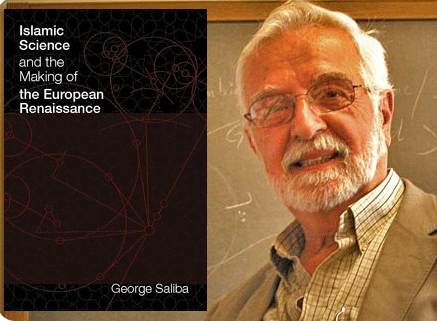
[On Rorotoko, historian of science George Saliba discusses the writing of his recent book, Islamic Science and the Making of the European Renaissance (Cambridge: MIT Press, 2007).]

This book started almost ten years ago. Initially, I wanted to know what were the conditions under which a civilization could produce science afresh.

I was trained in ancient Semitics, and mathematics, but I was always interested in these rumors that the general reader knows about, that the great invention of science was a really Greek project. And that everything else is either a shadow or a continuation of the classic antiquity.

Growing up, you assimilate these paradigms. You begin to think that these are the normal things. But then, trained in mathematics, and beginning to read a little bit of what was produced in the Islamic civilization, in science, I grew curious. I grew curious because I began to note that some of the science produced was not a shadow of the Greek project. It was more re-focusing of light, a new way of looking at things, which the Greeks did not know.

I began to also wonder about a fact that many a student of history and general reader would know. That there was this period of fantastical effervescence in the classical Greek tradition, say from the 4th century BC to the 2nd century AD. All the major names that we can think of happen to be in this period, all the major classics, in every discipline you can think of, from Plato to Aristotle to Ptolemy to Euclid to Diophantus to Galen to Dioscorides. And all comes to an end by the 2nd century. Then nothing happened. And then, all of a sudden, we begin to hear, in the 9th century, of the crazy caliphs of Baghdad who are spurring this and that, translating this and that, incorporating all of the Greek material. Continue reading Saliba on Europe and Islamic Science

Following Seward’s Folly: #1 Brits and Hindoos


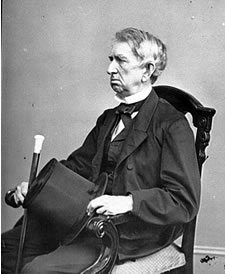
Portrait of William H. Seward, Lincoln’s Secretary of State, ca. 1865; photo by Matthew Brady

William H. Seward (1801-1872) is remembered primarily, to the extent anyone but a historian would bother to remember him, for his folly. An ardent opponent of slavery, this staunch Yankee republican might well have received the presidential nomination in 1860 instead of Lincoln, but he went on to serve as Secretary of State to both Lincoln and the first President Johnson. It was in 1867 that he pushed through the purchase of Alaska from Russia for 7,200,000 dollars, a sizeable sum for a nation coming out of a costly civil war. Horace Greeley in the New York Tribune wrote in criticism that Alaska “contained nothing of value but furbearing animals, and these had been hunted until they were nearly extinct.” Little did the man who famously said “Go west, young man” know that one day a young woman named Sarah Palin would come to power in this once Russian icebox. In 1870 Seward left politics and went on a trip around the world with his adopted daughter, who kept a record of the trip and published this in 1873. From New York to San Francisco to Japan and China to the straits of Malacca, Ceylon and British India to Egypt and Palestine and Europe and finally returning home to Auburn, New York in October of 1871: this was the folly the old man followed shortly before his death. Continue reading Following Seward’s Folly: #1 Brits and Hindoos

M F Hussain’s Aesthetic View on Islam


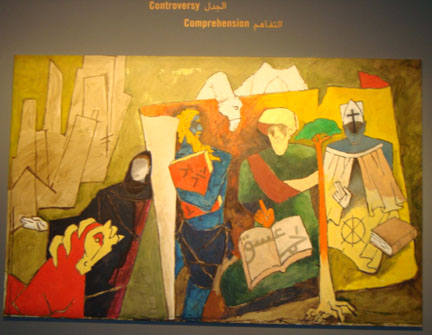
Hussain’s painting courtesy of Dr. Bruce Lawrence

One of the most famous, and at times infamous, painters in modern India is M.F. Hussain, who was born in 1915 and currently resides in London. He is perhaps best known for the controversy over his nude paintings, especially one that depicted “Mother India” and caused such a major backlash that he removed it from view. Less known, perhaps, are his paintings about Islam. Bruce Lawrence recently sent me several illustrations of paintings by Hussain on Islamic themes. Several of these were commissioned by Sheikha Mouza of Qatar for the Islamic museum in Doha. The picture above portrays the three monotheisms as “People of the Book.” As a painter it is clear that Mr. Hussain is less interested in promoting a particular religion than in celebrating the human spirit through his art.

Here is Bruce’s description of the painting above (this is an excerpt from a volume on Hussain, edited by Sumathi Ramaswamy and to be published by Routledge in October 2010): Continue reading M F Hussain’s Aesthetic View on Islam

Ibn Taymiyya on Snake Oil

[Webshaykh’s Note: The Muslim World has made some of their articles available, perhaps only for a limited time, to non-subscribers. In the latest issue (Volume 99, Issue 1, Pages 1-20, 2009) there is an interesting article by Yahya Michot (“Between Entertainment and Religion: Ibn Taymiyya’s Views on Superstition”). I attach here a brief excerpt from the article.]

One day, Ibn Taymiyya was asked to answer the following questions in a fetwa: “Are there, in this community, virtuous persons whom God keeps absent to people’s eyes? They are only seen by those by who they want to be seen. Even if they are among people, they are, in the state which is theirs, veiled to these people’s eyes. And also, are there, on Mount Lebanon, forty men absent to the eyes of those who look there? Every time one of them dies, they take somebody else among the people, who absents himself with them just as they are absent. All those, the earth hides them. They perform the pilgrimage. They accomplish in an hour distant trips that would normally take a month or a year. There are some among them who fly like birds, speak of hidden things before they happen, eat bones and clay and find this nourishing and sweet, etc.”27 Continue reading Ibn Taymiyya on Snake Oil

Al-Qaeda in Yemen

[Salon Magazine recently published an interview with Gregory Johnsen on the recent attacks against alleged al-Qaeda sites in Yemen. Here is a brief excerpt from the interview. The whole piece can be found at salon.com.]

Glenn Greenwald: My guest today on Salon Radio is Gregory Johnsen, who is an expert on Yemen; he’s a Ph.D. candidate in Near Eastern Studies at Princeton University and has advised the U.S. and British governments on issues relating to Yemen. Thanks very much for joining me today.

Glen Greenwald: How would you characterize what is being called al-Qaeda in Yemen in that spectrum, and how significant of a threat it is really to the United States, not within Yemen, but outside of Yemen and in the homeland?

Gregory Johnsen: Well, let me talk about it this way, if I can. This is the second incarnation of al-Qaeda in Yemen. Immediately after September 11th, we had what I like to term the first phase of the war against al-Qaeda. This lasted essentially from, say, the USS Cole attack in 2000 and really the September 11th attacks in 2001, up through November 2003. So, in this phase, the US and Yemeni governments partnered very closely. There was the drone strike in November 2002 that I mentioned earlier, and this was largely, at least for al-Qaeda, a reactionary war. Continue reading Al-Qaeda in Yemen