All posts by tabsir

More Travels with Kitto

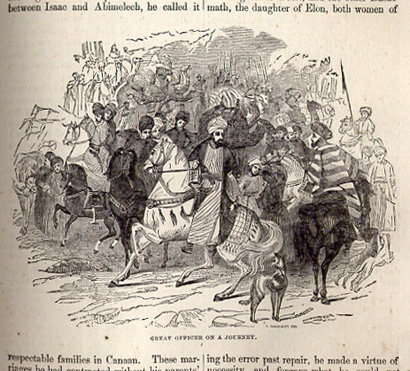
Following up on an earlier post, here is another illustration from John Kitto’s An Illustrated History of the Holy Bible (Social Circle, Georgia: E. Nebhut, 1871). The illustration above of a contemporary Arab scene illustrates the discussion of the patriarch Isaac receiving King Abimelech, “whom, with his attendants, he entertained with great liberality. The articles for a treaty of friendship were agreed on that same evening, and the next morning confirmed by a solemn and mutual oath; after which Abimelech took his leave, and returned home (pp. 118-119).

Now, if only Mahmoud Abbas and Benjamin Netanyahu could remake this scene with all its fanfare, the world would be a better place.

Know Your Customers First

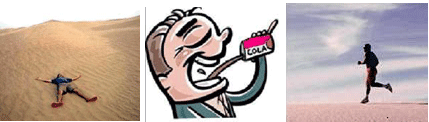
A disappointed salesman of Coca Cola returns from his Middle East assignment. A friend asks him: “Why weren’t you successful in Saudi Arabia? The salesman explained, with a sigh: “When I got posted in the Middle East, I was very confident that I would make a good sales pitch as our cola is virtually unknown there. But, I had a problem. I didn’t know how to speak Arabic. So, I planned to convey the message through three posters, like this:

Continue reading Know Your Customers First

Why does this land make me quiver?

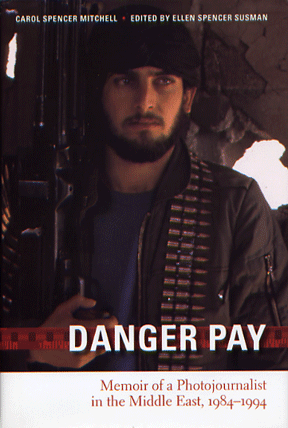
[Webshaykh’s note: Carol Spencer Miller (1954-2004) worked as a photojournalist in the Middle East, covering the crises there for some of the major American and european journals and newspapers. She had access to the elites, including King Hussein and Yassir Arafat, as well as ordinary people. Although she died before publishing her reflections on this experience, her book has been edited by her sister as Danger Pay: Memoir of a Photojournalist in the Middle East, 1984-1994 and is now available as an intriguing first-person memoir of events that seem to recycle more than disappear from the news cycle. I provide here an excerpt about her feeling of disorientation reporting on the Israeli/Palestinian issue.]

It grows increasingly unclear to me why people call this a “Westernized” country. the phones don’t work, the press is censored, there are guns everywhere. I am perpetually uneasy. How, I wonder, can anyone relax when wherever you look, there is someone toting or pointing a machine gun? they casually rest across shoulders, carried by anybody who wants to. Will I get used to the sight of civilians wearing sandals, shorts, T-shirts, and Uzis. in movie theaters, at the supermarket, at shopping malls, and at bars? They aren’t frightening as much as disconcerting.

This is a difficult country to get accustomed to. There are bomb shelters in homes and children’s playgrounds, security at every store, the ever-present notion of “security reasons,” the way people dress, as if they don’t give two hoots about appearance (they don’t). Restaurants and movies open on Fridays are stoned by the ultra-Orthodox Haredim. Continue reading Why does this land make me quiver?

Following Seward’s Folly: #4 The Dome of the Rock


Illustration of Cairo from Seward’s Travels (1873)

William H. Seward, the American Secretary of State who is forever linked with the “folly” of acquiring Alaska from the Russians, spent a year traveling around the world near the end of his life. In three previous posts I posted the comments he and his daughter made about India and Aden, and Egypt. The journey continued to Palestine and the city of Jerusalem:

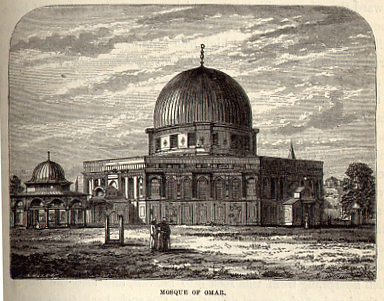
Yussef Effendi, with the brother and secretary of the pacha, attended us to the Mosque of Omar. It is only within the last five years that this mosque, scarcely less sacred in the eyes of Mussulmans than the Church of the Holy Sepulchre is in ours, has been opened to Christian travelers. Even now a careful, though somewhat disguised surveillance, is practiced over them. The mosque stands in an area enclosed with a high, parapeted wall, overlooking the vally of Jehoshaphat, and confronting the Mount of Olives. This occupies one-sixth of the land of the entire city. On the eastern side of this wall is a gate-way, built of marble, called by the Mussulmans the “Golden Gate,” which they are fond of representing as the “gate of the temple called Beautiful,” but its modern architecture does not support that claim. It is only interesting from the tradition that it was closed with the Roman conquest, and has never been reopened. The so-called Mosque of Omar is not single. It consists of two distinct mosques, placed at some distance from each other – the one here named Kubbet-es-Sukhrah, or “the Dome of the Rock,” commonly called the Mosque of Omar, and the Mosque-el-Aqsa. Though differing entirely from the Church of the Holy Sepulchre, the Mosque of Omar is not less unique and peculiar in its sacred antiquities. Twelve hundred years ago, on the surrender of the Greek Patriach, the Caliph Omar demanded to be shownt he site of the Jewish temple. He was taken to the sacred rock, he knelt and prayed over it, and he built over it a mosque, which, with subsequent repairs, is the present “Dome of the Rock,” or Mosque of Omar. In architectural design and execution it rivals the finest in Cairo and Constantinople. Continue reading Following Seward’s Folly: #4 The Dome of the Rock

Eurabian Follies

Eurabian Follies
The shoddy and just plain wrong genre that refuses to die

by Justin Vaïsse, Foreign Policy, January/February, 2010

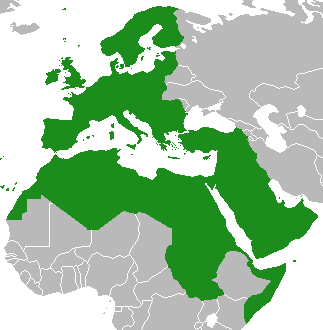
By 2050, Europe will be unrecognizable. Instead of romantic cafes, Paris’s Boulevard Saint-Germain will be lined with halal butcheries and hookah bars; the street signs in Berlin will be written in Turkish. School-children from Oslo to Naples will read Quranic verses in class, and women will be veiled.

At least, that’s what the authors of the strange new genre of “Eurabia” literature want you to believe. Not all books of this alarmist Europe-is-dying category, which received its most intellectually hefty treatment yet with the recent release of Christopher Caldwell’s Reflections on the Revolution in Europe, offer such dire and colorful predictions. But they all make the case that low fertility rates among natives, massive immigration from Muslim countries, and the fateful encounter between an assertive Islamic culture and a self-effacing European one will lead to a Europe devoid of all Western identity.

For the rest of this much longer article, click here.


Justin Vaïsse is senior fellow at the Brookings Institution’s Center on the United States and Europe and co-author of Integrating Islam: Political and Religious Challenges in Contemporary France.

On the loss of his grandfather


King Hussein with Queen Noor, 1985; Photograph by Carol Spencer Mitchell

[Webshaykh’s note: Carol Spencer Miller (1954-2004) worked as a photojournalist in the Middle East, covering the crises there for some of the major American and european journals and newspapers. She had access to the elites, including King Hussein and Yassir Arafat, as well as ordinary people. Although she died before publishing her reflections on this experience, her book has been edited by her sister as Danger Pay: Memoir of a Photojournalist in the Middle East, 1984-1994 and is now available as an intriguing first-person memoir of events that seem to recycle more than disappear from the news cycle. I provide here a second excerpt about her interview with King Hussein about the murder of his grandfather in which he himself was almost killed.]

On the Loss of His Grandfather

CS: What do you remember about the day your grandfather was assassinated?

KH: (He is silent for a moment,) You want me to go through the whole experience? I remember it very vividly … very vividly. (He is silent again.)

My grandfather was everything to me – a father, an example – who a few days before had asked me a strange question, which I’ve tried to live up to ever since. He asked me to ensure that his work was no lost and that I would continue to serve the Arab nation and this country as he had done. That particular day, I went with him to the city of Nablus because people insisted that we spend the day with them. We had the intention to go pray at the Al-Aqsa Mosque. I remember being in the uniform that he insisted I wear that morning. It was the only one that I had. I remember the meeting that he had in Jerusalem with certain Palestinians that fateful Friday. I remember him speaking about his relations with some of them. The fact that his differences with people were not always of a personal nature, but were matters of policy and approach. I remember him speaking of death and that he wished he would go while he was still in possession of his faculties and the best way in his view would be from a bullet from an unknown assailant. Continue reading On the loss of his grandfather

IUAES Conference in Turkey

The 2010 IUAES Inter-Congress Antalya, Turkey

The Ahi Evran University Department of Anthropology is proud to announce to you the 2010 IUAES (International Union of Anthropological and Ethnological Sciences) Inter-Congress to be held October 3-6 2010 in Antalya, Turkey.

Since our approval to host the congress, preparations and arrangements have been conducted in collaboration with various anthropology departments, professors, and graduate students across Turkey. Our collaborative efforts promise to bring a diverse, exciting, and informative Inter-Congress.

Turkey’s location at a point where three continents of the old world are closest to each other and where Asia and Europe meet has served as a crossroads that is one of the few areas that has been continuously inhabited since the dawn of mankind. The archeological richness is a telling measure of the human history of cultural interaction, conflict, and integration that shape the region. Since the founding of the Turkish Republic in 1925 anthropology as a discipline has assumed an important role in understanding and theorizing cultural exchanges between ethnically, linguistically, and religiously diverse Anatolian peoples and their neighbors; we are honored to strengthen this legacy with IUAES. Continue reading IUAES Conference in Turkey