All posts by tabsir

Ibn al-Mujâwir and the al-Huthi Rebellion


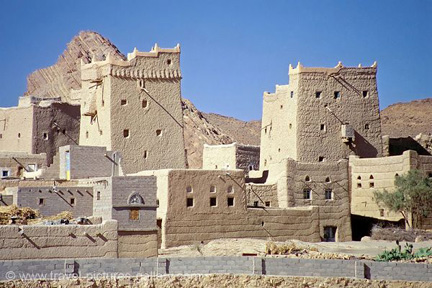
Traditional buildings in Sa‘da, Yemen

Over the past few years a major civil war has been simmering, at times brewing over into neighboring Saudi Arabia, in the north of Yemen. It has been called the al-Huthi rebellion and much of the fighting took place around the historic town of Sa‘da, the main entry of the Zaydi imams in the 10th century C.E. The exquisite travel text of Ibn al-Mujâwir, penned and quilled in the early 13th century, has a brief account of the overall region. Here is what Ibn al-Mujâwir, as ably translated by G. Rex Smith, said:

A description of these areas. The [previous] informant, [al-Kirmani], informed me as follows: All these areas [are made up of] settlements similar in size to one another to a greater or lesser degree. Each settlement has its own people. Every Arab tribal group and even bedouin section is [represented] in a settlement. As a result of their behaving badly [towards others], no one can settle with them, either on a temporary or a permanent basis.

A stronghold of stone and plaster has been built in every settlement and everyone living in the settlement has a store in the stronghold in which he keeps all his possessions, taking only from it what he needs on a daily basis. the inhabitants of the settlement surround the stronghold on all four sides. Each settlement is ruled over by an old shaykh of some power, clever and intelligent. When he gives a ruling, no one else shares in, nor opposes, what he advises them to do and what judgement he gives. There is no other authority ruling over all those in these areas and they pay no tax, nor do they hand over any levy at all, except whatever one wishes. thus they are constantly fighting, one getting the better of another’s wealth and the relatives of Zayd taking the wealth of ‘Amr. They do this all the time.

Their crops are wheat and barley; their trees are vines, pomegranates and almonds. All [kinds] of fruits and choice things are to be found among them. Their food is ghee and honey and they [bask] in their God[-given] ease and security. They are tribes who go back to Qahtân and others in their family trees.

Quoted by Ibn al-Mujâwir in his early 13th century travel text, translated by G. Rex Smith, A Traveler in Thirteenth-Century Arabia: Ibn al-Mujâwir’s Târîkh al-Mustabsir (London: The Hakluyt Society, 2008), p. 65.


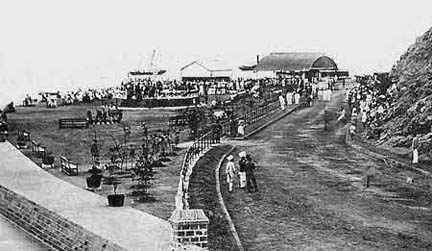
Iraqi Student Project


Iraqi students on road trip to Niagara Falls

[Editor’s Note: Below is information about an organization devoted to helping Iraqi students. Details are at http://iraqistudentproject.org/]

Iraq: A Cradle of Civilization in Ruins

Iraq’s people were among the first to learn irrigation, to invent the system of writing sounds that is key to our own alphabet, to create a legal system that is the foundation of modern law. During the early Islamic centuries Iraq was a center where ancient learning was translated and preserved, where poetry and music and medicine flourished. In modern times Iraqis have built a thriving system of higher education and have sent thousands of students to study all over the world, returning to teach and work in Iraq. Western institutions of higher learning benefit from the contributions to scholarship and human development that have taken place across the centuries in Iraq. Continue reading Iraqi Student Project →

Mearsheimer at The Jerusalem Fund

Edited Transcript of Remarks by Professor John J. Mearsheimer
Transcript No. 327 (29 April 2010)

To view the video of this briefing online, go to
http://www.palestinecenter.org

The Palestine Center
Washington, D.C.
29 April 2010

Professor John Mearsheimer:

It is a great honor to be here at the Palestine Center to give the Sharabi Memorial Lecture. I would like to thank Yousef Munayyer, the executive director of the Jerusalem Fund, for inviting me, and all of you for coming out to hear me speak this afternoon.

My topic is the future of Palestine, and by that I mean the future of the land between the Jordan River and the Mediterranean Sea, or what was long ago called Mandatory Palestine. As you all know, that land is now broken into two parts: Israel proper or what is sometime called “Green Line” Israel and the Occupied Territories, which include the West Bank and Gaza. In essence, my talk is about the future relationship between Israel and the Occupied Territories.

Of course, I am not just talking about the fate of those lands; I am also talking about the future of the people who live there. I am talking about the future of the Jews and the Palestinians who are Israeli citizens, as well as the Palestinians who live in the Occupied Territories.

The story I will tell is straightforward. Contrary to the wishes of the Obama administration and most Americans – to include many American Jews – Israel is not going to allow the Palestinians to have a viable state of their own in Gaza and the West Bank. Regrettably, the two-state solution is now a fantasy. Instead, those territories will be incorporated into a “Greater Israel,” which will be an apartheid state bearing a marked resemblance to white-ruled South Africa. Nevertheless, a Jewish apartheid state is not politically viable over the long term. In the end, it will become a democratic bi-national state, whose politics will be dominated by its Palestinian citizens. In other words, it will cease being a Jewish state, which will mean the end of the Zionist dream. Continue reading Mearsheimer at The Jerusalem Fund →

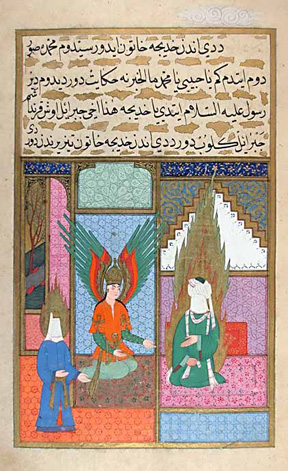
Why Islam does (not) ban images of the Prophet


Prophet Muhammad with the Angel Gabriel. Miniature from the Ottoman Empire, c. 1595 CE (Topkapi Museum, Istanbul)

Why Islam does (not) ban images of the Prophet

By Omid Safi, Newsweek, May 2, 2010

When a pair of adolescent and anonymous Muslim bloggers (“Muslim Revolution”) threatened the producers of South Park for depicting the Prophet Muhammad in a bear suit in an April 2010 episode, pundits responded by saying that the “Muslim Revolution” folks were extremist idiots (true) and that they were offended because Islam bans the depiction of the Prophet Muhammad (not true).

When the Danish cartoon controversies broke out in 2005, many pundits–and some Muslims–stated that Muslims were offended because Muslims have never physically depicted the Prophet.

That is actually not the case, and marks yet another example of what is at worst an acute sense of religious amnesia, and at best a distortion of the actual history of Islamic practices: Over the last thousand years, Muslims in India, Afghanistan, Iran, Central Asia and Turkey did have a rich courtly tradition of depicting the various prophets, including Prophet Muhammad, in miniatures. Continue reading Why Islam does (not) ban images of the Prophet →

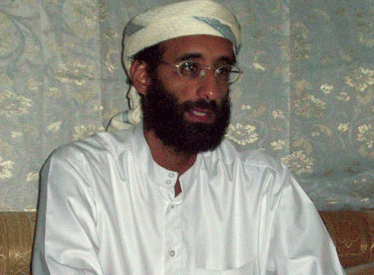
Anwar Al-Awlaki: The Jim Jones of Islam

by Kamran Pasha, The Huffington Post, May 23, 2010

As a Muslim and an American, let me say this loudly and clearly — Anwar al-Awlaki is a servant of evil and a traitor both to Islam and to America. He is intent on misleading the world by spreading the lie that Islam permits the killing of civilians. It does not.

Prophet Muhammad forbade the killing of non-combatants and reacted with horror when he heard of civilian deaths on the battlefield. In order to expound his own political agenda, Al-Awlaki is defaming the Prophet and the global Muslim community, which rejects terrorism. And in the process, he is revealing himself to be a modern Jim Jones — a narcissist creating a death cult.

In 1978, Jim Jones led 900 of his devoted followers to mass suicide by forcing them to drink cyanide mixed in a fruit beverage. The term “drinking the Kool-Aid” has since become synonymous with people who blindly follow their leaders to their doom. And it is clear that al-Awlaki’s followers are very much drinking his brand of Kool-Aid. Indeed, the alleged Fort Hood shooter, Major Nidal Malik Hasan, was apparently a follower of al-Awlaki before he turned on his fellow soldiers in an orgy of murder. Like Jim Jones, al-Awlaki has remarkable charisma and uses it to lead his followers down a very dark path.

I say all of this with great grief. Al-Awlaki was once a highly regarded Muslim scholar who taught a message of peace and brotherhood. But his story is like that of the archetypal villain of the movie Star Wars — Anakin Skywalker, a defender of justice, who devolves into Darth Vader, a monster who cares only for his own twisted quest for power. Continue reading Anwar Al-Awlaki: The Jim Jones of Islam →