All posts by tabsir

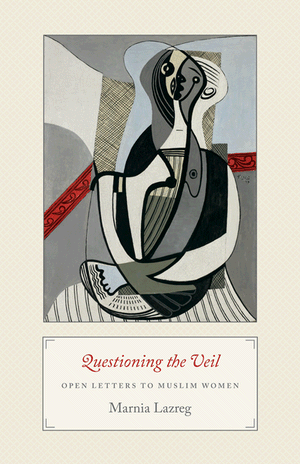
Questioning the Veil


[Editor’s note: Marnia Lazreg’s Questioning the Veil: Open Letters to Muslim Women (Princeton: Princeton University Press, 2009) is a refreshing unveiling of the long debated arguments on the use of some sort of “veil” in Muslim societies. These letters, concise and impassioned arguments in essay format, are for all to read. Modesty? Protection against sexual harassment? Newly formatted cultural identity? Conviction and Piety? Lazreg draws on her own upbringing in Algeria and research as a sociologist to frame her conviction of why Muslim women should not wear the veil. No one interested in the ongoing discussion should fail to read her important contribution. I provide here a brief excerpt from her Introduction.]

I do not approach veiling from the perspective of the struggle between “tradition” and “modernity,” which purportedly women resolve by opting for the veil, as a number of studies have claimed. New styles of veiling are less confining to a woman’s ability to move about than old ones, and a number of veiled women throughout the Muslim world have been carrying out their professional activities side by side with men in their workplaces. Nor do I consider wearing a veil at work as ushering in a new form of “modernity.” Furthermore, I do not intend to characterize veiling as representing women’s “alienation,” “enslavement,” or “subjugation” to cultural norms. Such characterizations are unhelpful as they can easily be applied to our postmodern condition, marked as it is by a retreat from a meaningfully shared human experience and the flaunting of privatized forms of consciousness, which result in conceptions of women that are as detrimental to women’s integrity as the veil might be. Continue reading Questioning the Veil

The Empire’s New Clothes


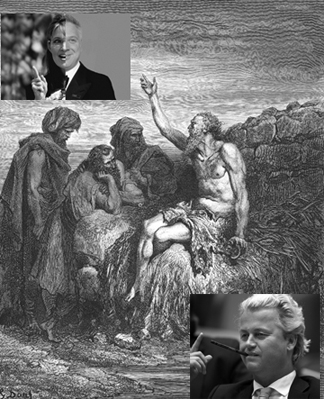
Biblical Job by Gustave Gore, surrounded by his so-called “friends”

In biblical times when an individual mourned, it involved tearing up everyday clothes and putting on coarse sackcloth and ashes. This is what the patriarch Jacob did when told his young son Joseph had been killed. When Job lost his family he sat on a dung pile. Both acts were motivated by humility rather than thoughts of revenge. As fitting as Job’s location might be for some of the memorial scenes yesterday, several of those making the news headlines represented the Empire (it is hard not to think of the United States superpower as anything else but an empire) in what they thought were patriotic “red, white, and blue” cloth, but which even a little child could see were politically naked to the core. The New York Times reports a woman at the 9/11 site holding up a sign that read ““Today is ONLY about my sister and the other innocents killed nine years ago.” Would that were true.

The loss of life nine years ago in a terrorist act deserves reflection for many reasons. For those of us who live in the New York area, there but for the grace of timing go we. Those who died had pulled no triggers, pushed no buttons to drop bombs, made no political decisions to invade another country, burned no Qur’ans. They died because politically motivated extremists so hated the policies of the United States in the Middle East that they were willing to commit an atrocious suicidal act to make a symbolic statement. It did not matter that among those killed were Americans who strongly disagreed with America’s foreign policy or were in fact Muslims. Such is the ethical nothingness that hate sets as a trap, no matter which God is being called upon to condone an evil act. Continue reading The Empire’s New Clothes

On al-Kindi

[Note: The following is a lengthy review of a recent book on the Muslim philosopher al-Kindi from the website Notre Dame Philosophical Reviews. Check out the website for accessible and useful reviews of recent books on philosophy.].

Peter Adamson
Al-Kindī

Peter Adamson, Al-Kindī, Oxford University Press, 2007, 272pp., $40.00 (pbk), ISBN 9780195181432.

Reviewed by Daniel Davies, Clare Hall, Cambridge for Notre Dame Philosophical Reviews,May, 2009

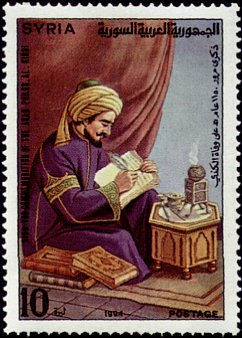
Al-Kindī is widely known as the first of the Islamic philosophers. In ninth century Baghdad he gathered around himself a circle that was highly active in translating the Greek sciences into Arabic. As well as being the first of the Arab philosophers Al-Kindī is now the first of the Arab philosophers to be included in the Great Medieval Thinkers series. Al-Kindī was expert in a vast array of scientific disciplines and in this book Peter Adamson concentrates on the philosophical topics on which Al-Kindī wrote, as is appropriate for the series: metaphysics; ethics; psychology; medicine; cosmology. One of the many virtues of the book is that it focuses on elucidating the philosophical arguments themselves, in a way that is both sympathetic and critical, rather than only seeking their provenance or tracing their after-effects. Certainly, al-Kindī has long been recognised as a creative and voluminous writer, though, until now, the extent and nature of his originality had yet to be mapped. Adamson shows that al-Kindī deserves a place amongst the great philosophers in his own right and not only because of the pervading presence of his work in later Islamic and Arabic thought. Continue reading On al-Kindi

Eid Mubarak: Blessed Holiday, Service to Humanity


by Omid Safi, The Huffington Post, September 9, 2010

Ramadan is the holiest month of the year for Muslims, a lovely combination of spiritual introspection, family gatherings, late night prayers, and social justice identification with those for whom going hungry is not a voluntary choice, but a daily reality. And Eid, the holiday marking the end of Ramadan, is a joyous time. In many Muslim cultures, this is the time of the year where families will buy new clothes for the children, and the whole town is dressed up in lights, sweets are served, and families visit loved ones, offering embraces and celebrations.

This Ramadan, on the contrast, has felt heavy. Don’t get me wrong: there have been hundreds of millions of Muslims fasting around the world, and untold numbers of Muslims have spent nights drawing nearer to their Lord through prayer and recitation of the Qur’an. There have been family gatherings and mosque prayers as before, but at least for Muslims in America a heaviness has also been a part of this Ramadan. The whole month has had the shadow of the Park51 controversy (the misnamed “Ground Zero Mosque”) and then more recently the prospects of the savage Qur’an-burning episode down in Gainesville, cast over it. Continue reading Eid Mubarak: Blessed Holiday, Service to Humanity

Burning books, burning bodies, burning bridges

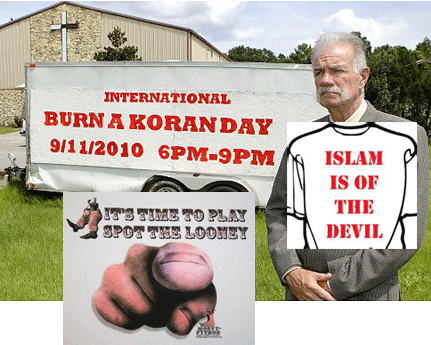
“Burn, baby, burn.” One might expect these words to come from a comedian as much as an arsonist. If you put the name “Terry Jones” into Google you will find a comedian. That is Terence Graham Parry Jones of Monty Python fame. These days there is another Terry Jones, a “Rev.ed” up one to boot. Rev. Terry Jones is the previously and foreseeably future little-known pastor of the Dove World Outreach Center on the outskirts of Gainesville, Florida. For a congregation estimated at about 50, their outreach may take a millennium or more, but they do have an inflammatory website, which promotes the “Right” (in all the irony this words entails) Rev. Jones’ book with the rather unoriginal title of “Islam is of the Devil,” which is for sale, as is a $20 t-shirt to advertise hatred of Islam. For an individual who has no clue about Islam, apart from his own rabid intolerance, the devil is certainly not in the details. His moment of fame is about to eclipse, but his motive is so shameful it deserves all the condemnation it can get, the kind in which the pen is mightier than the bonfire.

Let’s start with the desire to burn. One name should suffice to call out the hypocrisy of Mr. Jones. That name is John Wycliffe, the 14th century Christian cleric whose name inspired the Wycliffe Bible Translators, one of the most active Protestant organizations translating the Bible into other languages. Wycliffe dared to translate the Latin Vulgate into English, so earning the ire of the Catholic Pope that he was excommunicated. Some 44 years after Wycliffe died of a stroke, the “Church” had his bones dug up and burned, along with all his writings. I suspect that Jones prefers the King James Version of the Bible, although I do not know if he is aware that this “authorized” version was greatly influenced by Wycliffe. Continue reading Burning books, burning bodies, burning bridges

Leaves from an old Bible Atlas #3


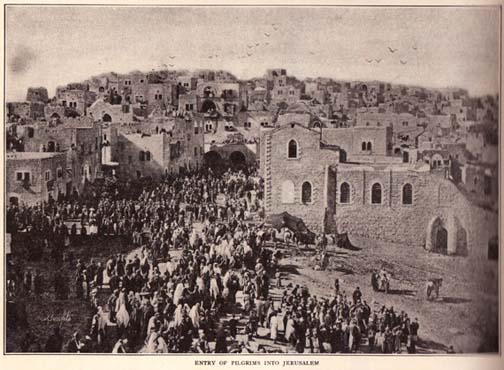
Entry of pilgrims into Jerusalem, Hurlbutt’s Atlas, p. 150

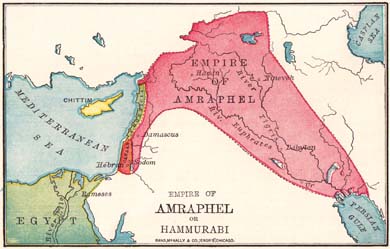
The Christian fascination with the Holy Land as a window into interpretation of the Bible has a long and indeed fascinating history of its own. Here I continue the thread on Jesse Lyman Hurlbutt’s A Bible Atlas (New York: Rand McNally & company, 1947, first published in 1882). The photograph above is actually the last in the atlas, just before a colorful foldout chart of Bible History.

The edition I am using includes an Introduction by Bishop John H. Vincent, whose memories of a visit to Palestine are quite typical of this Holy-Landaphilia. The following is a good example of the preacher’s rhetoric:

At one time I was permitted to spend forty days and forty nights in Palestine. I saw Abraham at his tent door; Rebekah veiling herself at the approach of the stranger; the long caravan of camels and Midianites on their way toward the south. I saw the wailing mourners at the house of death; the roof that might easily have been broken up; the wedding procession; the grass on the housetops; the sparrow making a nest for her young in the synagogues of Jerusalem. I saw the elders in the gates; David the shepherd, with his sheep, on the hillside; the Jewish mother, teacher Timothy, the words of the old Book in the old city on the hill. Verily, it is the old land; it is the old life; it is the memorial presentation in concrete form of what the Book says was true there thousands of years ago.

To be continued …

The Meaning of Democracy

The Meaning of Democracy

by Roya, Afghan Womens’ Writing Project

After the Taliban‘s black regime, when houses were cages for women and only the wild Taliban ideology was law, when the burqa was accepted as a symbol of freedom and the real Islamic hijab disappeared unknown—after all this, Afghan women recognized the word for Democracy.

But Democracy is a very young word for the people of our country, very new in our cultural dictionary, and the question is: Do women understand this word? Do they welcome it, or hide under their burqa?

I think Democracy knocked on the doors of only some women in Kabul, Mazar, Herat, only a few of Afghanistan’s 34 provinces. In most areas, Afghans still don’t know this word. Many think it is a word used only by politicians who travel all over the world, live in the tallest buildings and own the latest car models. Democracy, easiest explanation, is government of the people, for the people. But in our country, people think whatever your heart wants, do it, and that is the meaning of democracy. Continue reading The Meaning of Democracy

Don’t Call Me Moderate, Call Me Normal


Ed Husayn

[The Wall Street Journal recently published a series of short commentaries on “moderate Islam.” Here is the one by Ed Husayn, author of “The Islamist” (Penguin, 2007) and co-founder of the Quilliam Foundation, a counterextremist think tank.]

By Ed Husain

I am a moderate Muslim, yet I don’t like being termed a “moderate”—it somehow implies that I am less of a Muslim.

We use the designation “moderate Islam” to differentiate it from “radical Islam.” But in so doing, we insinuate that while Islam in moderation is tolerable, real Islam—often perceived as radical Islam—is intolerable. This simplistic, flawed thinking hands our extremist enemies a propaganda victory: They are genuine Muslims. In this rubric, the majority, non-radical Muslim populace has somehow compromised Islam to become moderate.

What is moderate Christianity? Or moderate Judaism? Is Pastor Terry Jones’s commitment to burning the Quran authentic Christianity, by virtue of the fanaticism of his action? Or, is Rabbi Ovadia Yosef, the spiritual head of the Shas Party in Israel, more Jewish because he calls on Jews to rain missiles on the Arabs and “annihilate them”?

The pastor and the rabbi can, no doubt, find abstruse scriptural justifications for their angry actions. And so it is with Islam’s fringe: Our radicals find religious excuses for their political anger. But Muslim fanatics cannot be allowed to define Islam.

The Prophet Muhammad warned us against ghuluw, or extremism, in religion. The Quran reinforces the need for qist, or balance. For me, Islam at its essence is the middle way in all matters. This is normative Islam, adhered to by a billion normal Muslims across the globe.

Normative Islam is inherently pluralist. It is supported by 1,000 years of Muslim history in which religious freedom was cherished. The claim, made today by the governments of Iran and Saudi Arabia, that they represent God’s will expressed through their version of oppressive Shariah law is a modern innovation.

The classical thinking within Islam was to let a thousand flowers bloom. Ours is not a centralized tradition, and Islam’s rich diversity is a legacy of our pluralist past.

Normative Islam, from its early history to the present, is defined by its commitment to protecting religion, life, progeny, wealth and the human mind. In the religious language of Muslim scholars, this is known as maqasid, or aims. This is the heart of Islam.

I am fully Muslim and fully Western. Don’t call me moderate—call me a normal Muslim.