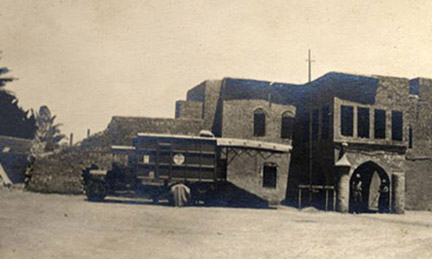
British headquarters in Ramadi, 1918
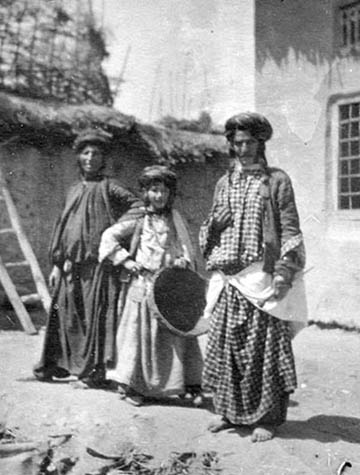
Children in Ramadi, Iraq street, 1918
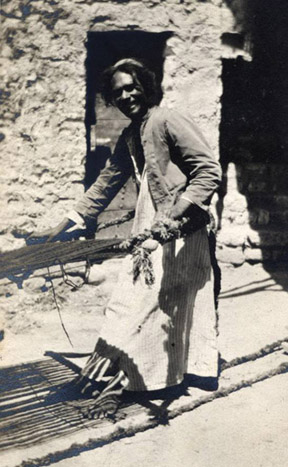
Jewish citizen of Ramadi, Iraq, ca. 1918
British headquarters in Ramadi, 1918
Children in Ramadi, Iraq street, 1918
Jewish citizen of Ramadi, Iraq, ca. 1918
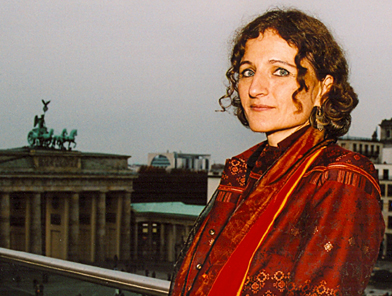
Almut Shulamit Bruckstein Coruh; photo by Simon Harik
by Almut Shulamit Bruckstein Coruh, Qantara.de
Every day in Germany, one hears talk of the Jewish-Christian tradition in the West. Usually, it is meant in the context of defending our system of the rule of law and the constitution, the liberal values of our society, and even “gender equality and the freedom of artistic expression, opinion, and religion”. On this battleground, there is one main opponent – Islam. And it doesn’t appear that any hyphen will come to our aid.
Islam is often reflexively equated with religion – one that cannot deny its “militant Arab” origins. It supposedly consists of Sharia and the Koran, explain the experts, TV presenters, educators, politicians, and journalists, all the while invoking the Jewish-Christian tradition.
They all unashamedly tinker around with concepts from a literary tradition that is foreign to them, and which, just as the rabbinical tradition, embraces a whole world of casuistic judgements. In all this, one thing prevails – a threatening, didactic tone of unambiguity: This is what it says in the Koran, Islam says this, that is what the Sharia commands. Continue reading The Jewish-Christian Tradition Is an Invention
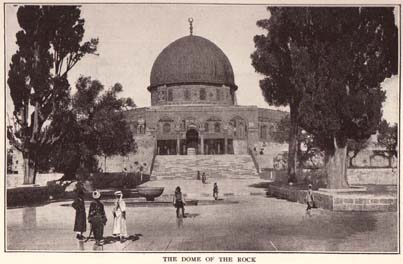
Hurlbutt’s Atlas, p. 137
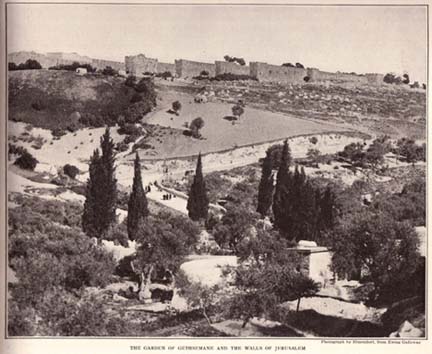
Hurlbutt’s Atlas, p. 133
The Christian fascination with the Holy Land as a window into interpretation of the Bible has a long and indeed fascinating history of its own. Here I continue the thread on Jesse Lyman Hurlbutt’s A Bible Atlas (New York: Rand McNally & Company, 1947, first published in 1882). As might be expected, a large part of the atlas is devoted to Jerusalem. Here are two century old pictures, one of the Dome of the Rock and the other a view of the Garden of Gethsemane looking toward an uncluttered landscape beneath the old city walls of Jerusalem.
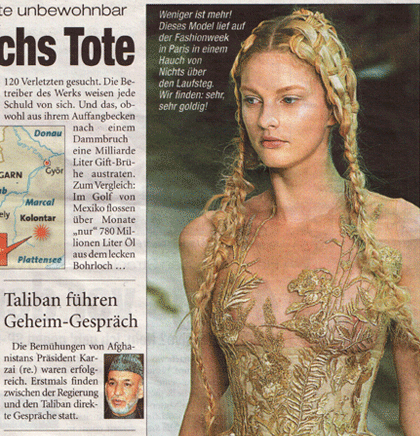
Heute, October 7, 2010, p. 5
While in Vienna earlier in the month I picked up a free Austrian tabloid called Heute. Leafing through the pages, it was obviously mainly about the upcoming election, lottery winners, local births in the Vienna zoo, movie stars and “Sexbombe Katy begeistert Fans.” But the layout on p. 5 was too precious not to comment on. Here is the fashion week model in a gold-laced dress with nipples poised not far over the head of Afghan President Karzai. One wonders if this was a total accident or if the editor was nurturing other fantasies.

[Webshaykh’s Note: In the current online issue of Foreign Policy there is an excellent essay by Robert Pape on the post 9/11 missteps and how a faulty narrative has not only bogged us down into two unwinnable wars, but also not made us safer from terrorism. Click here for the full article; I excerpt the ending here.]
by Robert Pape, Foreign Policy, October 20, 2010
Put differently, adopting the goal of transforming Muslim countries is what created the long-term military occupation of Iraq and Afghanistan. Yes, the United States would almost surely have sought to create a stable order after toppling the regimes in these countries in any case. However, in both, America’s plans quickly went far beyond merely changing leaders or ruling parties; only by creating Western-style democracies in the Muslim world could Americans defeat terrorism once and for all.
There’s just one problem: We now know that this narrative is not true.
New research provides strong evidence that suicide terrorism such as that of 9/11 is particularly sensitive to foreign military occupation, and not Islamic fundamentalism or any ideology independent of this crucial circumstance. Continue reading It’s the Occupation, Stupid
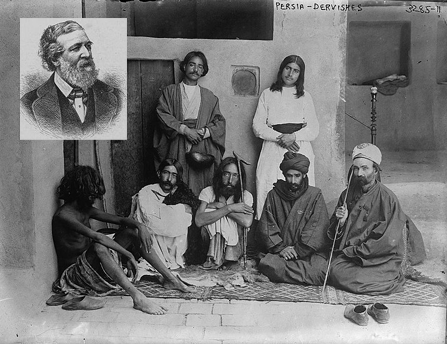
The poet Robert Browning left a large corpus, including his translation of Goethe’s masterful West-östlicher Diwan. One of his longer poems is an Oriental tale entitled Ferishtah’s Fancies. Recently in a used book shop I bought a copy of the 1885 edition published in Boston by Houghton, Mifflin and Company. There is an ironic epigraph for this Orientalist tale from Shakespeare’s King Lear (Act III, Scene 6) at the forefront:
You, Sir, I entertain you for one of my Hundred; only I do not like the fashion of your garments: you will say, they are Persian; but let them be changed.”
Browning’s verse is as antiquated today as the tale he spun, but still worth looking at if only for the nostalgia of Victorian English prose. Here is an excerpt from the encounter of Dervish Ferishtah with a former high official now beggared:
The Mellon-seller
Going his rounds one day in Ispahan, –
Half way on Dervishhood, not wholly there, –
Ferishtah, as he crossed a certain bridge,
Came startled on a well-remembered face.
“Can it be? What, turned melon-seller – thou?
Clad in such sordid garb, thy seat yon step
Where dogs brush by thee and express contempt? Continue reading Of Dervishes, Fools and Prime Ministers
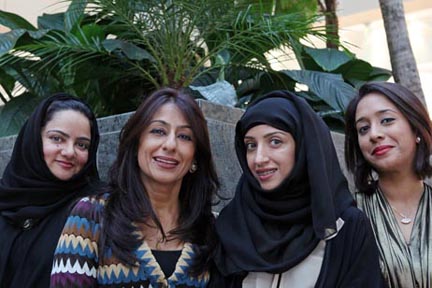
Left to right) Salwan Al Shaibani, 39, Hala Kazim, 47, Maha Jaber, 32, and Aida Al Busaidy, 27, all of Dubai. Kazim recently took the other women on an 80-kilometer hike in Austria through her program, Journey Through Change; Photo by Amy Leang / The National
Hike across Austria raises profile of Emirati women
by Maey El Shoush, The National, October 15, 2010
DUBAI // Five Emirati women who traded their abayas for backpacks have returned from a successful five-day hiking trip through Austria aimed not only at their own personal development but also at breaking down stereotypes outside the UAE.
Their tour was organised through Journey Through Change, a Dubai life coaching and organising company run by Hala Kazim, 47.
Mrs Kazim said: “I wanted to show the ladies and men in our communities, there are more things to life. This was not just a walking trip: I exposed them to different cultures, showed them how to absorb the beauty around them, and counselled them as we walked.â€
The group, composed of women from their mid-20s to 40s, walked 80 kilometres, starting at Vienna through Fuschl towards St Wolfgang, across mountainous terrain and past green fields, farms and villages. Dressed down and wearing no makeup, with minimal internet access at the bed and breakfasts where they spent each night, the trip took the women back to basics. Continue reading Abayas for backpacks
A Revolutionary of Arabic Verse
By CHARLES McGRATH, The New York Times, October 17. 2010
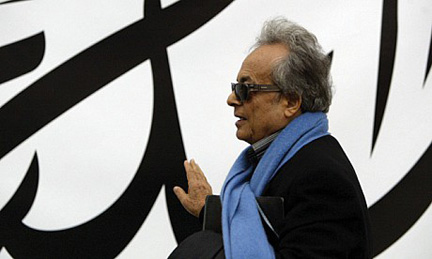
ANN ARBOR, Mich. — Every year around this time the name of the Syrian poet Adonis pops up in newspapers and in betting shops. Adonis (pronounced ah-doh-NEES), a pseudonym adopted by Ali Ahmad Said Esber in his teens as an attention getter, is a perennial favorite to win the Nobel Prize in Literature. This year Ladbrokes, the British bookmaking firm, had his chances at 8-1, which made him seem a surer bet than the eventual winner, Mario Vargas Llosa, a 25-1 long shot. Why Adonis appeals to the oddsmakers, presumably, is that he’s a poet, and poets have been under-represented among Nobelists lately; that he writes in Arabic, the language of only one Nobel winner, Naguib Mahfouz; and that as is the case with so many recent winners, most Americans have never heard of him.
In the Arab world it’s a very different matter. There he is a renowned figure, if not everywhere a beloved one. He is an outspoken secularist, equally critical of the East and West, and a poetic revolutionary of sorts who has tried to liberate Arabic verse from its traditional forms and subject matter. Some of his poems are immensely long and immensely difficult and resemble Pound’s Cantos at their most impenetrable. Others reveal a Paul Muldoonish playfulness, a Jorie Graham-like expansiveness and fascination with blank space. His poems are as apt to cite Jim Morrison as the Sufi mystics, and his 2003 volume “Prophesy, O Blind One†includes some long, leggy lines about traveling that could have been written by Whitman, if only Whitman had spent more time in airports. Continue reading The Poet Adonis