All posts by tabsir

New book on Lawrence


A new book has appeared by Michael Korda entitled
The Life and Legend of Lawrence of Arabia (Harper/HarperCollins Publishers, 762 pages). A review by Ben MacIntyre was published in yesterday’s New York Times, the beginning of which I attach here.

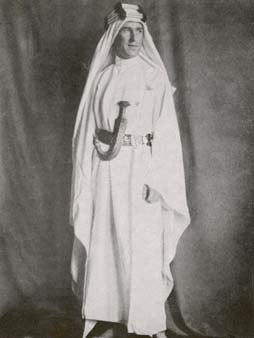
Lowell Thomas, the pioneering American journalist and filmmaker, was buying dates on a Jerusalem street soon after the holy city had been wrested from Turkish control by British forces in 1917, when he spotted a group of Arabs, led by a most remarkable figure. “A single Bedouin who stood out in sharp relief from his companions; . . . in his belt was fastened the short curved sword of a prince of Mecca, . . . marking him every inch a king. . . . This young man was blond as a Scandinavian. . . . His expression was serene, almost saintly, in its selflessness and repose.”

The robed figure was T. E. Lawrence, Lawrence of Arabia, Laurens Bey to his Arab comrades in arms, the “Uncrowned King of Arabia” according to his boosters. And if Thomas’s description seems sensationalist, that is hardly surprising, for the American did more than any other single person to turn Lawrence into a glittering multimedia global celebrity, a fable, a saint and a myth.

Lawrence was an ambiguous figure in his lifetime, and has remained so ever since, in part because the fog of fame made it virtually impossible to see him clearly, then and now. He was a scholar and warrior, an imperialist and supporter of Arab independence, a politician and rebel, a publicity seeker and recluse. Fighting alongside Arab irregulars in the revolt against Turkish Ottoman rule during World War I, he was fanatically brave and chillingly ruthless. He was fastidious, inconsistently vegetarian, sexually repressed, allergic to physical contact and addicted to danger, flagellation and roasting baths. He was fabulously weird. Continue reading New book on Lawrence

“Our Foreign-Born Citizens”


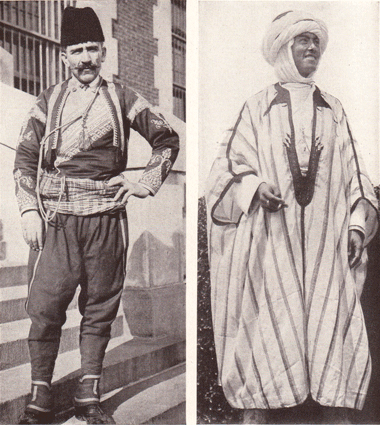
” Turkish Bank Guard” (left), “Even Algeria Sends its Quota to America” (right)

Like many Americans, my father was born in this country, but his father came from Sicily in the 1890s. The year my father was born, 1917, National Geographic Magazine published a lead article entitled “Our Foreign-Born Citizens.” Given the current anti-immigration sentiment of many Americans today, it is useful to look back at the same issue that rocked American politics almost a century ago. Given the optimistic note below that our territory could hold 900 million people, the latest census results showing the U.S. population is now over 300 million is a hopeful, even if not well documented, sign. Here is a sample from the article:

Never in the history of the American people has a measure been passed by Congress as often and vetoed by the President as many times as the immigration bill recently enacted into law. Three presidents of the United States have felt so keenly that the founders of the government and their successors were right in holding that the lack of opportunity to learn to read and write should not bar an alien from freedom’s shores, that they have overridden the will of the four Congresses and have interposed their veto between the congressional purpose and the unlettered immigrant’s desire. Continue reading “Our Foreign-Born Citizens”

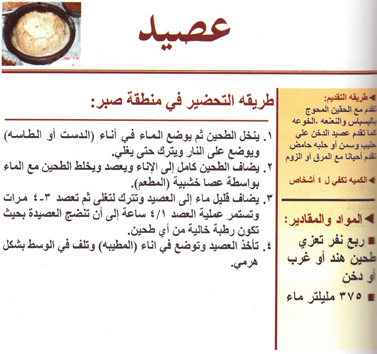
What’s Cooking in Yemen 2

In a recent post on Yemeni cooking the steps for making barley bread were illustrated. One of the staple dishes of the Yemeni highlands, and one that I enjoyed while living in a rural setting in al-Ahjur in the late 1970s, is the sorghum porridge called ‘asîd. The recipe is above and the steps illustrated below. Sorghum flour is available in the United States, most easily at Indian food stores, but also on the Internet. Continue reading What’s Cooking in Yemen 2

Tulip mania


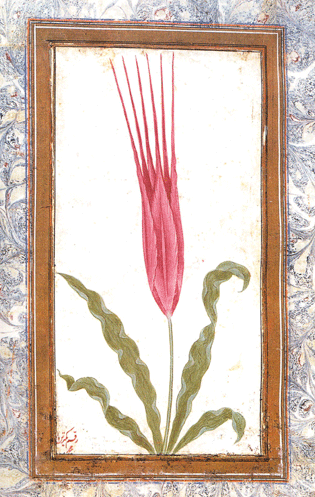
Unnamed tulip from the Turkish ‘The Book of Tulips’, ca. 1725

Webshaykh’s Note: With winter snow buffeting Europe and the Middle East, what better time to think about tulips, an Ottoman treasure that took Europe by storm almost half a millennium ago. There is an excellent book on The Tulip by Anna Pavord (Great Britain: Bloomsbury, 1999), but one of my favorite articles is one that Jon Mandaville wrote for ARAMCO World over three decades ago. The full article is available online, but I provide the first part below.]

Turbans and Tulips
Written by Jon Mandaville. ARAMCO World Magazine, May/June, 1977

Tulips come from Holland. Right? Wrong! Or at least, they haven’t always. Tulips come from Turkey, the only country in the world to call one of its major eras of national history—the years 1700 to 1730—the “Tulip Period.” And how that era got its name . . . thereby hangs a tale.

Tulips, even in the early 18th century, were nothing new to Turkey. Along with other bulbous plants such as the narcissus, the hyacinth and the daffodil, tulips had grown there for centuries, both wild and domesticated for house and garden. The Tulip Period took its name from an established hobby, which started as court fashion, grew into a generalized fad and fancy, and finally became an explosion of unrestrained international speculation in bulbs which buyers never even saw.

It all began when tulips first went to Europe. In 1550, no one in Holland had heard of tulips. Different varieties do grow wild in North Africa and from Greece and Turkey all the way to Afghanistan and Kashmir. Very occasionally they are even found in southern France and Italy, usually in vineyards or on cultivated land, which has led some botanists to speculate that they may have been brought back by the Crusaders.

The Persians were familiar with tulips, but they didn’t domesticate them as thoroughly as the Turks. For centuries they admired the flowers wild. Even as decorative motifs in Persia, they were never as popular as the narcissus, iris or rose.

In Turkey it was different. Continue reading Tulip mania

THE STORY OF PRINCE AGIB


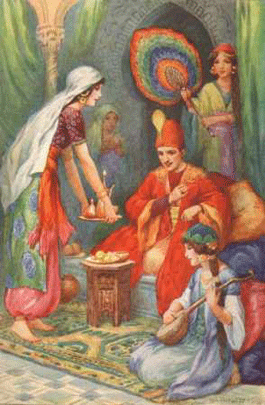
Illustration of Prince Agib by Harry G. Theaker from The Arabian Nights

THE STORY OF PRINCE AGIB

by W. S. Gilbert

STRIKE the concertina’s melancholy string!
Blow the spirit-stirring harp like any thing!
Let the piano’s martial blast
Rouse the Echoes of the Past,
For of Agib, Prince of Tartary, I sing!

Of Agib, who amid Tartaric scenes,
Wrote a lot of ballet-music in his teens
His gentle spirit rolls
In the melody of souls –
Which is pretty, but I don’t know what it means

Of Agib, who could readily, at sight,
Strum a march upon the loud Theodolite :
He would diligently play
On the Zoetrope all day,
And blow the gay Pantechnicon all night.

One winter -I am shaky in my dates-
Came two starving minstrels to his gates,
Oh, Allah be obeyed,
How infernally they played
I remember that they called themselves the” Oiiaits.” Continue reading THE STORY OF PRINCE AGIB

Discovering fashion and identity in Yemen


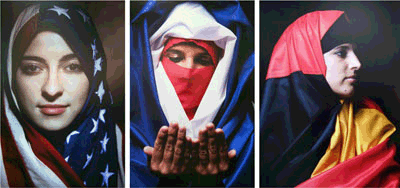
Photographs by Boushra Al-Mutawakel

by Yazeed Kamaldien, Yemen Times, December 16, 2010

A packed crowd swarmed around the Sana’a Styles: Fashion and Identity photo exhibition and artworks event earlier this week, when it opened at the House of Culture on Al-Qasr Street in Sana’a.

Striking photographic essays plastered the venue walls. Large color portraits of Muslim women wearing the hijab, or Islamic headscarf, photos showing women in black veils surrounded by contemporary fashion and snapshots of ordinary Yemenis making a statement with their everyday clothes.

Photographer Sophie Elmenthaler showed a series of photos under the title ‘Hijab and High Heels’. These pictures showed fashion for women that would reveal skin if worn in public, but that Yemeni women would only wear in private. The images included clothes labeled the “cheapest goods from China and India” sold in Sana’a.

A short film showed Yemenis talking about the clothes they wear and what motivates their sense of style. Another series of photos showed women in various uniforms and cultural dress, commenting on how clothes ensured that individuals became part of the communities where they live.

“People with a strong sense of assertiveness accept identities of their social group,” reads the statement from this series of photos. Continue reading Discovering fashion and identity in Yemen

Heroic, Female and Muslim


Dr. Hawa Abdi runs a hospital in Somalia and stands up to extremists there; photograph by Casey Kelbaugh for The New York Times.

By NICHOLAS D. KRISTOF, The New York Times, December 15, 2010

What’s the ugliest side of Islam? Maybe it’s the Somali Muslim militias that engage in atrocities like the execution of a 13-year-old girl named Aisha Ibrahim. Three men raped Aisha, and when she reported the crime she was charged with illicit sex, half-buried in the ground before a crowd of 1,000 and then stoned to death.

That’s the extremist side of Islam that drives Islamophobia in the United States, including Congressional hearings on American Muslims that House Republicans are planning for next year.

But there’s another side of Islam as well, represented by an extraordinary Somali Muslim woman named Dr. Hawa Abdi who has confronted the armed militias. Amazingly, she forced them to back down — and even submit a written apology. Glamour magazine, which named Dr. Hawa a “woman of the year,” got it exactly right when it called her “equal parts Mother Teresa and Rambo.”

Dr. Hawa, a 63-year-old ob-gyn who earned a law degree on the side, is visiting the United States to raise money for her health work back home. A member of Somalia’s elite, she founded a one-room clinic in 1983, but then the Somalian government collapsed, famine struck, and aid groups fled. So today Dr. Hawa is running a 400-bed hospital. Continue reading Heroic, Female and Muslim

A Persian Anatomy Lesson

The National Library of Medicine has a splendid manuscript collection, including an 18th century Persian text with illustrations. Here is the information from the webpage, with two of the illustrations provided here.

Anonymous Persian Anatomical Illustrations. [Iran or Pakistan, ca. 1680-1750].
Anonymous Persian Anatomical Illustrations.

The National Library of Medicine owns approximately 300 Persian and Arabic manuscripts dating from the eleventh to the nineteenth centuries. Most of these manuscripts deal with medieval medicine and science and were written for learned physicians and scientists. Among them are a number of anonymous anatomical treatises or groups of anatomical drawings.

The two featured here consist of a Persian bloodletting figure and a venous figure, probably drawn in the 18th century but based on earlier models (MS P 5 fol. A); and six early-modern anatomical drawings showing some European and Indian influences (MS P 20, item 2).

Six Early Modern Anatomical Illustrations

Six anonymous anatomical drawings occur on folia 554-559 at the end of a volume containing Tibb al-Akbar (Akbar’s Medicine) by Muhammad Akbar, known as Muhammad Arzani (d. 1722/ 1134) in an undated copy probably made in the 18th century. The paper on which these figures are drawn, however, is distinct from that of the main text, though similar in many respects. The illustrations appear to be unrelated to the accompanying text and to draw upon Indian and early-modern sources.

One full-opening of the manuscript, folia 554b-555a, contains two full-figure anatomical illustrations, one of a female and one of a male. Continue reading A Persian Anatomy Lesson