All posts by tabsir
Ben Ali’s Friends …
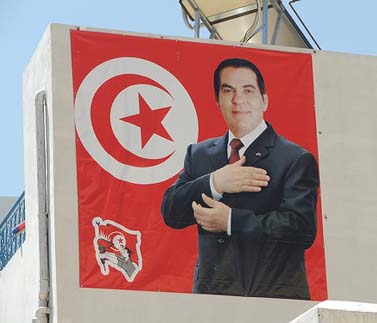
For those wondering how former President Ben Ali found a place of refuge, this Youtube video might help…
A Geography Lesson from 1879: #2: An Enlightened National View of the Others
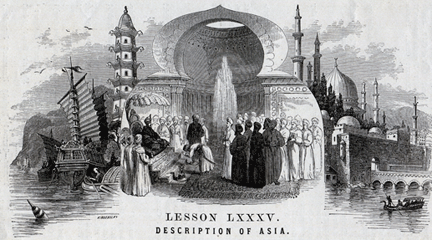
I recently started a thread on a school geography book from 1879. At that time the idea of “civilization†was fixed in a hierarchy. According to Lesson XXI (States of Civilization), there were degrees for separating out the inhabitants of the earth. Here is the sequence, with the student no doubt informed in the classroom that the United States was the most enlightened:
1. Nations, with regard to the degree of their civilization, are divided into five general classes: Savage, Barbarous, Half-civilized, Civilized, and Enlightened Nations.
2. Savages dwell in tribes; they live in caves, dens, or huts, and are chiefly occupied in hunting, fishing, or war.
3. Barbarous Nations live in larger communities than savages, practice some rude arts, attend to the rearing of flocks and herds, and in some cases, till the soil.
4. Half-civilized Nations have organized governments and dwell in cities, occupy themselves in agriculture and mechanic arts, but are without education, refinement, or morality.
5. Civilized Nations are such as have made considerable progress in knowledge and morality, have good governments and generally wise laws.
6. Enlightened Nations are such as hold the highest rank in intelligence, scientific progress, and moral, religious, and social culture.
Excerpt from: Colton’s Common School Geography (New York: Sheldon and Company, 1879), 17.
to be continued
A Geography Lesson from 1879: #1: The Earth is not a Plain
Once upon a time Geography went right along with the three r’s in the school curriculum. I have a copy of the geography text my great, great Aunt Ida used. This was Colton’s Common School Geography illustrated by numerous engravings and twenty-two study maps, drawn expressly for this work, and specially adapted to the wants of the class-room, to which are added two full-paged railroad maps, showing the chief routes of travel, and a complete series of twelve commercial and reference maps of the United States. It was published by Sheldon and Company, located at the time on 8 Murray Street in New York, in 1879.
In 1879, when my discipline of Anthropology was still in academic diapers, Geography was defined as “that branch of science which describes the surface of the earth, the divisions and inhabitants†(p. 3). Apparently back then it was still important to show why we knew the earth was not flat. As the text explains:
We know that the earth is not a plain, because 1. Navigators have sailed around it; 2. The upper portions of objects at a distance, as a ship at sea, are seen before any other part; 3. The shadow of the earth, as seen at the time of an eclipse of the moon, has always the form of a circle or a segment of a circle. (p. 3)
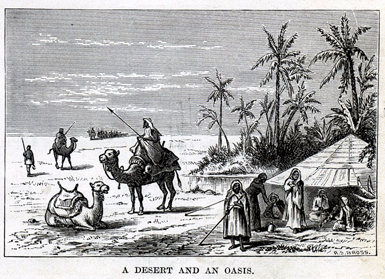
In discussing land divisions some 20 different kinds are listed, including a desert (“a tract of land nearly or quite barrenâ€) and an oasis (“a fertile spot in the desertâ€) with both of these rating an illustration as shown above.
to be continued
Which Terry Jones is Banned in the UK?
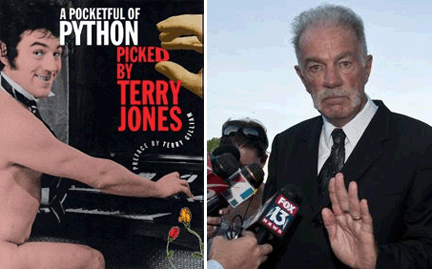
Which of these is the real loonie?
So here is late breaking news from the BBC: Terry Jones is banned from entering the UK. As it happens, of course, there is more than one Terry Jones out there and it is obvious that one of them is a loonie worthy of Monty Python satire. So which one is it? The one on the left or the one on the right (so far right he is off the end of a flat earth)?
The BBC clears up the confusion:
Controversial US pastor Terry Jones has been barred from entering the UK for the public good, the Home Office says.
The pastor, who last year planned a Koran-burning protest in the US, had been invited to address right-wing group England Is Ours in Milton Keynes.
The Home Office said Mr Jones could not enter the UK as the government “opposes extremism in all its forms”.
Mr Jones told BBC Radio 5 live he would challenge the “unfair” decision and his visit could have been “beneficial”. Continue reading Which Terry Jones is Banned in the UK?
Iraqi Voices Project
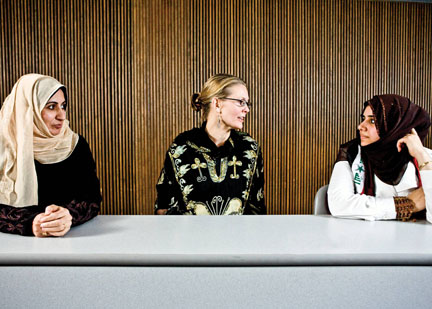
Photo of Khawla Hadi, Kimberly Wedeven Segall and Marwa al-Mtowaq. Iraqi Voices Panel, March 2009; photo by Luke Rutan, Seattle Pacific University.
Iraqi Voices Project: Poetry Workshops, Alternative History, and Community Awareness
by Kimberly Wedeven Segall
The dead . . .
come in shifts . . .
in our dreams . . .
over the houses we left behind.–Dunya Mikhail, The War Works Hard
How can universities work alongside communities to build understanding of the Iraqi refugee crisis? Historically, Iraq as a state was established in 1920, centered on Baghdad, and controlled first by the British and then by Iraqi governments. As the force of the state made demands upon the people, it caused its residents “to rethink existing political identities, values, and interests,†to engage in “strategies of cooperation, subversion, and resistance,†[1] as Charles Tripp argues, and to construct narratives “to understand and to justify their political engagement.†[2]
How do memories challenge the narratives the West has presented on Iraq? How does family memory record and preserve history, after so much history has been destroyed in the post-occupation loss of valuable historical records and objects from Iraq’s museums?
The Iraqi Voices Project, 2008-2009, was designed as a workshop forum. Reading and responding to Iraqi poetry, the workshop created a forum for telling stories of displacement in Iraq and building awareness of the challenges in relocating in Seattle, Washington. Continue reading Iraqi Voices Project
An Adeni Artist
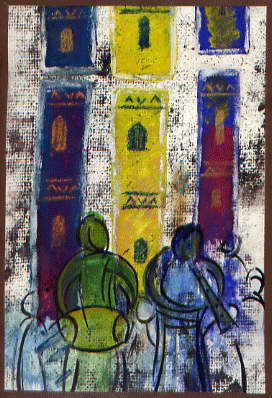
One of my most admired paintings by a Yemeni artist is the painting shown above by the Adeni artist Abdulla al-Ameen. I purchased the painting a decade ago at an exhibition sponsored by Yemen’s Ministry of Culture. Al-Ameen received an M.F.A. in 1984 from the Fine Arts Academy in Moscow. In addition to illustrations in books, he has designed stamps for the Yemeni government. In 1987 he received Kuwait’s “Golden Dhow Medal” for his artistic achievements.
How to Put Out the Fires of Hate
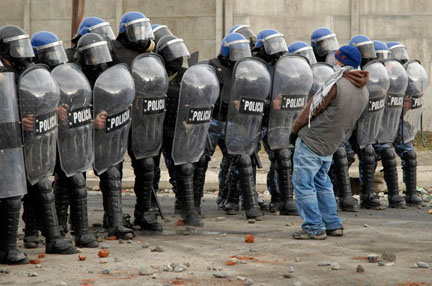
There are times when a picture needs no words. This photograph by Mohamed Kacimi provides such commentary on the current violence in Tunisia and all such dictatorial mentalities.