UCLA Geographers Weren’t Far Off the Mark in Predicting Bin Laden’s Location
By Ben Wieder, Wired Campus, The Chronicle of Higher Education, May 3, 2011
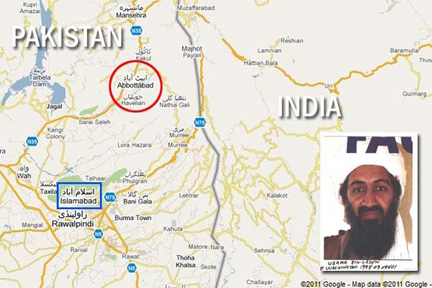
Osama bin Laden’s hiding place in Abbottabad, Pakistan, came as a surprise to many when U.S. forces located and killed the former Al Qaeda leader early Monday. It was less of a surprise to two geographers at the University of California at Los Angeles.
According to ScienceInsider, a geography class taught by Thomas W. Gillespie, an associate professor, and John A. Agnew, a professor, predicted in 2009 that there was an 88.9 percent chance Mr. bin Laden was hiding in a city less than 300 kilometers from Tora Bora, his last known location. That swath of Pakistan would include Abbottabad, Mr. bin Laden’s actual hiding place. Continue reading Geographers and Osama