All posts by tabsir

The World Was His Canvas: The Legacy of M.F. Husain


The World Was His Canvas: The Legacy of M.F. Husain
Remembering “the Picasso of India”

By Bruce B. Lawrence, Religion Dispatches, June 9, 2011

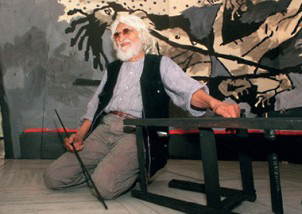
Maqbul Fida Husain, known as M.F. Husain, was India’s most famous, and its most infamous, contemporary painter. Often labeled the Picasso of India, his life and work spanned the 20th century and inched into the 21st. He produced over 30,000 paintings, some of which have sold at auction for over $1.5 million.

I organized a conference to celebrate his 95th birthday in Doha last September. It was titled (as Husain himself had requested) “The World is My Canvas.” Husain came back from London, where he also has a home and studio, but as an active participant, not a mere observer. He talked, he doodled, he joked, he even posed for a group photo.

M.F. Husain remained a dynamic, ceaseless explorer of art, life, and beauty until a couple of weeks before his death in London on Thursday June 9. In 2003, to celebrate his 88th birthday, he produced 88 oils across four Indian cities. “After open-heart surgery they said: ‘take it easy, and only paint miniatures,’” he scoffed, referring to an operation he had in 1988.

Yet controversy embroiled him from the mid-’90s because he loved, and painted from, India. Politically-minded Hindu partisans objected to his portrayal of women. He painted not just women but Hindu goddesses, and he painted them as they have been painted for centuries: unclad. But secular Indian courts allowed advocates for the Hindu right to bring a case against Husain. He was accused of causing harm to the sensibilities of others. He faced not one case but multiple cases, along with vandalism of his art and threats against both himself and those close to him. Soon after his victorious 88th birthday, he moved from India to the Gulf; first to Dubai, and then after 2007 to Doha, the capital of Qatar. Continue reading The World Was His Canvas: The Legacy of M.F. Husain

Israelis and Palestinians: Live Long and Prosper


by Leonard Nimoy, Americans for Peace Now, June, 2011

Dear Friend,

When I was a teenager, I told my dad I wanted to be an actor. In response, he gave me the only piece of advice he ever offered me–“Learn to play the accordion.” And he was serious. He said, “You can always make a living with an accordion.”

Because I ignored his advice, I never found out if he was right. Instead, I’ve lived 80 creative years pursuing acting and photography, and working as a director and poet.

If I had listened to my father, and hadn’t done any of those things, chances are you wouldn’t have recognized my name and you wouldn’t be reading this. Now that you are, I’d like to ask you to consider what I have to say. I reach out to you as someone who is troubled to see the conflict between Israelis and Palestinians continue apparently without an end in sight.

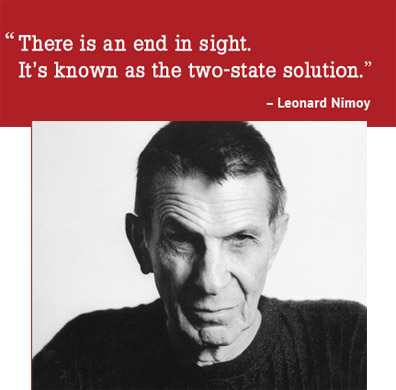
In fact, there is an end in sight. It’s known as the two-state solution–a secure, democratic Israel as the Jewish State alongside an independent Palestinian state. Even Israel’s nationalist Prime Minister Binyamin Netanyahu, has come to see this as the shape of the future. The problem is how to reach that end point. It’s something we should be concerned about–not only as world citizens, but as Americans. Continue reading Israelis and Palestinians: Live Long and Prosper

Quoth the Raven (in Arabic)


Edgar Allen Poe

New Release: Translation of the complete works of Edgar Allen Poe into Arabic

The complete works of the macabre and quintessentially American poet Edgar Allan Poe are now available in Arabic, giving more readers the chance to be chilled

Ahram Online, Thursday, June 2, 2011

Egypt’s National Center for Translation has published the complete works of the American poet, Edgar Allan Poe. It is translated into Arabic by Ghada Al-Halawani and reviewed by the novelist Edward El-Kharrat. This comes as a part of a poetry series supervised by Dr Rania Fathi. The first volume is entitled The Valley of Anxiety.

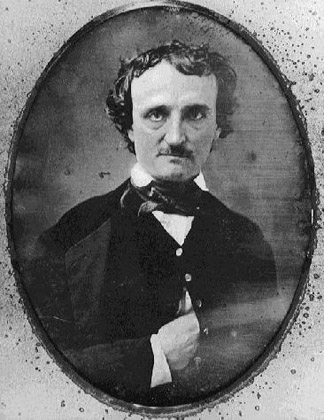
Edgar Allan Poe, born in 1809 in Boston, Massachusetts, the American poet, critic and one of the greatest short story writers is one of the leaders of American Romanticism. His fame came from his macabre stories and poems that sometimes reach into science fiction. He invented the Gothic horror novels or detective literature.

As life imitates art, his death is surrounded by mystery: at the young age of forty he was oddly found wearing clothes that were not his. The cause of his death remains a mystery – as well as the location of his grave. Continue reading Quoth the Raven (in Arabic)

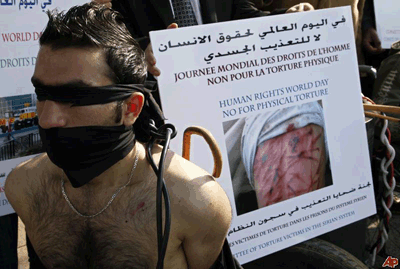
Love in a Time of Torture


A young man’s account of sadistic torture in a Syrian secret prison, and how a girl’s note helped him through his pain.

Hugh Macleod and Annasofie Flamand, Al Jazeera, June 6, 2011

Arrested during a protest in the first days of the Syrian uprising, a young man endured acts of sadism and torture at the hands of Bashar al-Assad’s secret police.

As his body was beaten, whipped, electrocuted and worse; the prisoner could think only of the girl he loves, clenching a note from her in his hand as the torturers did their worst.

Told largely in his own words, this is his remarkable personal story of endurance and hope in a place filled with darkness and despair.

A small piece of paper held tight in a clenched fist. A lifeline to a better place.

Days become nights become days. The kicks, the punches, the questions, the insults, the humiliation and the pain.

“She was always on my mind in the toughest moments during the torture. The only thing that relieved the pain was my belief that, at that moment, she was comfortable in her bed.”

The beatings begun on the police bus driving arrested protesters to one of Syria’s most notorious secret police branches.

“Your mother is a whore!” screamed one of the policemen, as he slammed the butt of his rifle into the prisoner’s face. “We will f*** her and your sister!”

But the young man wasn’t listening.

“In the first five minutes I was only thinking of her. I was so afraid for her. But when the bus drove off I saw her trying to phone somebody, so I was so happy that she’s wasn’t under arrest. I didn’t know then that they arrested her a few minutes later. Continue reading Love in a Time of Torture

Is it civil war yet in Yemen?


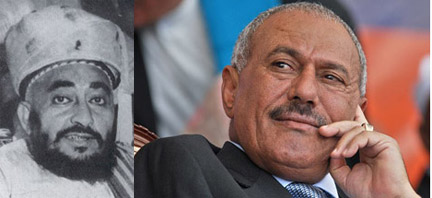
Imam Ahmad, left; Ali Abdullah Salih, right

[Webshaykh’s Note: This is a nice summary of the situation in Yemen just before Salih was wounded and left for Saudi Arabia.]

An avoidable civil war in Yemen that has already begun

by Brian O’Neill, The National, June 5, 2011

The scenes coming to us out of Yemen appear as raw and bloody chaos: running gun-battles through the streets, protesters screaming fiercely and the president, Ali Abdullah Saleh, apparently wounded in a mortar attack at the weekend (and rumoured to be headed to Saudi Arabia for treatment).

But while it looks like madness, the falling apart of Yemen is deeply rooted in the inexorable logic of its own history, the personalities of the major players and a looming generational shift. While civil war is not inevitable, circumstances have made it likely, and it may be too late to prevent the country from violently tearing apart its own seams.

Probably the biggest question swirling around the fighting is why? Not why is President Saleh clinging to power, but why has he established a series of feints and dodges that would appear to propel unrest rather than restore stability?

For instance, why did the president offer to sign a GCC-sponsored transfer of power, only to back away multiple times? If he had no intention of signing, why even bother with the pretence?

The answer to these questions is one of the keys to understanding why Yemen is where it is.

Mr Saleh has ruled parts or all of Yemen for over 30 years. But even the “all” in that sentence is misleading. Mr Saleh has never ruled all of Yemen, even if he has arguably the longest reach in his country’s ancient history. Yemen is governed by negotiation and appeasement, by the carrot and the stick, by squeezing one party while massaging the other.

Rule in Yemen is very personal; the president, like the Imam before him, is intimately involved in tribal politics – a game of swirling alliances. Continue reading Is it civil war yet in Yemen?

How appalling, Mr. Naipaul


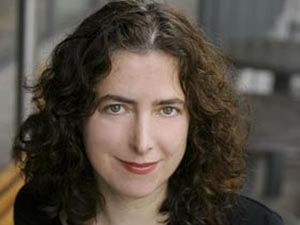
Diana Abu-Jaber is the author of five award-winning books, including the forthcoming novel Birds of Paradise

From One Writer To Another: Shut Up, V.S. Naipaul

by Diana Abu-Jaber, NPR, June 3, 2011

Dear V.S. Naipaul:

You recently remarked, “I read a piece of writing and within a paragraph or two I know whether it is by a woman or not. I think [it is] unequal to me.”

I was sad to read this, to realize that you’re apparently unable to think beyond schoolyard rankings and peevish comparisons, that you’re incapable of recognizing grace and power from unexpected and unfamiliar places, such as a woman’s experience.

But what worries me more is your comment that that women write with “sentimentality, the narrow view of the world,” because, “inevitably for a woman, she is not a complete master of a house, so that comes over in her writing too.”

Your use of the word “master,” is chilling. Continue reading How appalling, Mr. Naipaul