All posts by tabsir

Lane’s Lexicon Online

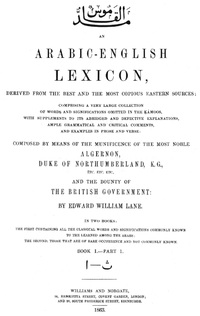
The indispensable, even though incomplete, Arabic-English lexicon of Edward Lane is available several places online. You can download online here. Or check out http://www.tyndalearchive.com/tabs/lane/ and http://www.studyquran.co.uk/LLhome.htm

I find it unfortunate that this Victorian era lexicon, valuable as it is, has never been completed in English. Many of the meanings that Lane provides are somewhat archaic and he is also quite arbitrary in what he chooses to record. So it is always advisable to use his text more as an index and then go to Lisan al-Arab, Taj al-Arus or one of his other important sources to see what the original says. The French variant by Kazimirski is also 19th century but at least is complete. Lisan al-Arab and several other lexicons are available and searchable online at http://www.baheth.info/ There are also several earlier Arabic-English lexicons available in pdf at archive.org. But the mother of all Arabic dictionaries, al-Zabidi’s Taj al-Arus is available either online or in pdf for the valuable Kuwait edition at http://www.archive.org/details/alhelawy09

Tea break


“Tea, made up from the blossoms of this fragrant tree [Linden] serves as an alternative to the caffeinated regular stuff. It’s supposed to be good for you, especially if you’re sick. Here, at this fancy cafe near Istiklal, it is served up in style.” Photo by Deniz.

Looking daily at the news about the Middle East has become frustrating because there is simply too much to digest. Take today, for example. Will more Copts be killed in riots in Egypt? Is Salih leaving Yemen or not? What about the young protester shot in Bahrain? Will Qaddafi be found in a bunker in Sirte? How many Syrians were arrested and will never be seen again? Is Palestine really going to be a state? And Tunis? Iran? And I have yet to mention Iraq, not to mention Afghanistan or Pakistan. There are times when it is nice to sit down with a calming cup of tea. The photo above is from a splendid website by the Turkish photographer Deniz. Enjoy.

Letter from Islah to Tawakkul Karman


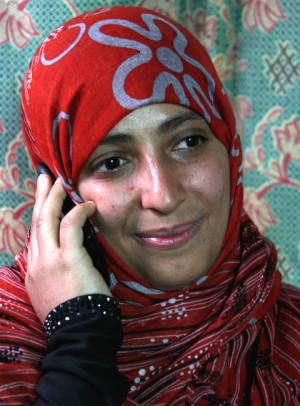
Tawakkul Karman

Yesterday I wondered how the Yemeni party Islah would respond to the Nobel Prize being given to one of its members. Here is the official letter, congratulating her, sent to Karman from Muhammad Abdullah al-Yadumi,

بسم الله الرحمن الرحيم

الأخت المناضلة / توكل عبدالسلام كرمان

رئيس منظمة صحفيات بلا قيود, عضو مجلس شورى التجمع اليمني للإصلاح

تحية وتقدير وبعد :

بكل ابتهاج تلقينا في التجمع اليمني للإصلاح إعلان فوزكم بجائزة نوبل للسلام كأول امرأة عربية تحظى بهذا التكريم وأول شخصية يمنية تمنح هذه الثقة الدولية الهامة.

إننا ونحن نهنئكم بهذا الإنجاز التاريخي نعتبر هذا الفوز مكسبا للثورة اليمنية السلمية وللمرأة اليمنية المناضلة والواعية القادرة على صنع النجاح رغم عوائق التخلف وموروثات الإستبداد التي حالت بين شعبنا وبين الإبداع لعقود من الزمن.

كما أن تكريمكم اليوم بجائزة نوبل للسلام يعد تتويجا مستحقا لجهود سنوات من نضالكم السلمي الدؤوب وكفاحكم المرير ضد منظومة الجهل والظلم والفساد في مختلف الميادين الإعلامية والحقوقية والسياسية ونصرة المظلومين وغيرها من المجالات وصولاً إلى العمل الثوري السلمي الذي مازال شعبنا برجاله ونسائه وشبابه وشيوخه يخوضه دون استكانة أو لين حتى يتحقق له ما يصبو إليه من حرية وكرامة وعدالة وحكم رشيد .

كما أننا نرى في هذا التكريم شهادة أممية على حضارية شعبنا اليمني وعدالة مطالبه وسلامة نهجه السلمي في التغيير، متمنين في هذا السياق ان يرافق هذا الإعتراف من المجتمع المدني الدولي بعدالة المطالب اليمنية إعتراف سياسي دولي بهذه المطالب وان يسارع العالم بأسره الى الوقوف مع الشعب اليمني التواق للحرية والتغيير.

نكرر تهانينا الصادقة لكم ولكل ذوي المبادرات الرائدة في وطننا الحبيب ، مع تمنياتنا لكم بالتوفيق والنجاح ومزيداً من العطاء.

والسلام عليكم ورحمة الله وبركاته،،

أخوكم /

محمد بن عبدالله اليدومي

رئيس الهيئة العليا للتجمع اليمني للإصلاح

Walter Dostal (1928-2011)


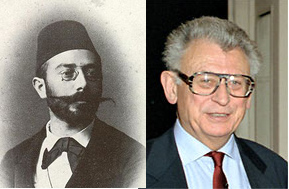
Eduard Glaser (1855-1908), left; Walter Dostal (1928-2011), right

[In early August the academic community lost one of the pioneers of ethnographic study on the Arabian Peninsula, the distinguished Austrian scholar Walter Dostal. Here is the obituary from the Austrian Academy of Sciences website.]

With Walter Dostal’s passing away in Vienna on August 6th/7th 2011, the anthropological communities in Austria, Central Europe and the German-speaking countries lose one of their best-known representatives shaping the field throughout the latter quarter of the 20th century.
Dostal was best known for his ethnographic studies of Arabian and Middle Eastern societies, but he also contributed substantially to anthropological theory – with particular emphasis on the interplay between environment, society, and history. As a leading expert for the Arab peninsula at this Academy, Dostal continued a remarkable research record into the early 21st century which at the Academy of Sciences goes back to the late 19th century.

Dostal had belonged to the first generation of anthropology students trained after the second world war, and his scholarly work was committed to build a new and internationally oriented foundation for the discipline once called “Völkerkunde” in the German-speaking countries after 1945. Born on May 15th 1928 in Grulich near Brno (today: Czech Republic), Dostal and his family moved at the end of the war to Vienna where he began his studies in anthropology. His critical engagement with the so-called “Culture Circles” theory led him to reject any speculative historical models, and to appreciate the empirical archaeological and textual evidence. Formative influences during those early years of his career were Robert Heine-Geldern (a corresponding member of the AAS) and Joseph Henninger. After his dissertation on Semitic-speaking peoples he began a first sequence of ethnographic fieldwork in the Arab peninsula, which he combined with international research sojourns in Frankfurt and Rome, and his first position as Curator for the Middle Eastern section at Vienna’s Ethnology Museum. Continue reading Walter Dostal (1928-2011)

Tabsir Redux: Hillbilly Heaven and Muslim Paradise

There is an old Tex Ritter song where he imagines going to heaven and hearing the roll call of future Country Western singers. It goes like this:

I met all the stars in hillbilly heaven
Oh what a star-studded night

Then I asked him who else do you expect in the next, uh, say a hundred years? He handed me a large book covered with star dust. Will called it the Big Tally Book. In it were many names and each name was branded in pure gold. I began to read some of them as I turned the pages: Red Foley, Ernest Tubb, Gene Autry, Roy Acuff, Eddy Arnold, Tennessee Ernie, Jimmy Dean, Andy Griffith, Roy Rogers, Kareem Salama
Whaaaatttt???
Kareem Salama? Oh, well, that’s when I woke up, and I’m sorry I did, because
I dreamed I was there in hillbilly heaven
Oh what a beautiful sight…

OK, so the original lyrics did not include Kareem Salama, but if Dolly Parton can rearrange the song, why can’t I? So who is Kareem Salama, you ask? Continue reading Tabsir Redux: Hillbilly Heaven and Muslim Paradise

US drone killing of Anwar al-Awlaki reinforces terrorists


by Maajid Nawaz, The Guardian, October 1, 2011

As Anwar al-Awlaki became the first individual to be summarily executed by his own government in the “war on terror” on Friday, we are reminded of the dark side in this relentless pursuit for security.

Awlaki was an evil man who preached against humanity. As a counter-extremism adviser, I dedicate all my energies to discrediting his ilk. I am under no illusion of the danger that he posed. I live with such danger every day, through my work. Awlaki’s desire to arbitrarily kill, deny rights and bypass due process is what made him evil. In summarily executing him in this way, the US has just called the kettle black.

Just as achieving liberty takes years of bloody struggle, its violation is rarely brought about overnight. Arbitrary detention, extraordinary rendition, targeted killings and “enhanced interrogation” – otherwise known as torture – are but some of the measures that have slowly been re-introduced into human practice by the US. Now, add to that list the summary execution of a citizen. Continue reading US drone killing of Anwar al-Awlaki reinforces terrorists

Somalia’s Famine


Severely malnourished child from southern Somalia sits in Banadir hospital… (Farah Abdi Warsameh/AP)

A Diplomatic Surge to Stop Somalia’s Famine

By Ken Menkhaus, Enough Project, September 21, 2011

[Ken Menkhaus is a professor of political science at Davidson College and a specialist on
Somalia and the Horn of Africa. He worked on famine response policy in Somalia in 1991
and served as a political advisor in the U.N. Operation in Somalia in 1993-94. He is author of
over 50 monographs, chapters, and articles on Somalia and the Horn of Africa, and has testified
five times before congressional committees on aspects of the Somali crisis.]

Somalia is dying. Three-quarters of a million people are at immediate risk of famine;
another 750,000 are refugees in neighboring countries, and 4 million – half the total
population – is in need of emergency aid. It is a calamity that could join the ranks of the
Rwanda genocide and the Darfur crisis in terms of scale and human suffering. And for
Somalia it is a terrible repeat of the 1991-92 famine that claimed 240,000 lives.

The international response to date has been shockingly inadequate – not just because
funds for humanitarian aid have fallen short, but because of the absence of political will
to take bold diplomatic action to remove impediments to the delivery of aid.

Unless this changes, the 2011 Somali famine will be to the Obama administration what
the 1994 Rwandan genocide was to the Clinton administration – a terrible stain, an
unforgiveable instance of lack of political will to push policy beyond incrementalism.
And for the Islamic world, al-Shabaab’s role in the Somali famine will be remembered as
the Islamic Khmer Rouge, in which an armed group with a deeply twisted interpretation
of the faith presides over the mass deaths of its own people. Continue reading Somalia’s Famine