All posts by tabsir

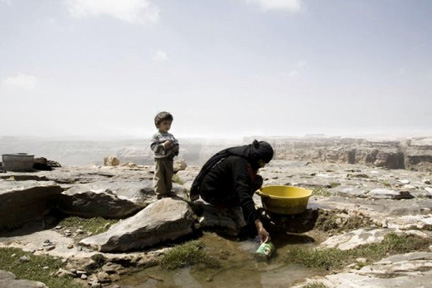
When Yemeni springs stop flowing…


غيول» اليمن تموت استنزافاً

عمر الحيان
المصدر أونلاين – الحياة

January 5, 2012

تعدّ الأنهار، أو الغيول كما يسميها اليمنيون، الشرايين الحيوية للموارد المائية في اليمن، فأرض اليمن هبة الغيول، مثلما مصر هبة النيل. ومنذ آلاف السنين اعتمدت الحضارات اليمنية المتعاقبة على جريان الغيول في الأودية، وعلى ضفافها شيّد الإنسان اليمني حضارته وأقام جنات سبأ ومعين.

ومقارنة بشبه الجزيرة العربية، أضفت الطبيعة الجبلية وكمية المتساقطات والمدرجات الخضراء طوال العام جمالاً وغنى على اليمن، ما جعل الأوروبيين يطلقون عليها لقب الأرض السعيدة. لكن الوضع اليوم مختلف، إذ تربض العاصمة صنعاء فوق حوضها المائي المهدد بالنضوب سنة 2025، وفقاً لدراسة أجراها مشروع إدارة حوض صنعاء، لتصبح أول عاصمة في العالم بلا مياه ربما بحلول سنة 2017.

مدينة صنعاء، الواقعة على ارتفاع 2150 متراً فوق سطح البحر، والمتربعة على قاع منبسط تحيط به الجبال من كل الجهات، كانت قبل أربعين عاماً منبعاً للغيول التي يعتمد عليها السكان في الشرب والزراعة، ولعلّ أشهرها الغيل الأسود الذي ينبع من شمال صنعاء.

تغيّرت ملامح المدينة، واندثرت الأراضي الزراعية تحت مباني الأسمنت المتمددة في كل الاتجاهات، مع ارتفاع عدد سكانها إلى نحو مليون وخمسمائة ألف نسمة، يعتمدون على الآبار الجوفية للحصول على مياه للشرب وللأعمال الإنشائية والصناعية والزراعية. وقد أصبح في سجلات أمانة العاصمة نحو 16 ألف بئر، بعمق بات يتجاوز 1000 متر.

يحكي الحاج حسين علي، من أهالي صنعاء، أنها كانت تعتمد على الغيول والآبار اليدوية التي لا يتجاوز عمقها عشرة أمتار. ويشرح بحسرة كيف جفت آبار صنعاء القديمة بعد «مشروع السائلة»، الذي رصف مجرى السيول وسط العاصمة.

Continue reading When Yemeni springs stop flowing…

Tabsir Redux: With Kitto Illustrating Bible History

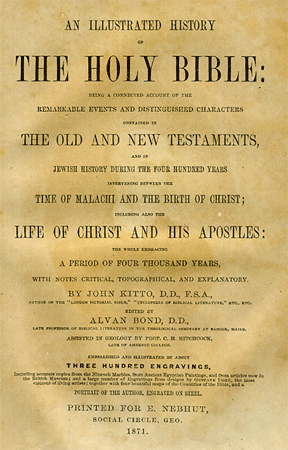
As a child I spent many inquisitive hours leafing through the books in my grandmother’s parlor bookcase. One that especially attracted my attention was John Kitto’s An Illustrated History of the Holy Bible (Social Circle, Georgia: E. Nebhut, 1871). Rev. John Kitto, recognized on the title page as author of the London Pictorial Bible, the Cyclopedia of Biblical Literature, ETC, ETC, retells the entire history of the Old and New Testament, from creation to the destruction of Jerusalem. Kitto was born into poverty in 1804 in Plymouth, England and due to an unfortunate accident ate age thirteen became entirely deaf and was forced into the poor house at the age of fifteen. This is quite an inauspicious beginning for a waif who went on to be a respected theological scholar. Through the local humanitarian efforts of several men in Plymouth, Kitto became a lay missionary to Malta and then for three and a half years in Baghdad. “While residing in that city,” writes Alvan Bond in the preface to Kitto’s book, Cairo “was visited by the plague, the terrific ravages of which swept off more than one-half the inhabitants in two months. Amidst this fearful desolation he remained calm and active at his post.” Once back in England he married and produced a travel account and several pictorial histories of the Holy Land. In 1844 the University of Giessen conferred upon him the degree of D.D. His ill health forced him to seek help in the spas of Germany, where he died after a mere half century in 1854. Continue reading Tabsir Redux: With Kitto Illustrating Bible History

Traveling with Ibn Battuta


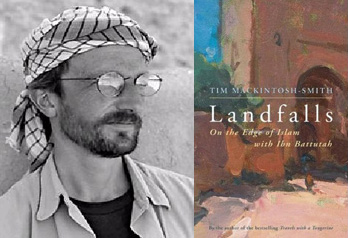
Tim, left; book, right

The superb travelsmith Tim MacIntosh-Smith has recently published the third volume of his fascinating trip in the footsteps and sailing lanes of the 14th century traveler Ibn Battuta. The book is called Landfalls: On the Edge of Islam with Ibn Battutah and is available in paperback or hardback. If you are looking for new year reading, here is a worthy volume to start with.

Here are some of the accolades:

‘The long-awaited and dazzling conclusion to the Tim Mackintosh-Smith trilogy . . . Again and again, this takes us into fascinating territory: into the company of dervish masters, soothsayers and magicians; towards the old rites of blood sacrifice, with demon ships of the Sea God blazing on the surface of the Indian Ocean; or on a quixotic hunt for a sacred musical instrument possessed by a royal dynasty of African kings. At such times, [Tim and Ibn Battutah] are united in a glow of wonder.’ Barnaby Rogerson, Country Life

‘Landfalls is a beautifully written account of Islamic life and culture in the 21st century . . . [and] a joyous celebration of cultural diversity. Just as Ibn Battutah did 700 years ago, Mackintosh-Smith helps make the alien familiar to his readers.’ Ian Critchley, Sunday Times Continue reading Traveling with Ibn Battuta

Tabsir Redux: Resolving the New Year


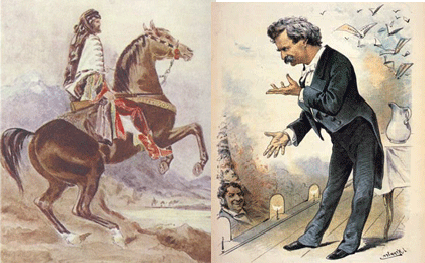
Wilfrid Scawn Blunt, left; Mark Twain, right

There is a curious annual custom inherited in many of our families, but one I am resolved not to take too seriously this year. I refer to the half-drunk notion of making resolutions for the new year (which I see no sound reason to capitalize, as my German blood is very far removed), as though the arbitrary turning of the calendar is a time to reflect on what went wrong over the last 365 days and pretend that things should go better in the next eighteen and a quarter score days. I have heard the rural urban tale that the pin-up 19th century cowgirl sharpshooter Annie Oakley started the custom of sending out Christmas Cards, but I am not sure which genius came up with penning new year’s resolutions, unless it was Johnny Walker in one of his more sober moments. Most people, and I surely fall into this anomalous category, do not remember the resolutions made a year ago. But then most godfearing redneck Americans could not repeat the 10 Commandments in order to save their souls, unless perhaps they were dead drunk. So my re-solution, since it is the defacto one I have been following for quite a few years, is to resolve to forget any resolution before I even make one. This saves me from having to make up a resolution, which is the same as making as silly a resolution as I can imagine.

I am not the first person to take aim at this impotent cultural pastime which has long since ceased to have any influence on what people really do. Mark Twain said it well over a century and a half ago:

New Year’s Day–Now is the accepted time to make your regular annual good resolutions. Next week you can begin paving hell with them as usual. Continue reading Tabsir Redux: Resolving the New Year

Muslim Hadramis in “Christian Ethiopia”


Muslim Hadramis in “Christian Ethiopia”: Reflections on Boundary Making Processes

by Samson A. Bezabeh, Bergen University

[Note: This is the Introduction to a recent article on the Hadrami experience in Ethiopia. The full article can be downloaded from the Journal of Muslim Minority Affairs.]

Introduction

Throughout recorded history sporadic population migration from Arabia to East Africa and Ethiopia has been a noted phenomenon. In the modern era Hadramis started to migrate and settle in Ethiopia at the end of the nineteenth century and the beginning of the twentieth century. Thus, by the beginning of the twentieth century, Ethiopia hosted a number of Arab families who were mainly Yemeni or Hadrami by origin. Although the exact population of the Hadramis at that time is not known, various statistical estimates and narrations, including narration of present day Hadrami families indicate that their number was substantial. This is particularly true in the case of major Ethiopian towns and trading centres such as Harar, Jimma and Asmara.

Despite their pronounced presence, however, their numbers, declined during the second half of the twentieth century as a result of negative factors that have forced them to leave the country. One such factor was the movement of pan-Arab nationalism which gained momentum in the 1960s. To be more specific, in 1969 Hadramis were expelled from Ethiopia for “supporting” the Eritrean Liberation Front (ELF), whom Arab nations, particularly Syrians and Egyptians, were supporting for fulfilling their goal of creating a united Arab land which in their vision also included the highlands of northern Ethiopia. In this scenario, Hadramis along with other Arabs were accused by the Haile Selassie regime4 in Ethiopia of sympathizing with the Arab backers of the Eritrean Liberation Front (ELF), and hence undermining Ethiopian unity. This has led many Hadrami families to voluntarily and involuntarily relocate themselves to Yemen and to oil reach countries in the Gulf such as Saudi Arabia. Continue reading Muslim Hadramis in “Christian Ethiopia”

The Zaydi manuscripts of Northern Yemen


Qu’ran manuscript in Western Library of the Great Mosque, Sanaa

by Arie Amaya-Akkermans, bikyamasr, 13 December 13, 2011

In recent articles on Bikyamasr.com, it was reported at length on the diversity of cultural sites, part of Yemen’s vast cultural heritage, that were threatened with neglect and destruction, partly because of the inability of the Yemeni authorities to preserve them and partly because of the state of unrest caused by the Yemeni uprising – namely the ancient cities of Sana’a, Shibam and Zabid, in which thousands of years of rich history are likely to become yet another casualty in Yemen’s struggle for freedom from the 33-years old dictatorial rule of Ali Abdullah Saleh.

It is fortunate however that these three ancient cities are considered UNESCO world heritage sites, due to the fact that they have received attention from international organizations – most prominently the government of Germany – and some degree of action has been taken in order to minimize the damage, or at least, that was the case until the beginning of the Yemeni uprising. The extent of the real damage done to the sites in the course of 2011 remains yet to be properly assessed in a post-revolutionary scenario.

More unfortunate is the fate not only of other sites but of something much more intangible but equally valuable: The rich intellectual Islamic heritage of the country embodied in over 50000 manuscripts held in many libraries and private holdings. The astounding numbers and the nature of the manuscripts make Yemen one of the most important archival collections in the world, easily rivaling similar holdings of Islamic manuscripts in the national libraries of Cairo, Istanbul and Teheran. Continue reading The Zaydi manuscripts of Northern Yemen

The Islamic World’s Nude Spring


Aliaa Mahdy

by Joseph Mayton, bikyamasr, December 6, 2011

Egypt’s revolution has stalled. Islamists have taken the lion’s share of the first round of voting. In Tunisia and Morocco, large gains by the Islamists have seen women begin to question their future in conservative societies. Aliaa Mahdy changed the global perspective on how women are viewed in the Arab world, when she posted in November a full-frontal nude photo of herself on her blog.

The posting of her naked body left Egyptians and Arabs angry. Hate and condemnation quickly followed. Ironically, despite all the hatred purported in her direction, millions of people logged onto her blog to see her picture, with even lewd comments being posted.

For Mahdy, it was a symbolic protest against the status of women in Egypt and across the Arab world. She said enough to the centuries of male-domination meted out to women in the country and the region. It was the beginning of the Islamic world’s “Nude Spring” and launched a debate over women’s rights, or rather, “what is appropriate for women.” Continue reading The Islamic World’s Nude Spring