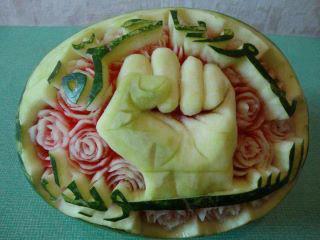
So many scenes of tanks and blood-soaked Syrian bodies, although there seem to be few good Samaritans willing to stop and heal the wounds. But there is also art, the spirit of which bullets can never penetrate …
So many scenes of tanks and blood-soaked Syrian bodies, although there seem to be few good Samaritans willing to stop and heal the wounds. But there is also art, the spirit of which bullets can never penetrate …
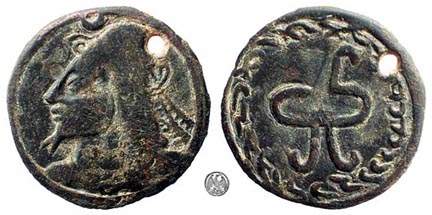
Sogdiana, Chach 3rd century
The Middle Eastern and Central Asian Studies program at Hofstra announces
the Fourth Seminar on Central Asian and Middle Eastern Numismatics in Memoriam Boris Kochnev
Hofstra University, Breslin Hall 217, March 17, 2012
(Directions to Hofstra)
Attendance is free and all are welcome.
11:00 am
Daniel Varisco (Hofstra University)
Opening Remarks
11:15 am
Vladimir Belyaev (Zeno.ru, Sankt-Petersburg) and Aleksandr Naymark (Hofstra University)
Ancient Sogdian Coins from the Center of Kashka-darya Valley
12:00 noon
Stefan Heidemann (Hamburg University)
A Hoard from the Time of the Collapse of the Sasanian Empire
12:45 pm Lunch Break
1:30 pm
Michael Bates (American Numismatic Society, New York )
How Ziyad Made a Name for Himself:
Coins and the Chronology of Ziyad ‘son of his father’/’son of Abi Sufyan’ Continue reading Numismatics at Hofstra

The leading right-wingers in America view Israel as a kind of political football made out of seven million residents, a football that can be kicked at the wall over and over.
By Boaz Gaon, Haaretz, March 7, 2011
I, Boaz Gaon, being of sound mind and body, hereby offer myself for sale to AIPAC. Should the committee decline, I offer the opportunity to Sheldon Adelson. In any event, I offer my internal organs for free, as a confidence-building gesture, to leading right-wingers in America – to all those who view Israel as a kind of political football made out of seven million residents, a football that can be kicked at the wall over and over. After all, we Israelis don’t feel any pain, and we know that our destiny is to be tossed around like a ball in some exclusive gym by Republican lobbyists, before they head off to the sauna and then cocktails.
I’m offering myself for sale even though I was warned by my lawyer that this is an irreversible step, and that in all likelihood I’ll find myself at Israel Hayom newspaper’s next conference, and/or at the next reunion of White House veterans who worked for George W. Bush – persons who are partners of the Israeli right (Daniel Pipes, Elliot Abrams ) – naked and trussed up, with an apple stuffed in my mouth and served on a silver platter that has a likeness of Irving Moskowitz inscribed on it.
I’m doing this because I can read the writing on the wall. Continue reading AIPAC, buy me!

HBO is rebroadcasting the documentary “Saving Face” today (8:45 am) about the attacks in Pakistan on women. It will also be available in their on-demand service.
Every year in Pakistan, many people – the majority of them women – are known to be victimized by brutal acid attacks, while numerous other cases go unreported. With little or no access to reconstructive surgery, survivors are physically and emotionally scarred, and many reported assailants, typically a husband or someone else close to the victim, are let go with minimal punishment from the state.
This year’s Oscar winner for Best Documentary Short, SAVING FACE chronicles the arduous attempts of acid-attack survivors Zakia and Rukhsana to bring their assailants to justice, and follows the charitable work of Dr. Mohammad Jawad, a plastic surgeon who strives to help them go beyond this horrific act and move on with their lives. Directed by Oscar and Emmy nominee Daniel Junge and Emmy-winning Pakistani director Sharmeen Obaid-Chinoy, SAVING FACE debuts THURSDAY, MARCH 8 (8:30-9:15 p.m. ET/PT), exclusively on HBO.
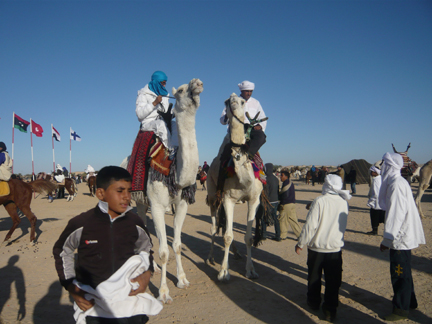
Mahri camels at the International Festival of the Sahara in Douz, Tunisia,
December 24, 2012. Photo by Sam Liebhaber.
by Sam Liebhaber
One of the long-standing myths of Berber ancestry places their origins in Yemen from whence they were dispatched to North Africa in the service of ancient Ḥimyarite kings. Although this chapter in the mythological prehistory of the Arab world can be refuted on the grounds that the Berber are indisputably indigenous to North Africa, the offhand dismissal of the South Arabian-Berber imaginary overlooks an important sociolinguistic kinship between the Berber of North Africa and one of the last indigenous linguistic communities of the Arabian Peninsula: the Mahra of Yemen and Oman.
A number of socio-cultural parallels distinguish the Berber and Mahra from the other minority language communities of the Middle East. For one, the Mahra and Berber are members of the Islamic ʾummah, unlike many of the other minority language communities of the Arab world where linguistic boundaries are frequently coterminous with religious divisions. Further, the Berber and the Mahra did not inherit a written tradition that includes religious and literary texts. As a consequence, the Mahri and Berber languages are frequently consigned to the category of “lahja,†an Arabic term that signifies any non-prestigious, vernacular idiom that lacks of historical or social value.
Without their own written history or affiliation to a prestigious, non-Arab civilization, the Mahra and Berber are more easily “willed†into historical narratives of “Arabness†(Ê¿urÅ«ba) than the other language minority communities of the Arab world. This motif is the mainstay of modern Arabic scholarship on Berber and Mahri genealogical and language origins. A sample of a few recent titles demonstrates this point: The Berber: Ancient Arabs (al-Barbar: Ê¿Arab qudÄmÄ, al-Ê¿ArbÄwÄ«, Tunis: 2000), The Arabness of the Berber: The Hidden Truth (Ê¿UrÅ«bat al-Barbar: al-ḤaqÄ«qa al-MaghmÅ«ra, MÄdÅ«n, Damascus: 1992), Comprehension of Arabic and the Secret of the Mahri Language (Fiqh al-Ê¿Arabiyya wa-sirr al-lugha al-mahriyya, al-Ways, Sana’a: 2004) and Ancient Arabic and its Dialects (ie, Mahri, al-Ê¿Arabiyya al-qadÄ«ma wa-lahajÄtuhÄ, MÄrÄ«kh, Abu Dhabi: 2000).
Even if contemporary scholarship on Mahri and Berber origins is problematic, it is conceivable that historical intersections between the Berber and the Mahra gave medieval Arab historians a justifiable basis to propose their common ancestry. Continue reading South Arabia and the Berber Imaginary
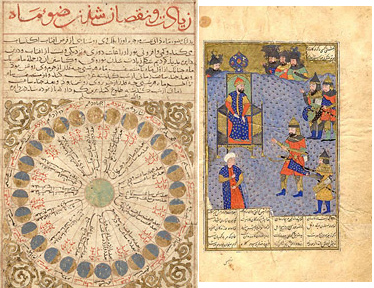
left, Illustration of the phases of the Moon (Or. 133, Golius collection) ;right, Firdawsi, Shahnama (15th century, Or. 494)
There are thousands of Middle Eastern manuscripts preserved in European libraries. One of the famous collections is that of Leiden University. Imagine if those were available online? It would be a dream come true for budding scholars and the old guard alike. A dream, indeed. Leiden University has joined with Brill to provide this collection online, but at a cost. The price posted is a mere (I mean only an emir can afford it) $25,900. I suspect it will take only a few sales to recoup the costs of onlining the manuscripts (and perhaps onlining the profits of both the Leiden libraries (a worthy cause) and Brill (a publisher that already charges so much that few can afford their books). Actually, it may be cheaper to matriculate at Leiden University, since university members have free access.
For those who are interested (either to lament or to have lots of money and little to do with it), here are the details:
Continue reading The Cost of Orientalism
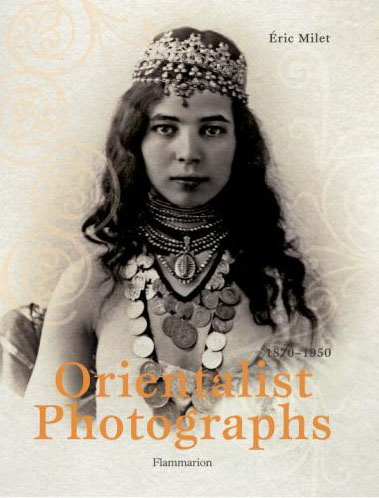
Cover of Milet’s book
In the Islamic Arts Museum in Qatar last December I bought a copy of a fascinating book of Orientalist Photographs by Éric Milet, who has worked as a tourist guide in Morocco for a number of years. The photographs, from both the 19th and 20th centuries, are accompanied by short vignettes. As Milet notes, “The ‘Oriental’ Maghreb was born in the darkrooms of Western photographers. A land of contrasts, revealed to the public at large by men and women who were delighted to have crossed to the ‘other side’ in their own lifetimes, constantly evoking the delights of this earthly paradise.” The book is well worth owning, not only to decorate your coffee table, but for easy, entertaining and informative reading.
As the author Malek Alloula has written, in his The Colonial Harem (1988), the ‘Oriental’ created by the photographer became “the oriental’ for the general public. The photographic lens is portrayed by Alloula as the structural enemy of the veil; capturing the image thus sought the removal of the veil and exposure of the female body as a voyeuristic object. Of course, the photographers who paid prostitutes to pose as “typical scenes” in the Maghreb were not the prudish Orientalist scholars, who would often render sexual argot in pseudo-scientific Latin (perhaps assuming that Victorian ladies did not know their Latin or at least that kind of vulgar Latin). But in the case of Milet’s book, the cover is a modern-day coverup that allows it to be sold in the likes of a bookstore of an Islamic Museum. The picture chosen for the cover has been altered so that the bare breast exposed by the photographer in this exquisite 1910 image (shown below) is lost in an arabesque and nipple-less swirl.
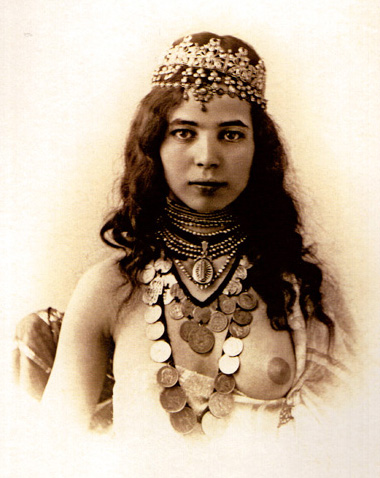
“Young Woman in Arab Costume, Algeria, 1910
The objectification of the female body, as shown by Alloula and many others, reinforced the image of the exotic and erotic harem girl open to the gaze of the European voyeur. True enough, although photographers of the time would expose the female body no matter what the nationality. Artistic nudes graced the major museums and were admired; the emerging visual realm of photographs quickly elided the erotic into the pornographic. But in the case of Milet’s book, undoubtedly due to the publisher rather than the author, there is a reversal, a kind of commercially smart prudery that removes the apparently offending body part, even though in so doing the very exposure for which such Orientalist photographs are critiqued is erased. It is not unlike sanitizing the Arabian Nights as children’s fairy tales.
In this case I am not suggesting we judge a book by its cover, but that we allow ourselves to be seduced into opening the book to see the range of images, some clearly bordering on the exploitative and others evincing a sensitivity usually reserved for poets.
Daniel Martin Varisco
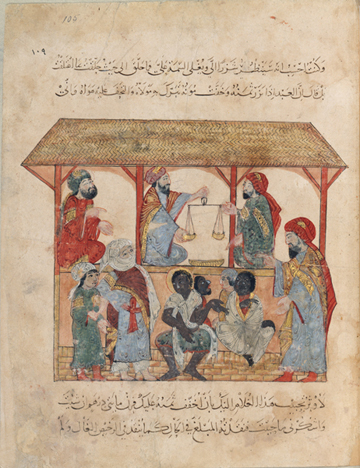
Slave Market in Yemen, 1237
Al-Maqamat, folio 105. Author: al-QÄsim ibn AlÄ« al HarÄ«rÄ« al-BasrÄ«. Illuminator: Yahya ben Mahmud al-Wasiti. Bibliothèque nationale de France. 021, an enslaved Ethiopian, Najah, seized power in the city of Zabid. This image represents the slave market at Zabid—at the time the capital of Yemen—in 1237. The illustration is part of “Al-Maqamat†(Assemblies), a genre of rhymed prose narrative. Both the author and the illuminator of this work were born in Iraq.
The Schomburg Center for Research in Black Culture has posted online a very nice exhibition on the African diaspora in the Indian Ocean World with illustrations and scholarly text. Continue reading The African Diaspora in the Indian Ocean World