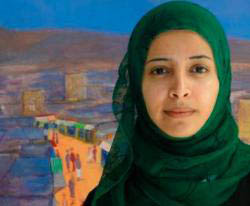
Bushra Al-Maqtari
by Sama’a Al-Hamdani, Yemen-iati, August 3
“The Arab Awakening protest movement encouraged religious tolerance among its participants, while in some instances, the resulting political crisis provided a context that stoked existing religious tensions” – Yemen’s Religious Freedom Report
Is it possible that the Arab Awakening opened doors for a new war on women? is there a new form of sexism that is declared in the name of religion?
Women all over the Middle East have been demanding political equality and while we await their democratic freedoms to expand, newspapers are reporting rapes from Libya, sexual assaults in Egypt and deaths in Syria. Sexism is not the least bit a phenomenon in the Middle East; however, the utilization of religion as a tool of war against women is becoming a trend. Religion, which was once implemented with care and knowledge, is now used in most political conflicts.
In Yemen, the political war between the Houthis and the government has become about religious ideology. Underneath the religious facade, it is mostly about power to rule. This war even invited unwanted political involvement from Iran and Saudi, threatening the security of the nation with a proxy war; all in the name of religious authenticity. This July, the United States Department of State released the International Religious Freedom Report for Yemen and declared that religious freedom in Yemen is not ideal yet not too problematic. The report focused on religious pluralism and sectarian violence, but it failed to recognize Yemeni women as victims of religious partiality.
Should Yemeni women be fearful? Perhaps, if they are to choose to have a voice and challenge Yemeni culture. Case in point, Bushra Al-Maqtari, a 31 year-old divorcee from Taizz. Bushra, a journalist, wrote an article about the revolution. In this article, she expressed her thoughts about the bloody battle of Khidar (Dec. 2011) between the demonstrators and pro-Saleh forces. She shared her feelings by saying that she questioned whether God was witnessing everything. While some may agree and many may disagree, religious extremists in the country declared Bushra an infidel who questioned the existence of God. In response, Bushra clarified that she is believing Muslim and that she did not question the existence of God but rather his presence in all situations. Regardless, what Bushra wrote may be a reason for many people to dislike her, but what happened after that made this about all women.
On January 29, 2011, a public fatwa was issued against Bushra declaring her an “unbeliever”, a charge punishable by death. Over night, more than 70 Imams supported this fatwa without solid proof. It is not surprising that many individuals are following these fatwas blindly as the total literacy rate is a mere 45.3%. More recently, Bushra has been threatened more seriously and her reputation was tarnished on facebook and newspapers. Is Bushra going to be safe? lets hope her friends and family can protect her and that Yemenis have more sense than to hurt someone for their opinions.
This is what happens in the absence of a central government. Chaos takes over and at the moment women are in danger. Hurting women by questioning their honor and integrity is not a new political tactic. In fact, it is used globally. Adding radical religion to the equation is what makes this tactic threatening, not only to Yemeni women, but to men who hope to see Yemen prosper.