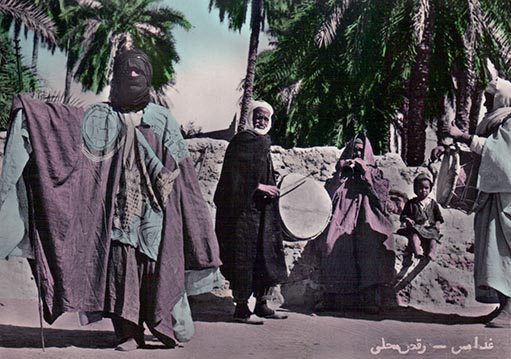
 Danza Caratteristica
Above and below are postcards of scenes in Ghadames, Libya from the 1950s, when it was still a kingdom.
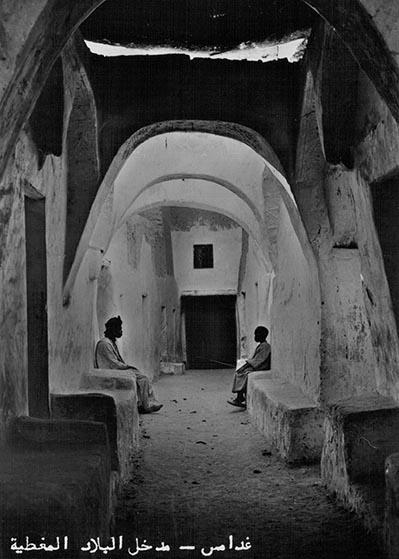
Ingresso alla Citt`a Coperta
Danza Caratteristica
Above and below are postcards of scenes in Ghadames, Libya from the 1950s, when it was still a kingdom.
Ingresso alla Citt`a Coperta

Joseph Massad: an Occidentalist’s Other Subjects/Victims
by S. Taha, The Arab Leftist
Joseph Massad, an associate professor at Columbia University and a now prominent figure in the US academic field of Middle Eastern studies, came to acquire his status through a hotly debated and highly acclaimed book, Desiring Arabs. Massad, who claims to be the disciple of another foundational academic figure from Columbia, Edward Said, seeks to complete his patron’s Foucauldian project on Orientalism. Said, who strikes me as a much more modest, engaged and consistent intellectual than his self-styled “discipleâ€, is best known for his critical study of “Orientalism,†which looks into the representation and construction of the “East/Orient†as Other to the Western/European self, a construction that, as Said had shown, was deeply engaged with the process of modern imperial expansion and colonialism. This process of domination was what both produced the European “will to know†the subject “Other†and enabled its realization “in an increasingly profitable dialectic of information and control.†However, while employing Michel Foucault’s analytical grid of power/knowledge and his methods of discourse analysis, Said’s project remains incompletely Foucauldian, since it does not probe into the effects of the colonial discursive regime of power/knowledge on the formation of the modern Arab subjects who languished under it for centuries. Therein, Massad makes his academic intervention and contribution, armed with Foucault’s conceptual tools to investigate sexual identities and subjects as effects and products of colonial power. Such territory of “subject formation†under colonialism, which Massad has ventured into is indeed an extremely slippery and delicate one, fraught with questions of agency and subjectivity, since it is not only an investigation into the workings of colonial power, but rather into the very subjectivity and the very being of those whom power represents and brings into its domain and universe of discourse. It is an investigation into the relationship between Western and non-Western, between colonizer and colonized with all that an interrogative representation of such relationship might, adverdantly and inadverdantly, entail about the truths, histories and identities of the two sides of the imperial divide. Continue reading Less than Desirable Review of “Desiring Arabs”
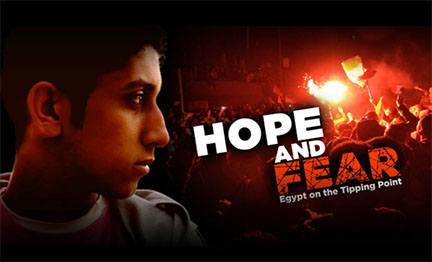
Hope and Fear: Egypt on the Tipping Point
Kickstart the post-production of this Film!
Go Deep: View Director’s Cut Trailer – HOPE & FEAR Long Trailer
Get Deeper: HOPE & FEAR website – www.HOPEandFEARmovie.com
HOPE & FEAR is unlike any documentary you’ve ever seen – providing a rare glimpse into the lives of four young liberal-minded Egyptians as they struggle to reshape their nation. Their story is one of aspiration and empowerment in the face of fear and chaos which dominates Egypt’s ongoing revolution.
Hi Kickstarters!
I’m Hosam Khedr, co-director and producer of HOPE & FEAR. Along with my partner Anjuli Bedi and our crazy dedicated team we set out on an audacious and dangerous quest to tell a more personal and timeless story.
HOPE & FEAR presents an insider’s-perspective on the lives of four young Egyptian activists who are pushing for freedom of expression through their art and community activism. We follow Salman, Nada, Ammar, and Reham beyond the idealism, euphoria and revolution of Tahrir Square as they struggle to navigate the difficult terrain of an Egypt hindered by an oppressive security force, corruption, political and economic instability, and religious intolerance under the new Islamist government.
HOPE & FEAR’s characters along with our special guest appearances, give a broader view of the challenges and implications of Egypt’s revolution. Will the homeland of civilization maintain civility? Nothing less than the future of the region hangs in the balance. With the outcome of Egypt’s liberal youth movement, HOPE & FEAR’s intimate portrayal of its characters shows the common thread that unites all humanity: the human spirit’s refusal to capitulate to oppression despite the costs.
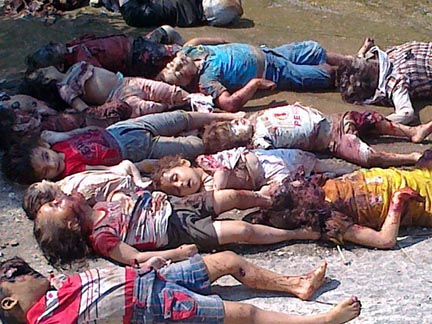
Scene after a massacre in a coastal Syrian village on May 4
Do we care? When the news media report yet another attack on civilians in Syria (or Iraq or Afghanistan or anywhere outside of Boston and New York), do we really care? It is hard to be sympathetic to the picture above without feeling the pain caused by imagining your own child’s body bloodied and lifeless. It is not easy for those of us in the fabled “land of the free†to admit that in war and civil strife everyone is presumed guilty by being in the way of a bomb and only proven innocent as a victim. These are bodies that have stopped growing, faces forever locked into expressions of horror. There can be no rest for these children in the grave for there can be no end to the grief of those who knew them.
But what do we care? It did not happen here. We make sure of that by sending arms to our erstwhile allies and droning anyone abroad who looks like a terrorist. As long as we proclaim our rhetorical support for human dignity, who can blame us? This was the act of a vicious dictator struggling to hold on to absolute power. Asad is Russia’s bastard, not ours. The weapons used to rip apart these childrens’ lives were Cold-War-forged Soviet, not Free World. Thank God, our God of course, there is no “Made in the USA†trademark on any of the bombs used here. But our’s will soon be in play here, as they are in Iraq and Afghanistan and Pakistan and Yemen, and even more children will never be able to play again.
Should we care? We did not know them. There are seven billion of us living and dying on this planet. What does it matter if a few children do not have a chance to live? Perhaps they would die of cancer before their teens or be run over by a car? What if one of these children had grown up to be a violent terrorist and take some of our lives? There are many ways not to look at these dead bodies, not to count them as our own. You can ignore what you see here, quickly click your mouse to escape caring. But tomorrow there will be another picture just like this, perhaps with women or men. Perhaps with soldiers who have little choice but to follow orders or risk their own lives. You need not worry, though, because you will not know any of them, not their names, not the sound of their laughter, not their dreams, not the goodness that shines through in every corner of our globally disconnected world.
So go ahead. Ignore what you see. Thank your God it’s not about you. Life goes on here no matter how many lives end over there. They say a picture is worth a thousand words. I have said what I want to say in less than 500. The rest is up to you.
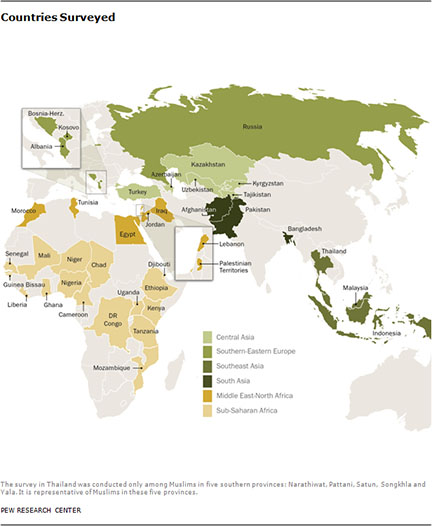
The World’s Muslims: Religion, Politics and Society
The Pew Forum on Religion and Public Life, April 30, 2013
Executive Summary
A new Pew Research Center survey of Muslims around the globe finds that most adherents of the world’s second-largest religion are deeply committed to their faith and want its teachings to shape not only their personal lives but also their societies and politics. In all but a handful of the 39 countries surveyed, a majority of Muslims say that Islam is the one true faith leading to eternal life in heaven and that belief in God is necessary to be a moral person. Many also think that their religious leaders should have at least some influence over political matters. And many express a desire for sharia – traditional Islamic law – to be recognized as the official law of their country.
The percentage of Muslims who say they want sharia to be “the official law of the land†varies widely around the world, from fewer than one-in-ten in Azerbaijan (8%) to near unanimity in Afghanistan (99%). But solid majorities in most of the countries surveyed across the Middle East and North Africa, sub-Saharan Africa, South Asia and Southeast Asia favor the establishment of sharia, including 71% of Muslims in Nigeria, 72% in Indonesia, 74% in Egypt and 89% in the Palestinian territories. Continue reading Pew Survey on World’s Muslims
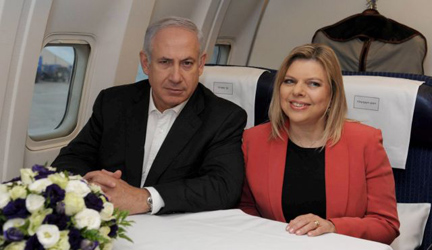
Austerity and sequestration are the dismal economic buzzwords of the day. While thousands of airline passengers in the United States waited for late flights due to a lack of air traffic controllers, and while tens of thousands of Israelis protested the latest cutbacks, Prime Minister Benjamin Netanyahu of Israel had his own solution. He flew to the funeral of Margaret Thatcher last month in a specially fitted plane. There are obvious perks to being a leader, especially a sleepy one. So why not rent a retrofitted El Al superliner to take 75 guests to London for a mere $427,000 from the national treasury. It was not the latest in security secrets that upped the price, but rather a newly installed rest cabin in which a $127,000 bed was installed for his wife and himself for a five hour trip. I am not sure if Bibi has ever watched the Lialda ad that warns a man to consult his physician if he experiences an erection lasting over four hours. No doubt some Israelis feel as though Israel has suffered enough from electoral dysfunction throughout his tenure.
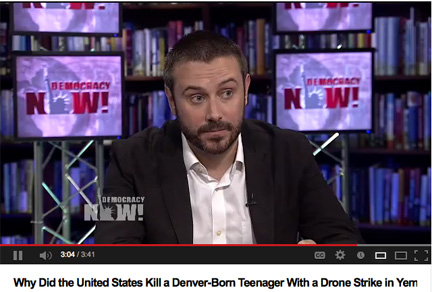
For a brief introduction to a report on the killing of the 16-year old son of Anwar al-Awlaki, check out this brief Youtube video. Here are the details on the video:
Watch the full 50-minute interview with Jeremy Scahill at http://owl.li/klnWN. Abdulrahman al-Awlaki was a 16-year-old boy, born in Colorado, who liked listening to hip-hop and posed as a rapper in pictures posted on Facebook. He was killed by a U.S. drone strike in Yemen two weeks after the Obama administration assassinated his father, the U.S. citizen Anwar al-Awlaki, in a separate strike. Abdulrahman’s death is a central part of Jeremy Scahill’s new book, “Dirty Wars: The World Is A Battlefield.” While the Obama administration has defended the killing of Anwar, it has never publicly explained why his son was targeted. Scahill reveals CIA Director John Brennan, Obama’s former senior adviser on counterterrorism and homeland security, suspected that the teenager had been killed “intentionally.” “I understand from a former senior official of the administration who worked on this program at the time, that when it became clear that Abdulrahman al-Awlaki had been killed, that President Obama was furious, and that John Brennan, who at the time was … the guy running all of these operations, that Brennan believed or suspected that it was an intentional hit … against this 16-year-old kid,” Scahill says.
Democracy Now!, is an independent global news hour that airs weekdays on 1,100+ TV and radio stations Monday through Friday. Check out our vast news archive and stream live 8-9am ET at http://www.democracynow.org.
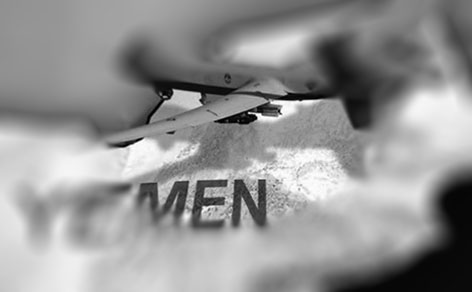
For anyone in the NYC region, I will be giving a talk at the COLUMBIA UNIVERSITY SEMINAR on KNOWLEDGE, TECHNOLOGY, and SOCIAL SYSTEMS on Wednesday, May 15, 7 pm (at Columbia University’s Faculty House). The title of the talk is: “Drone Strikes in the War on Terror: The Case of Post-Arab-Spring Yemen.” Unmanned drones have been used by the US military against terrorism in many areas of the world. In particular, these drones have become the US military’s weapon of choice in targeting terrorists in Yemen, where strikes quadrupled in 2012 from the previous year. This talk addresses the impact of these strikes on the political context within Yemen and the effectiveness of the strategy in combating Al Qaeda recruitment. The talk builds on a commentary published in the Middle East Muddle blog of the Anthropology News website.
For information on the talk, please contact me directly by email at daniel.m.varisco@hofstra.edu.