Headless in Saudi Arabia

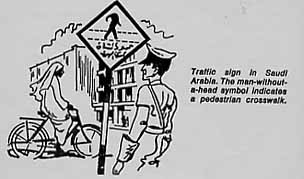
[”Traffic sign in Saudi Arabia. The man-without-a-head symbol indicates a pedestrian sidewalk.”]

I recently came across a rather plebian junior high school level text on The Middle East: History, Culture, People (by Thomas G. Kavunedos and Harold E. Hammond, Bronxville, New York, Cambridge Book Company, Inc, 1968). The book is quite forgetable, but some of the illustrations bring you to a full stop. My favorite is the illustration above. If indeed this was once the sign for a crosswalk, no wonder everyone seems to drive Mercedes in the kingdom.

Daniel Martin Varisco

How Pundits Fuel Nonsense

There are multiple ways of looking at polygamy, but in an op-ed piece this summer William Tucker did so with blinders on. His July 26 op-ed piece, called “How polygamy fuels terrorism” foolishly fuels nonsense instead.

I suppose enterprising American pundits like William Tucker need to find things to say for weekly (or shall I say weakly?) columns. Continue reading How Pundits Fuel Nonsense →

Where Are We Beheading?

The search engine Google can easily become a kind of ouija board for those of us engaged in connected scholarship. There is much useful information just a click away, but also much out there of which to be wary. It is worthwhile to take time out every once in awhile to see what Goggle will offer up for an innocent query. Out of curiosity on October 4, 2005, I decided to type “beheading” into Google and see what came up.

The first 10 sites (of 1,890,000) are instructive (you can see for yourself) of the problem facing the representation of Islam on the internet. Continue reading Where Are We Beheading? →

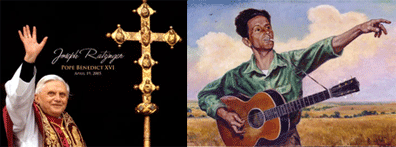
Woody Guthrie, Pope Benedict and Western Stereotypes

“Argue not with the People of the Book unless it be in a better way, except with such of them as do wrong; and say: ‘We believe in that which has been revealed to us and revealed to you; our God and your God is One, and to God do we surrender’” (Qur’an 29:46)

I am a Canadian Muslim (of Pakistani background) who teaches theology at a Jesuit university in Los Angeles. As such, a number of people have asked me about my thoughts on His Holiness Pope Benedict XVI’s remarks in September about Islam, and the subsequent events that unfolded. Before I do that, I begin with a story about the importance of symbols for Christians and Muslims. Continue reading Woody Guthrie, Pope Benedict and Western Stereotypes →

Holy War over Papal Bull

The recently installed Pope Benedict gave a speech on Tuesday in his native Germany. Even though the Vatican has ruled that the pope as the prime representative of Christ on earth is as close to being infallible as anyone, such dogma has long since ceased to be newsworthy. Individuals designated as Catholics and Protestants have found other things to fight over (or even to agree with against a common secular enemy) and the thousands upon thousands of victims in Europe’s religious wars are more or less relegated to a historical footnote. Last Tuesday this doctrine of ex cathedra truth rose from the dead of church history and crashed through the gate of ecumenical tolerance.

Continue reading Holy War over Papal Bull →

Mob Rule on a Featherbed

In a speech yesterday before the annual convention of the American Legion, President Bush launched yet another premptive strike against anyone who dares to question the strategic logic and moral worth of his failed policies in the Middle East. Near the end of his self-congratulatory talk, patriotic fervor was appealed to with a reference to Thomas Jefferson: “In the early years of our republic, Thomas Jefferson said that we cannot expect to move ‘from despotism to liberty in a featherbed.’ That’s been true in every time and place.” Jefferson was a prolific author, and there are a number of other quotes that Bush’s speech writer chose judiciously not to cite. For example, “Experience hath shewn, that even under the best forms of government those entrusted with power have, in time, and by slow operations, perverted it into tyranny.” The problem with the President’s speech is that it confuses the tyranny of his self-righteous refusal to admit mistakes with the diversity of opinions liberty necessitates. Continue reading Mob Rule on a Featherbed →

Alaa Al Aswany: Voice of Reason

This month’s National Geographic Magazine has an extended interview with the Egyptian author (and dentist) Alaa Al Aswany, whose recent Arabic novel, The Yacoubian Building, is a major bestseller.

“Just who is the Arab world listening to? Not only radical sheikhs and militant politicians. The man whose voice has captivated the Arab public is a Cairo dentist by day and a novelist by dawn. Alaa Al Aswany’s novel The Yacoubian Building is a phenomenon—the best-selling novel in the Middle East for two years and the inspiration for the biggest budget movie ever produced in Egypt. The novel paints a poignant and uncompromising picture of life in modern Cairo, as seen through the eyes of a carnival of characters—from the richest and most powerful to the poorest. An outspoken critic of the Mubarak regime and a friendly, self-effacing man, Dr. Al Aswany studied dentistry, and the American way of life, in the U.S. He has a humanist’s love of pondering what makes people do what they do.”

To read the interview online, click here.

Mel Brooks, Where are You?

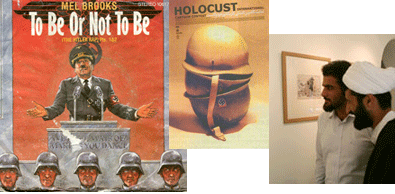
One of the top stories in today’s New York Times is called “Iran Exhibits Anti-Jewish Art.” This has all the media makings of another blown-out-of-proportion cartoonnami, especially since the exhibit was concocted by an Iranian newspaper (Hamshahri) in direct response to the Danish cartoons about Muhammad. Add to this the fact that more than 200 cartoons (of the 2000 plus submitted) are displayed in the Palestine Contemporary Art Museum in Tehran. So is this artistic tit for tat or just another op-ed tempest in a samovar? Continue reading Mel Brooks, Where are You? →